

To help customers find information on the web, companies frequently use various advertising techniques, including Google Ads. SaaS companies are no exception. In this blog post, we will discuss the benefits of Google Ads for SaaS businesses, along with some best SaaS ads strategies to maximize your revenue with the help of Google Ads.
Quick summary:
- Google Ads helps SaaS businesses reach buyers actively searching for software solutions.
- B2B SaaS campaigns should account for longer buying cycles and multiple decision-makers.
- Relevant keywords, clear landing pages, and remarketing help guide prospects toward trials or demos.
- Bidding strategies should align with meaningful conversion goals and reliable tracking.
- Campaign performance should reflect qualified leads, paying customers, and recurring revenue rather than signups alone.
What is SaaS?
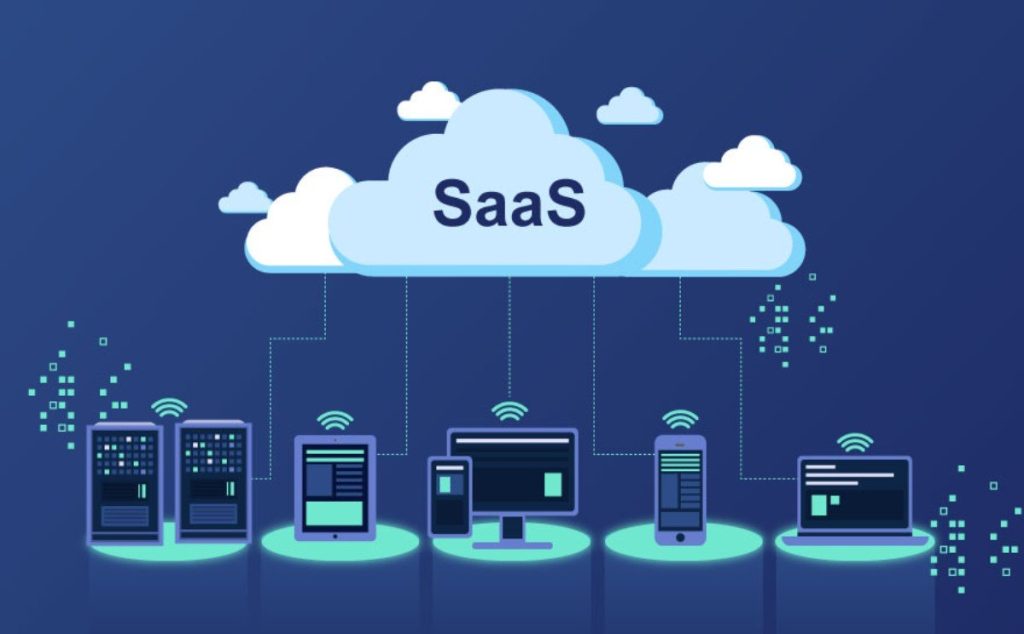
SaaS stands for Software as a Service, a model where users access software over the internet while the provider manages hosting, maintenance, and updates. Pricing may include subscriptions, usage-based charges, or free plans with paid upgrades.
Common SaaS applications include customer relationship management (CRM), accounting, human resources, and content management tools. SaaS businesses can serve companies (B2B), individual consumers (B2C), or both. This guide focuses on Google Ads for B2B SaaS.
How does Google Ads for B2B SaaS differ from B2C advertising?
The main differences involve who makes the purchase, how long the decision takes, and which outcomes the campaign needs to generate.
| Factor | B2B SaaS | B2C businesses |
|---|---|---|
| Target audience | Businesses with specific operational needs, often within a defined industry or company size. | Individual consumers buying for personal or household use. |
| Decision-makers | May involve end users, department heads, IT, procurement, and finance. | Often involves an individual or household, with fewer approval steps. |
| Sales cycle | Often includes product evaluation, demos, security checks, and contract discussions. | Often shorter for everyday purchases, although expensive products can require lengthy consideration. |
| Lead volume | A specialized audience can mean fewer relevant leads, making qualification particularly important. | Mass-market products can reach broader audiences, although volume varies by niche. |
| Ad messaging | Emphasizes business outcomes, integrations, security, and suitability for the buyer’s needs. | Emphasizes personal benefits, price, convenience, and product appeal. |
| Conversion goals | May include demo requests, trial signups, qualified opportunities, and paid subscriptions. | Often focuses on purchases, bookings, or consumer signups. |
| Performance evaluation | Connects initial leads to pipeline and revenue over the sales cycle. | Often connects advertising to purchases more quickly, while also considering repeat business. |
How are SaaS businesses doing with Google Ads?
Currently, many SaaS businesses have chosen Google Ads as an advertising tool to attract potential clients and increase conversion rates. However, only a few businesses truly understand this advertising platform and know how to implement effective Google Ads strategies.
Mega Digital conducted a survey with SaaS businesses to gain a deeper understanding of this issue. The survey is based on the following question: “How would you rate your Google Ads expertise and skills?”. The results of the survey shown below have solidified our arguments.
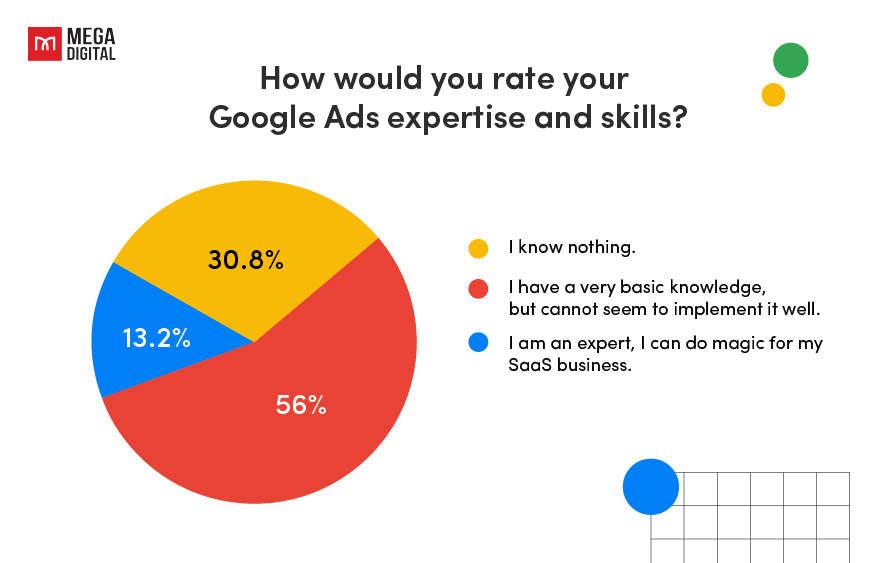
If you have little to no knowledge about how to execute an effective Google Ads campaign for your SaaS business, don’t worry. You’ve come to the right place. In the following sections, we’ll delve into the details, providing you with a step-by-step guide on how to navigate this process successfully.
Benefits of using Google Ads for your SaaS business
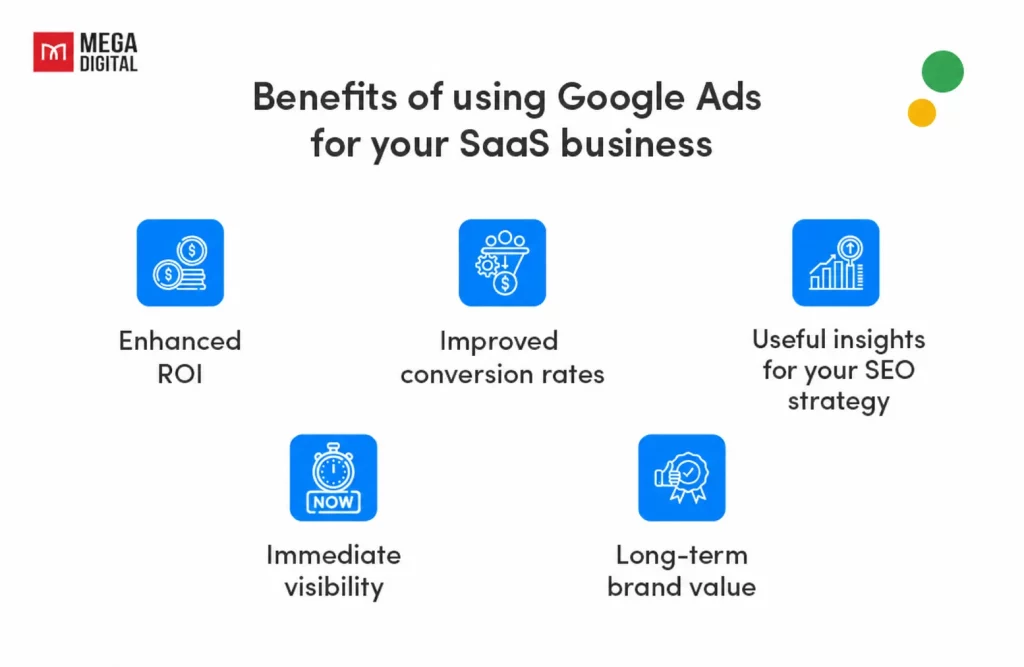
A Gartner survey found that 67% of B2B buyers prefer a buying experience without a sales representative. For SaaS marketers, this highlights the importance of helping buyers explore products independently. Google Ads can connect relevant searches with product information, demos, and free trials. Here are five potential benefits.
Enhanced ROI
The SaaS sector places significant emphasis on the Return on Investment (ROI), a crucial metric for assessing the profitability of a specific system. Using Google Ads for SaaS offers the potential for increased ROI.
In comparison to conventional online advertising methods, Google Ads stands out as a more effective avenue for generating revenue, suitable for small and medium-sized enterprises aiming to boost their financial returns.
Improved conversion rates
Google Ads are one of the best ways to improve your SaaS company’s conversion rates. By precisely targeting your audience and bidding on relevant keywords, you ensure that your ads are displayed to users actively searching for your offerings, increasing the likelihood of conversions.
Useful insights for your SEO strategy
Google Ads can help you identify search terms and messages that attract qualified prospects. Use these findings to prioritize relevant topics, improve product pages, and address the questions buyers ask when comparing SaaS solutions.
For example, searches about software integrations could inform a dedicated integration page. These insights can support your content strategy, but advertising spend does not improve organic rankings.
Immediate visibility
Visibility in Google Ads is one of the most important digital advertising strategies. It’s also one of the best ways to get your products seen by a more targeted audience.
With Google Ads, SaaS businesses can achieve immediate visibility on Google search results and other partner websites. As soon as the campaign is set up and activated, the ads can be visible to users actively searching for relevant terms or browsing websites related to the SaaS business’s offerings.
This is particularly advantageous for quickly reaching potential customers when they are actively searching for related solutions.
Long-term brand value
To establish a long-lasting brand value for your SaaS company, it’s crucial to have a strategy for crafting compelling advertisements. And running ads on Google might be the right move to make. Utilizing Google Ads for SaaS enables the creation of relevant ads tailored to your target audience. When they recognize your brand in both paid and organic search results, it can enhance trust and credibility.
Best SaaS Ads Strategies using Google Ads
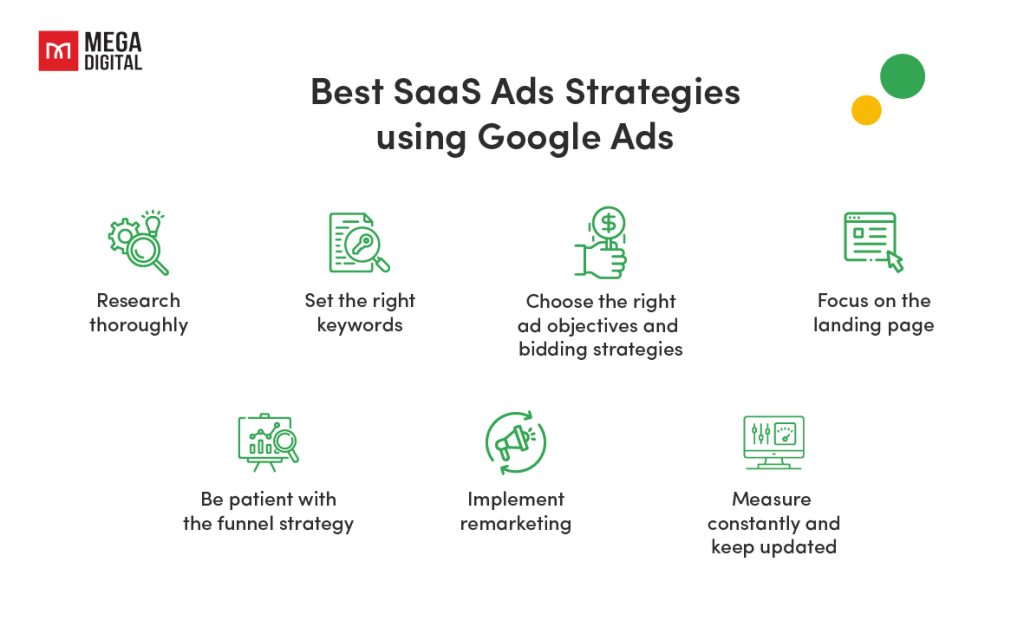
Building effective Google Ads campaigns for your SaaS business requires a strategic approach to maximize visibility, engagement, and conversions. Here are some best strategies suggested by Mega Digital that you should consider adopting:
1. Research thoroughly
Competitor analysis is a significantly crucial process for any type of business, whether that is a SaaS business or other digital business.
Before using Google Ads to promote your products, you must conduct a comprehensive competitive analysis about how your competitors advertise and succeed in their promotion. It will help get the idea that your industry has potential for Google Ads. Also, Google Ads has powerful features like “auction insights” to help you easily get information about your competitors who are using the same keywords as you.
2. Set the right keywords
When searching for SaaS solutions, potential clients might use some specific terms that show their concerns and desires. Therefore, to capture the most potential clients possible, your business should conduct thorough keyword research to identify the most accurate and high-converting terms and phrases that they might use. Use a mix of all keyword match types (broad, phrase, and exact match keywords) to cover various search intents.
For instance, security and technology issues can greatly influence the users’ intention to adopt SaaS services. Therefore, SaaS vendors should emphasize these issues and include the keywords related to their ad campaigns.
Don’t automatically exclude “free” if your SaaS product offers a free plan or trial. Review the full search query and whether those signups become paying customers before adding it as a negative keyword.
3. Choose the right ad objectives and bidding strategies
Choose conversion goals that reflect your sales process, such as trial signups or qualified demo requests. Verify tracking before selecting a bidding strategy, and avoid treating every form submission as an equally valuable lead.
Maximize Clicks can support an initial traffic test, but there is no fixed requirement to use it for one month. Maximize Conversions focuses on tracked conversions within your budget, while value-based bidding requires reliable values that reflect differences in business value.
Agree with sales on what qualifies a lead, including company size, use case, and serviceable market. Apply those criteria consistently in your CRM before using qualified leads to guide bidding.
Learn more: Google Ads bidding strategies and practical tips.
4. Focus on the landing page
A landing page is at the forefront of your business in the online world. The quality of your landing page gives the very first impression about your brand to your audience. Poorly executed or difficult-to-navigate landing pages will have a detrimental effect on your conversion rates.
Campaigns should enable your brand’s landing page to feature well in Google’s search engine results page (SERPs), so once you’ve gone through the hurdle of building your campaign and getting your audience to stop by, you then want to make sure your landing pages are optimized for conversions. The content should align with the ad messaging, and there should be a clear and prominent call-to-action (CTA). Don’t forget to test different variations to find the most effective layout.
5. Be patient with the funnel strategy
As I have mentioned earlier, SaaS companies are expected to be involved in a prolonged sales cycle, in which several stages take place. It is nowhere near an overnight process. This usually results from the fact the client has to conduct thorough research to ensure the product/service behind your brand’s campaign will be worth the investment. Therefore, patience is much needed here.
A funnel strategy in Google Ads is a powerful approach to guide potential customers through the buying journey, from initial awareness to conversion. It involves crafting a series of ad campaigns targeting different stages of the funnel with specific goals and messages.
Also, you can monitor where the lead is at any time within the sales funnel. It is a crucial part of understanding our leads and when (and if) they choose to convert. It also helps us understand the buying journey from our client’s perspective, which can be helpful for future campaigns.
6. Implement remarketing
Remarketing is a powerful digital marketing strategy that involves targeting users who have previously interacted with your website or mobile app with customized ads. For SaaS businesses, remarketing plays a crucial role in re-engaging potential clients who have previously visited your website but did not convert.
Inside Google Ads, you can install a remarketing tag on your website. This tag tracks user interactions and builds lists of visitors for remarketing. Next, you define specific audience segments by creating remarketing lists based on various criteria, such as all website visitors, users who visited specific pages, or those who completed certain actions. Once you have that data, start crafting engaging ad copies that resonate with your remarketing audience.
7. Measure constantly and keep updated
Track trial signups, qualified leads, and paying customers separately. Connect CRM outcomes with campaign data to measure cost per qualified lead, lead-to-customer conversion rate, and advertising cost per new customer.
Review recurring revenue and retention alongside acquisition costs. Allow for the delay between an ad click and a sale before adjusting budgets, and remember that total customer acquisition cost includes other sales and marketing expenses.
Compare leads acquired in different months after the same follow-up period. Last week’s leads have had less time to close than leads acquired three months ago, so comparing their current revenue can distort campaign performance.
Case study: Boosting SaaS growth with Google Ads
Background
Semrush, a SaaS platform for online visibility and digital marketing, wanted to increase conversions without additional budget. Its team shared the campaign in a case study published by Think with Google in January 2022.
Strategy
Semrush expanded beyond Search and Display into YouTube advertising. The team tested audiences, bidding strategies, and creative formats while improving attribution to account for conversions influenced by video views.
Implementation
The team adapted video messaging and length to different buying stages, improved landing pages, and tested campaign combinations.
Key actions included:
- Using short videos to introduce the product and encourage trials.
- Creating longer videos explaining features and customer success stories.
- Comparing skippable in-stream ads alone with a combination that included the then-available Video Action campaigns.
Results
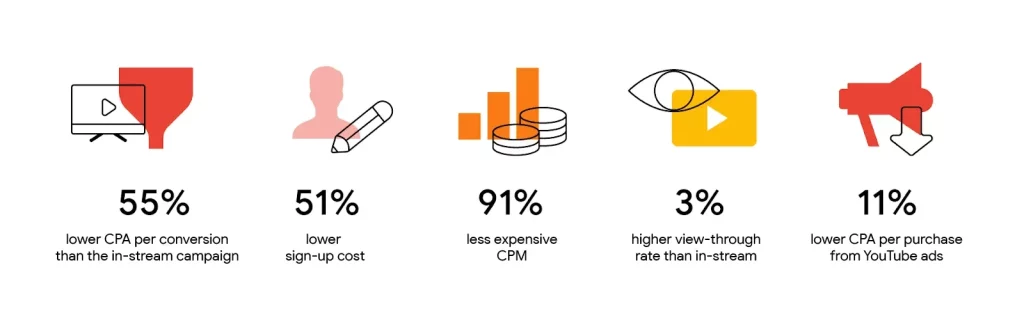
Source: Think with Google
The case study reported the following results:
- Lower-funnel CPA decreased by 55% in the combined campaign test compared with in-stream ads alone.
- Cost per signup decreased by 51%.
- After expanding Video Action campaigns across its automated bidding campaigns, Semrush reduced YouTube advertising CPA per purchase by 11%.
FAQs about Google Ads for SaaS
Yes. A limited campaign can invite relevant prospects to join a waitlist or request beta access. Clearly state that the product is not yet available, and treat signups as expressions of interest rather than proof of willingness to pay.
No. Depending on the product, you can offer a guided demo, consultation, or paid pilot. Choose an offer that lets buyers evaluate the software without promising access or functionality you cannot provide.
Include pricing when it helps buyers assess affordability and understand your offer. For custom enterprise plans, explain how pricing works instead of advertising an unrealistic starting price. Make billing periods and minimum commitments clear.
Yes, but attracting overseas leads is only part of the process. Before entering a market, confirm that your product, payment options, onboarding, and customer support can serve those buyers in the language you advertise.
Wrap-up
To achieve the overall growth of your SaaS company, you should consider using Google Ads to leverage your product promotion campaigns. In this blog post, we have discussed how you can take full advantage of what Google Ads can do for the sake of your SaaS company’s advertising success. Whether you’re using Google Ads for B2B SaaS, implementing SaaS Google Ads, or looking for the best SaaS ads, this guide has you covered.