

Phrase match in Google Ads offers a middle ground between the broad reach of broad match and the tighter control of exact match. If broad match brings in too many irrelevant clicks while exact match limits your traffic, phrase match can help you reach more relevant searches without sacrificing too much volume. In this article, I’ll explain what phrase match is, how it works, and how to use it effectively to improve your Google Ads campaign ROI.
Quick summary:
- Phrase match offers a reliable middle ground by showing your ads on searches that include the core meaning of your keyword.
- Google updated phrase match recently to incorporate the flexible behaviors of the retired Broad Match Modifier.
- Using this match type effectively requires a strategic combination of relevant phrases and negative keywords to prevent wasted ad spend.
- Advertisers can significantly improve their click-through rates and ad relevance by mastering this specific targeting method.
What is phrase match in Google Ads?
Phrase match is one of the core keyword match types in Google Ads that allows your ads to show for searches that include the meaning of your keyword. It offers more reach than exact match while giving you more control over which searches can trigger your ads compared to broad match.
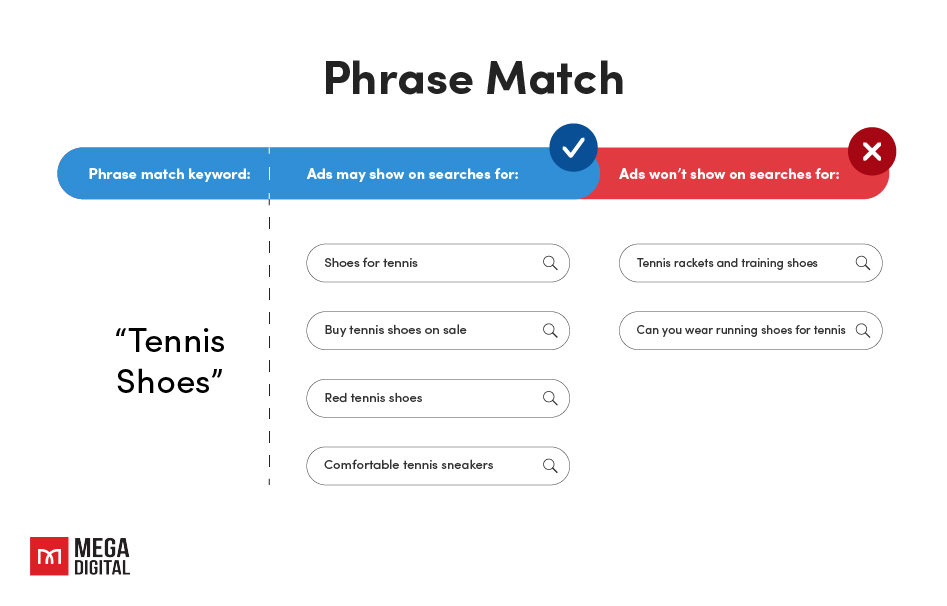
With phrase match, a user’s search query doesn’t need to contain your keyword exactly. Google may also show your ads for searches where the meaning of your keyword is implied or expressed in a more specific way.
For example, if your phrase match keyword is “tennis shoes”, your ad may appear for searches that convey the same meaning, even when the exact wording differs.
Industry Update: In 2021, Google incorporated the matching behavior of the discontinued Broad Match Modifier (BMM) into phrase match. Today, phrase match focuses more on keyword meaning, while word order only matters when it changes the meaning of the search.
To specify a phrase match keyword in Google Ads, simply put the keyword in quotation marks, such as “tennis shoes”.
Phrase match keywords example
For example, if your phrase match keyword is “tennis skirt”, you want your ad to show for searches containing the phrase “tennis skirt” or its close variants.
Let’s look at a few examples with explanations in this table:
| Search query | Will your ad show? | Reason |
|---|---|---|
| tennis skirt | Yes | The search query exactly matches your phrase |
| buy tennis skirt | Yes | The search query includes the exact phrase with an additional word before it |
| best tennis skirts | Yes | The search query includes the exact phrase with an additional word before it, plus the plural form is a close variant |
| tenis skrt | Yes | The word “skrt” is count as a close variant of misspelling. |
| tennis stylish skirt | No | An extra word is added in the middle of your keyword |
Benefits of Phrase match keywords in Google Ads
Using phrase match keywords for your Google Ads campaign offers several benefits. Here are the top 3:
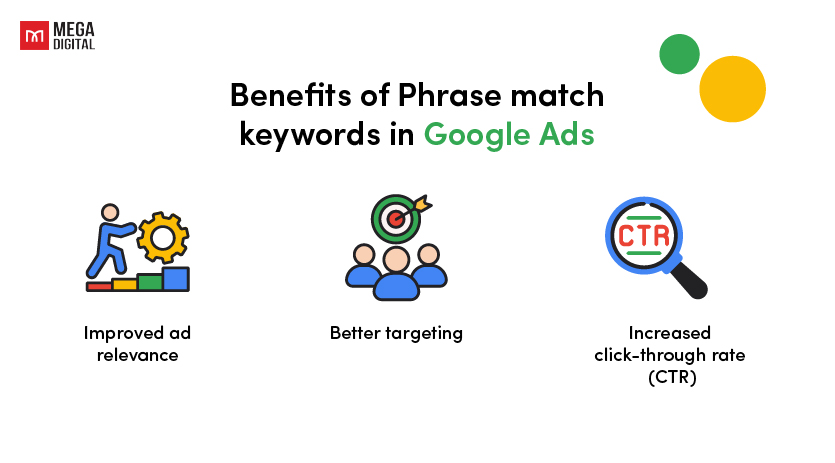
Improved ad relevance
Ads triggered by phrase match keywords are more likely to be relevant to the user’s search query. This can increase the chances that your ad will be seen by people who are actually interested in what you have to offer.
Better targeting
Phrase match empowers you to dictate the precise phrasing that activates your ad, providing you with enhanced precision to target specific searches.
Increased click-through rate (CTR)
Phrase match can be cost-effective because it narrows down the audience to those specifically interested in the core phrase. This can result in higher click-through rates and potentially lower costs per click compared to broad match.
Phrase match vs Broad match: What’s the difference?
While both phrase match and broad match share the commonality of being keyword match types that allow for variations, they differ in terms of precision, control, and use cases. Here’s a table highlighting the differences between phrase match and broad match in Google Ads:
| Aspect | Phrase match | Broad match |
|---|---|---|
| Precision | Higher precision, targeting specific phrases and close variations | Less precision, capturing a broader range of variations and related searches |
| Control | More control over when ads are triggered | Less control over ad placements |
| Use cases | Suitable for a balance between reach and specificity, targeting users with specific phrases | Suitable for casting a wider net, discovering new keywords, and maximizing visibility |
| Adaptability | More adaptable for advertisers wanting a balance between the specificity of exact match and the reach of broad match | More adaptable for advertisers focused on exploration, discovery, and maximizing exposure to a diverse audience |
How to add Phrase match to your ad campaign?
Applying phrase match keywords in your Google Ads campaigns is a straightforward process. Here’s a step-by-step guide on how to do it:s
Step 1: Create or select the campaign you want to edit
First, log in to your Google Ads account at https://ads.google.com. If you don’t have one, you’ll need to create an account.
Click on the “Campaigns” tab to access the dashboard where you manage your ad campaigns. Choose the campaign to which you want to add the phrase match keyword. If you don’t have a campaign set up, you may need to create one.
Step 2: Click on the “+” button to add a keyword
Once you’re in the campaign, look for the “+” or “Add” button, usually located in the “Keywords” tab. Click on it to add a new keyword.
Step 3: Choose “Phrase match” option
In the keyword entry field, you’ll have the option to select the match type. Choose “Phrase match” from the dropdown menu.
Step 4: Enter your keyword
Type in the specific keyword or phrase you want to target with phrase match. Enter the bid amount for your keyword.
Best Practices for using Phrase match keywords in Google Ads
Phrase match can be a great way to maintain a balance between relevant and precise targeting, but it’s important to use it carefully and wisely as well. To help you achieve that, here are some tips from Mega Digital for using phrase match effectively:
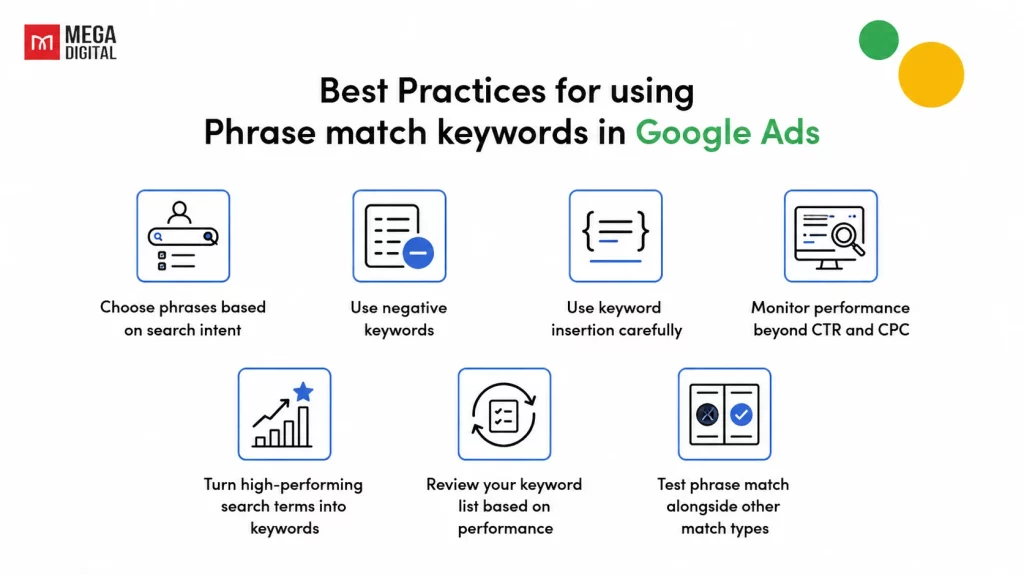
#1 Choose phrases based on search intent
Choose phrase match keywords that clearly reflect what users are looking for and how closely that intent aligns with your offer. Instead of broad terms like “shoes”, prioritize more specific phrases such as “running shoes for women” or “buy running shoes online” when they better represent commercial intent.
According to Google, around 15% of searches it sees every day are new, so you do not need to build dozens of slight keyword variations. Focus on the core intents you want to capture and let phrase match cover relevant variations.
#2 Use negative keywords
Review your Search Terms report regularly to identify irrelevant queries and add suitable negative keywords to reduce wasted spend. For example, if you sell running shoes, terms such as “free”, “repair”, or “jobs” may be worth excluding when they repeatedly trigger clicks without valuable conversions.
Tip: Do not exclude a search term after just one poor click unless the intent is clearly irrelevant. For relevant queries, wait until you have enough performance data before deciding whether to block them.
#3 Use keyword insertion carefully
Keyword insertion can make your ad copy more relevant by dynamically inserting the keyword that triggered the ad. Use it only in tightly themed ad groups where every possible keyword still reads naturally, accurately reflects the offer, and matches the landing page.
#4 Monitor performance beyond CTR and CPC
CTR and CPC can help diagnose traffic quality, but they should not be the only metrics used to evaluate phrase match keywords. Also review conversion rate, CPA, conversion value, and ROAS to determine whether the traffic is actually contributing to your campaign goals.
Tip: Judge phrase match by business outcomes, not engagement alone. A keyword with a higher CPC may still be valuable if it consistently generates qualified leads or profitable sales.
#5 Turn high-performing search terms into keywords
Use the Search Terms report to identify queries that repeatedly generate conversions at an acceptable CPA or ROAS. Add those queries as dedicated phrase or exact match keywords when you want more control over bidding, ad copy, or landing page relevance.
#6 Review your keyword list based on performance
Update your keyword list based on actual search-term and conversion data rather than removing keywords simply because they have low volume or CTR. Keep keywords that attract relevant intent or profitable conversions, and reconsider those that consistently spend without producing meaningful results.
#7 Test phrase match alongside other match types
Phrase match can work alongside exact and broad match rather than replacing them entirely. Google states that phrase match can reach more searches than exact match but fewer searches than broad match, making it useful when you want more reach without giving up as much control.
Is Phrase match the best option for your ad campaigns?
It is true that phrase match strikes a balance between the broad reach of broad match and the precision of exact match, making it a popular choice for advertisers aiming to capture a relevant yet diverse audience. But this type of keyword match is nowhere near the perfect choice that works for every advertising campaign. There are some specific situations where you should really consider using other keywords match types:
- Exploratory campaigns: In the initial stages of a campaign where you are still exploring and discovering new keywords, broad match might help uncover unexpected opportunities.
- Very broad audience targeting: If your goal is to reach a wider audience than what phrase match can provide, broad match might be more suitable.
- Highly specific targeting: If you know your customers well and need extremely precise targeting to make your ads show only for the exact words they search for, then exact match might be more appropriate.
Many advertisers find success in using a combination of two or more keyword match types within their campaigns. We recommend you do so to extend your reach to a wider audience while maintaining control over the visibility of your ad.
FAQs about Phrase Match Google Ads
No. Changing a keyword’s match type does not directly affect its Quality Score. However, phrase match can influence the quality of traffic you attract, which may affect metrics such as CTR and conversions.
Yes. Phrase match works with Smart Bidding strategies such as Target CPA, Target ROAS, and Maximize Conversions. Phrase match determines eligible searches, while Smart Bidding adjusts bids based on the likelihood of conversion.
No. Performance Max does not use traditional keyword match types like phrase match. Instead, it relies on Google’s automated targeting and optional search themes to find relevant searches.
Google does not automatically prioritize the most restrictive match type. It follows keyword prioritization rules based on factors such as query relevance and then uses Ad Rank when eligible keywords have the same priority.
Wrap-up
Learning how to use phrase match helps advertisers find the perfect balance between reaching lots of people and being super specific. So, in your next ad campaign, use what you’ve learned here to make your ads connect with the right people at the right time.
If you need expert support, Mega Digital’s Google Ads services can help you manage and optimize your campaigns for better results.