

Effective TikTok Ads targeting options are the bridge between your creative content and high conversions. In 2026, success isn’t just about demographics, it’s about leveraging AI precision to reach your ideal customers and maximize Return on Ad Spend (ROAS).
In this blog post, we break down the 4 core targeting pillars, the power of Smart+ automation, solutions for common targeting issues, and expert tips to maximize your ad performance.
Quick Summary
- TikTok Ads targeting relies on four essential categories including Demographics, Audiences, Interests, and Device options.
- Smart+ automation utilizes advanced machine learning to identify high-converting users better than manual selection.
- Advertisers should solve narrow audience issues by avoiding hyper-segmentation and following the Rule of One.
- Broad targeting combined with high-quality creatives allows new campaigns to exit the learning phase faster.
- Renting a TikTok Agency Account provides the only reliable method to target global markets without geolocation restrictions.
What are TikTok Ads Targeting Options?
TikTok Ads targeting options are tools within TikTok Ads Manager that allow advertisers to filter and define exactly who sees their advertisements. By leveraging criteria like demographics, interests, and behaviors, these options narrow down the vast user base into a refined group of potential customers most likely to convert.

Essentially, targeting ensures your creative content reaches the right eyes, preventing budget waste on irrelevant audiences.With users spending an average of 55-58 minutes per day on the app globally, the potential for reach is immense, but only if you can navigate the noise to find your specific niche.
Key TikTok Ads Targeting Updates in 2026
Before diving into the options, it is crucial to understand how the landscape has shifted this year. TikTok is moving aggressively towards automation and search intent.
- Predictive AI Dominance: The algorithm now prioritizes “likely intent” over strict manual filters. This means broad targeting often outperforms narrow interests.
- Search Ads Toggle: Targeting based on search terms has become more powerful, allowing brands to capture high-intent users actively looking for solutions.
How many TikTok Ads Targeting Options are there?
There are four pillars of TikTok Ads Targeting Options, including: Demographics, Audiences, Interests & Behaviors, and Device. Below is detail information about them:
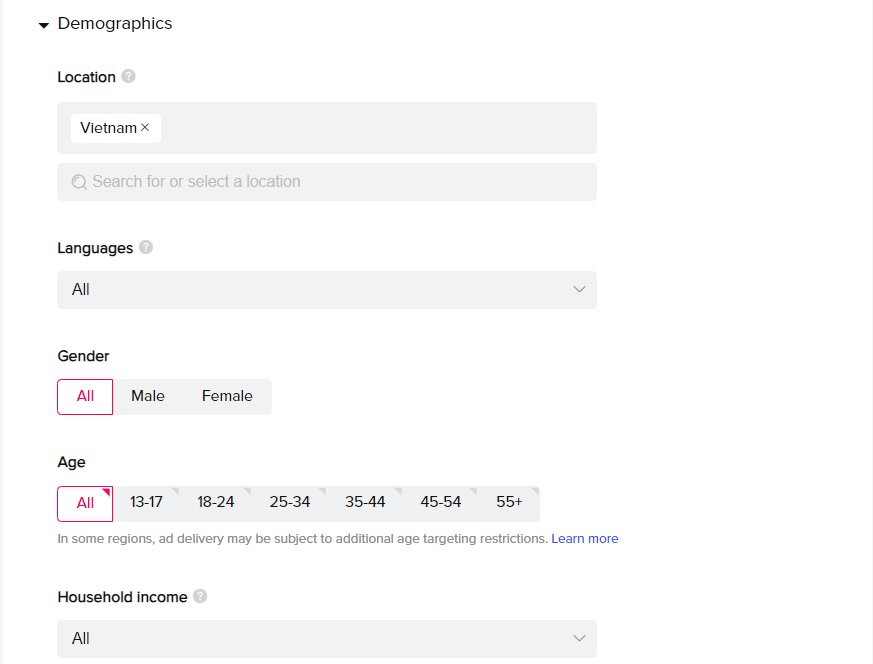
#1 TikTok Ads Demographics Targeting
Demographics targeting creates the foundational layer of your audience. It includes:
- Location: Targeting by Country, Region, State, DMA (Designated Market Area), or specific cities. For Global campaigns like targeting the US/UK from Vietnam, a TikTok Agency Account is often required to bypass geo-restrictions.
- Gender & Age: Segments ranging from 13-17 up to 55+.
- Language: Based on the user’s app language settings.
- Spending Power: Targeting users based on household income (High/Top tiers), which is crucial for luxury or high-ticket items.
#2 TikTok Ads Audiences Targeting
TikTok Ads Audiences Targeting manages your “Warm” and “Cold” traffic strategies.
- Custom Audience: This allows you to re-engage users who have interacted with your brand. Sources include Customer Files, Website Traffic (via TikTok Pixel), Engagement (video viewers), or App Activity.
- Lookalike Audience: This powerful tool finds new users who share characteristics with your best existing customers. In 2026, the algorithm for Lookalike audiences has become significantly more predictive, requiring smaller seed data to generate high-quality matches.
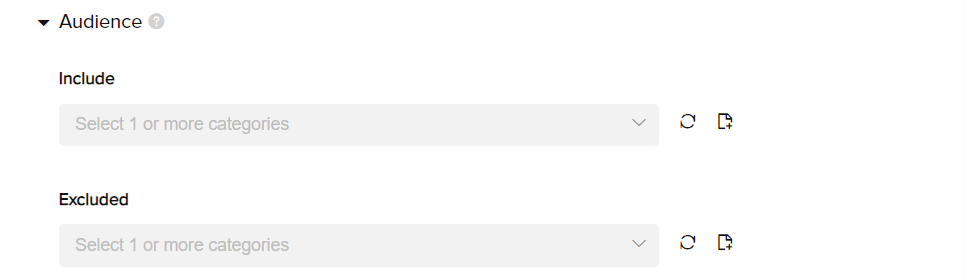
Quality input equals quality output. A “Lookalike Audience” derived from 1,000 “Purchasers” will always outperform one built from 10,000 “Site Visitors”. Prioritize intent over volume when building your seed lists to train the AI effectively.
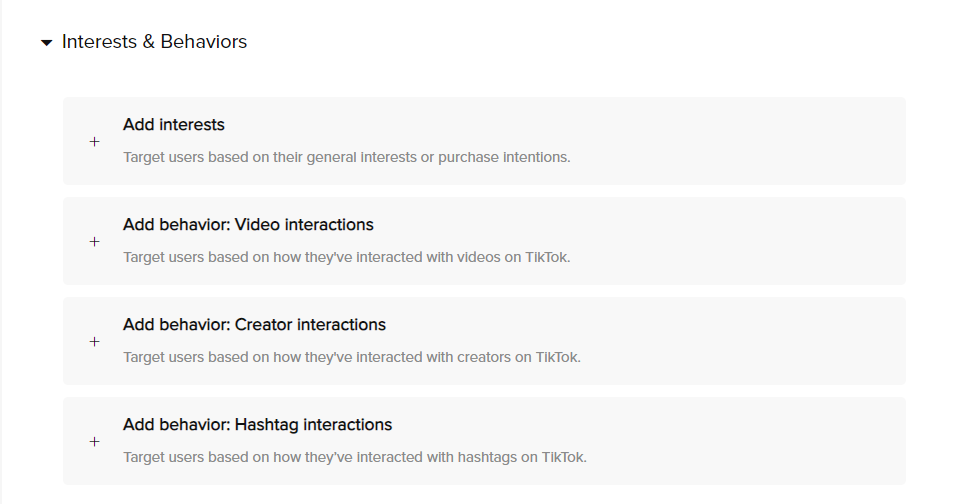
#3 Interest and Behavior Targeting
This is where psychographic targeting comes into play.
- Interests: Targets users based on long-term consumption habits like Gaming, Beauty, Financial Services.
- Behaviors: Targets users based on recent interactions (past 7-15 days) such as watching a video to the end, liking, commenting, or sharing specific content categories.
- Hashtag Interactions: Targets users who have viewed videos with specific hashtags.
#4 Device Targeting
Often overlooked, this option is vital for technical optimization.
- Connection Type: (WIFI/4G/5G) – Essential for heavy app downloads.
- Operating System & Version: iOS vs. Android (critical for ensuring compatibility with the advertised app).
- Device Price: A proxy for purchasing power.
>>> Read more: What is TikTok Inventory Filter? A full guide to using it
AI-Assisted Targeting in Manual TikTok Ads
Smart TikTok Ads targeting refers to features like Targeting Expansion and Automatic Targeting that leverage machine learning to broaden your reach beyond predefined manual constraints. This approach is designed to help advertisers find high-converting users that strict manual targeting might inadvertently exclude.
Specifically, there are two main mechanisms within this category:
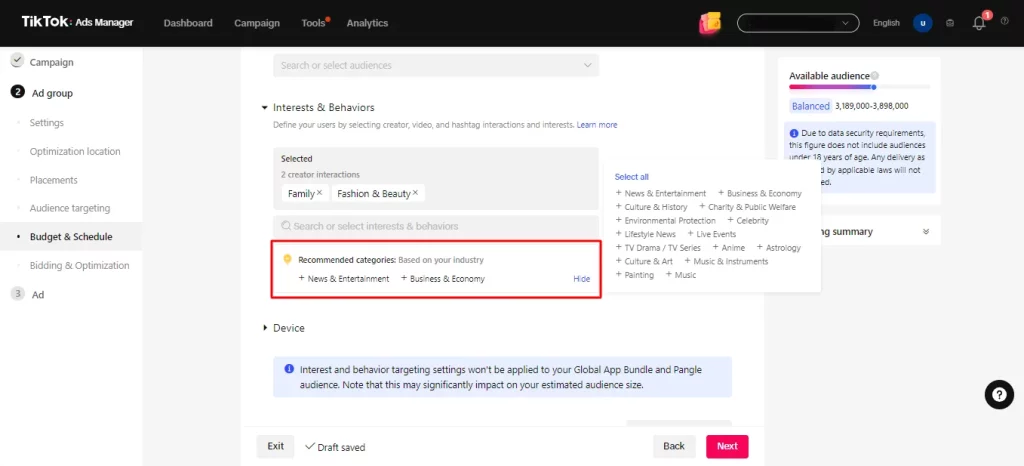
Targeting Recommendation
When setting up an ad group, TikTok analyzes your industry and past performance to suggest relevant Interest and Behavior categories. This acts as a guided assist, ensuring you don’t miss obvious audience segments.
Targeting Expansion
This is the precursor to full automation. When enabled, it allows the system to deliver ads to users outside your selected targeting settings if the algorithm predicts a higher likelihood of conversion.
- How it works: If you target “Beauty Interests” but the algorithm detects a high conversion probability in the “Fashion” user base, Targeting Expansion will dynamically allocate budget to capture those users.
- Benefit: It prevents ad fatigue and stabilizes CPA (Cost Per Action) by constantly hunting for fresh inventory.
However, while “Smart” options assist manual setup, the true revolution in 2026 lies in the “Smart+” ecosystem, which represents the pinnacle of automation.
Smart+ TikTok Ads Targeting Options
Smart+ TikTok ads targeting is an end-to-end automated solution where the system autonomously handles all targeting decisions based on your marketing objective, creative assets, and attribution data. Unlike standard targeting, Smart+ (often associated with Smart Performance Campaigns) removes the need for manual audience definition entirely.
In this model, the “Targeting” is no longer a list of settings but rather a function of your Creative and Data. Industry case studies suggest that automated campaigns like Smart+ can deliver up to 27% reduction in CPA compared to manual setups for web conversion objectives.
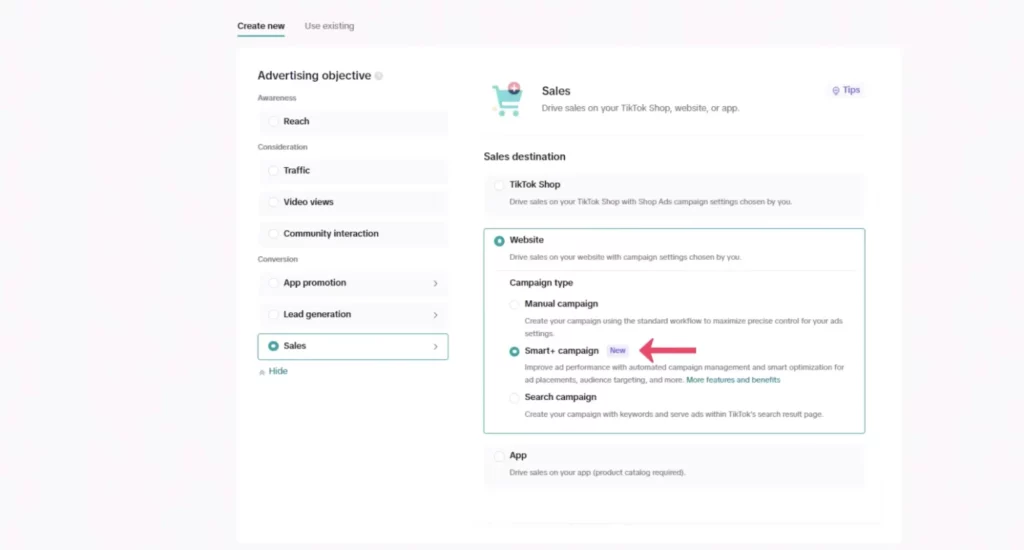
How Smart+ Works
- Input: You provide the marketing goal like Website Sales, the budget, and the creative assets.
- Process: TikTok’s advanced AI analyzes the content of your video and your landing page to understand who the product is for. It then tests this against broad audiences, rapidly iterating to find the “perfect match.”
- Optimization: The system continuously adjusts who sees the ad in real-time, prioritizing users with the highest predicted conversion rate (CVR).
In the era of Smart+, your creativity is your targeting. The algorithm is now smart enough to find your customers better than you can manually, provided your content clearly communicates your value proposition.
When to use Smart+
- Scaling Phase: When manual audiences are saturated.
- Broad Appeal Products: For FMCG or general utility apps.
Mega Digital Case Study – Dries Bollen:
For Dries Bollen, a dropshipping brand specializing in football jerseys, Mega Digital switched to Smart+ Web Campaigns to maximize efficiency. The strategy achieved an impressive 6.89 ROAS and stabilized CPA at $9.36, proving that automated targeting could identify high-value buyers more effectively than manual interest stacking.
Difference between Manual vs. Smart+ Targeting
| Feature | Manual Targeting | Smart+ Automation |
| Control | High (You choose audiences) | Low (AI chooses based on data) |
| Setup Time | High (Requires research) | Low (Instant setup) |
| Learning Phase | Slower (Needs specific data) | Faster (AI tests broadly) |
| Best For | Retargeting, Niche Products | Scaling, Mass Appeal Products |
TikTok Ads Targeting Options: Common issues & Solution
Here are the common issues which Ad Specialists face challenges during scaling. Let’s take a look below at these challenges and the solutions recommended by Mega Digital.
Issue 1: Audience Size “Too Narrow”
- Problem: Layering too many filters (e.g., Age 18-24 + Female + Interest A + Behavior B + iPhone 15) restricts the algorithm. The “Balanced” meter turns red.
- Solution: Follow the Rule of One”. Combine broad demographics with only one hard constraint like just Interest. If using Custom Audiences, ensure the seed file has at least 1,000+ matched users (though 10,000+ is ideal).
Trust the machine. Hyper-targeting in the early stages often chokes the learning phase. Think of broad targeting as a discovery tool, it allows the AI to find pockets of buyers you didn’t even know existed.
Issue 2: High Ad Frequency & Fatigue
- Problem: Users see your ad too many times because the pool of people is too small. CTR drops, and CPM rises.
- Solution: Enable Targeting Expansion or switch to Broad Targeting. Alternatively, refresh your creatives to reset the engagement loop. A healthy benchmark to aim for is a CTR of 0.8% – 1%; if it falls below this industry standard while frequency rises, it is a clear sign of creative fatigue.
Issue 3: Inaccurate Geolocation
- Problem: Advertisers using standard accounts cannot target high-value markets like the US or Europe from restricted regions.
- Solution: The only reliable fix is to Rent a TikTok Agency Account from partners like Mega Digital. These accounts are whitelisted for global targeting, allowing you to reach any market regardless of your physical location.
Tips to Master TikTok Ads Targeting
Here are some tips to elevate your targeting strategy:
1. Embrace Broad Targeting for New Pixels
If your TikTok Pixel is new, avoid guessing specific interests. Start with Broad Targeting (no interest/behavior selected). This allows the AI to cast a wide net, gather data on who actually clicks and converts, and build a “heat map” of your ideal customer. Once you have 50+ conversions, you can create Lookalike Audiences from this data.
Example: For Teddy, a Gen Z dropshipper, Mega Digital utilized broad targeting combined with high-quality “expensive-looking” creatives to help his new e-commerce store bypass the learning phase efficiently. This approach resulted in an incredibly low $3.43 CPM, a $1.8 CPA, and a 4.2x ROAS, propelling his business to a revenue explosion in just two months.
2. Stack Interests Strategically
Don’t just pick one interest. Use “Interest Stacking” to create a robust persona.
- Example: If selling a fitness app, target “Sports” + “Health & Wellness” + “Outdoor Equipment”.
- Logic: This increases the pool size while keeping the theme consistent.
3. Exclude Past Converters
Always use Custom Audiences to exclude people who have already purchased or installed your app. This saves budget and improves your CPA immediately.
In the Mini Games: Calm & Relax, Mega Digital optimized targeting strategies to boost performance. By refining the audience to exclude inefficient segments and focus on high-quality users, the campaign achieved a 10–20% improvement in ROAS compared to previous benchmarks, effectively stabilizing costs while scaling.
Efficiency lies in exclusion. By suppressing users who have already converted, you force the algorithm to hunt for net-new growth rather than recycling old wins.
FAQs about TikTok Ads Targeting Options
No, you cannot directly target specific external assets like a YouTube channel or a Facebook Fanpage. However, you can use Interest Targeting to select categories that align with those channels’ niches, or use Behavior Targeting to find users interacting with similar content on TikTok.
While TikTok allows low daily budgets, to make targeting work effectively, your budget should be at least 50 times your target CPA per week (or roughly 20x daily for the learning phase). If the budget is too low, the algorithm cannot test enough audience segments to find the winner.
This usually happens if the “Seed Audience” (Source file) is low quality or too small. Ensure your seed list contains high-value customers (e.g., those who purchased, not just visited the site) and has been updated recently to reflect current trends.
>>> Read more: TikTok Ads Geo-Targeting 101: How to Reach Local Audience
Conclusion
In summary, TikTok Ads targeting options offer a powerful blend of granular manual control and sophisticated AI automation like Smart+, giving advertisers more tools than ever to reach their ideal customers. Success ultimately depends on a continuous cycle of testing and refining your strategy, so if you are ready to unlock global targeting and maximize your ROAS, contact Mega Digital today to rent a premium TikTok Agency Account and get expert consultation.