

Are you facing skyrocketing CPIs and strict data privacy limits? Mobile game marketing in 2026 demands proven user acquisition strategies to attract high-value players without exhausting your budget. Success now relies on a smart, full-funnel approach rather than just basic ad campaigns. In this blog post, we break down the most effective tactics, funnel stages, and emerging trends to help you scale your game’s player base profitably.
Quick Summary:
- Rising acquisition costs and strict privacy regulations force marketers to shift from volume-based installs to retention-led growth in 2026
- Artificial intelligence now drives predictive bidding and generates massive volumes of ad creatives to keep campaigns profitable
- Authentic user-generated content and specialized TikTok ad formats consistently bypass ad fatigue and outperform traditional networks
- Deploying custom product pages and building unified studio ecosystems can drastically lower user acquisition costs without external ad spend
- Adopting a hybrid monetization model increases overall player lifetime value and provides the budget needed to outbid competitors
The State of Mobile Game Marketing in 2026
The 2026 mobile game marketing landscape is defined by strict privacy regulations, rising costs, and the absolute dominance of AI. With easily trackable device identifiers gone, success now relies on predictive modeling and producing high-converting ad creatives at scale rather than manual audience targeting.
“AI has fundamentally changed the rules of gaming marketing. It’s no longer just about targeting; it’s about massive creative volume and predicting retention.” – AppsFlyer State of Gaming 2026
These shifts affect every aspect of mobile game marketing, from user acquisition to long-term monetization and player retention.
- Quality Over Quantity: With gaming IAP revenue hitting $82B despite falling downloads, marketers must prioritize payback periods and conversion over raw install volume.
- The Privacy-First & AI Reality: As non-game IAPs surpass gaming and downloads stagnate, predictive AI modeling is now mandatory to identify and capture high-value players.
- AI-Driven Creative Dominance: AI tools and massive creative iteration are the new standard to combat rapid ad fatigue in saturated markets.
- Retention-Led Growth & Rewarded UA: 82% of developers report that reward-based UA vastly outperforms traditional channels, significantly improving overall ROAS.
- Authenticity Over Deceptive Advertising: Strict platform penalties for misleading ads have forced a definitive shift toward genuine gameplay, UGC-style creatives, and leveraging native TikTok trends.
The Full-Funnel Mobile Game Marketing Strategy
Here are three distinct stages in a full-funnel mobile game marketing strategy:
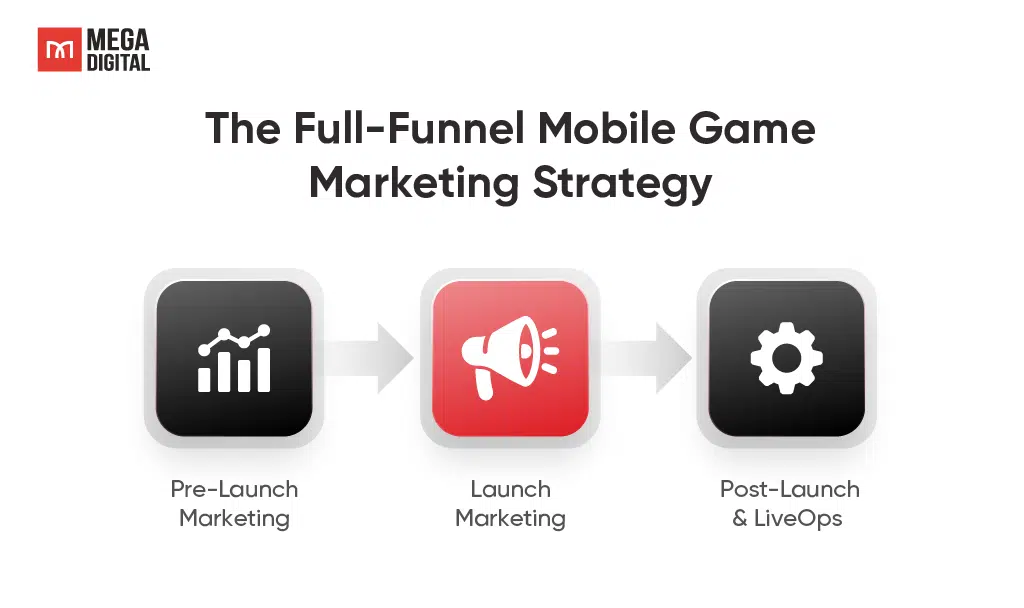
Pre-Launch Marketing
The pre-launch phase focuses on building hype, establishing a community, and testing core game mechanics before the official release. This stage is critical for gathering initial feedback and securing Day-1 downloads. In 2026, top studios build a solid foundation by utilizing these data-driven tactics:
- Soft Launching: Releasing the game in smaller, similar markets (like the Philippines or Canada for a US target) allows studios to test server stability and measure early retention metrics without overspending the primary budget.
- Marketability Testing: Using AI to generate gameplay mockups and running test ads before coding even begins effectively gauges market interest and prevents wasted development resources.
- Pre-registration Campaigns: Optimizing store listings with exclusive rewards encourages a waitlist effect that grants higher organic visibility upon release.
- Apple Search Ads (ASA): Bidding on brand keywords early ensures a massive pool of high-intent players ready for day one.
Launch Marketing
Launch marketing is the aggressive push to acquire users globally and achieve peak visibility on the app stores during the initial release week. At this stage, massive burst campaigns across ad networks and social media platforms are deployed to dominate the charts. A successful launch in 2026 requires a coordinated effort across several key fronts:
- Creator-Led Livestreams: Coordinating 24-to-48-hour continuous livestreams on TikTok and Twitch generates intense FOMO and immediate downloads.
- App Store Featuring: Submitting the game to Apple and Google editorial teams 6 to 8 weeks in advance can secure invaluable organic placements.
- Scaling Winning Creatives: Instead of testing from scratch, marketers now immediately scale the highest-performing creatives identified during the pre-launch phase.
Post-Launch & LiveOps
Post-launch marketing focuses on sustaining growth through continuous Live Operations (LiveOps), re-engaging lapsed users, and optimizing long-term retention. Acquiring a user is only half the battle; keeping them is where true profitability lies. To maintain player interest and maximize Lifetime Value (LTV), successful games implement the following strategies:
- In-Game Events & Battle Passes: Regularly introducing new content supported by push notifications and email marketing keeps the community active.
- Retargeting Campaigns: Deploying specific ads to bring back players who have uninstalled the app or haven’t logged in for a specific period.
- Loyalty & VIP Programs: Creating dedicated reward tiers tailored specifically to the highest-spending segment.
- User-Generated Content (UGC): Hosting in-game events that reward players for sharing gameplay clips on TikTok and YouTube Shorts provides a continuous, highly authentic stream of organic traffic long after the initial launch.
5 Proven User Acquisition Strategies for 2026
There are five proven user acquisition strategies for mobile games in 2026, categorized by traffic sources. Let’s explore each channel, as mastering these dictates your game’s ultimate scalability and market penetration.
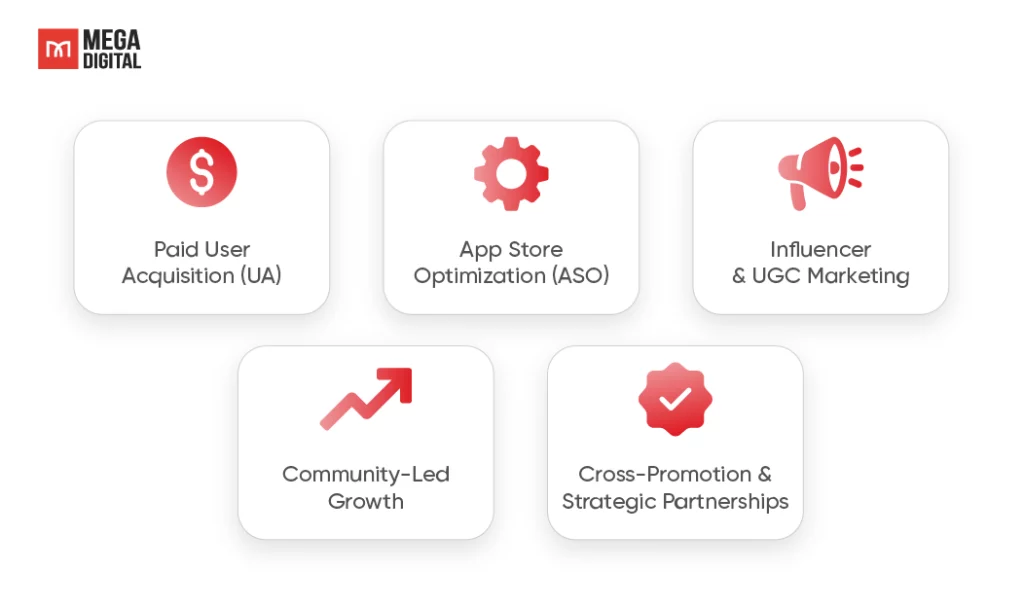
Paid User Acquisition (UA)
Paid User Acquisition involves purchasing ad inventory on platforms like TikTok, Google UAC, and Unity Ads to drive direct game installations. For comprehensive scaling, utilizing specialized TikTok Ads Management Services is now an industry standard.
- Key Innovation for 2026: Predictive ROAS Bidding. Due to strict privacy limits, marketers now rely on AI models to predict a user’s Lifetime Value based on their first few interactions, allowing algorithms to aggressively bid only on players likely to spend money.
- The Execution: Short-form video and Playable Ads dominate the creative landscape, with TikTok serving as a leading platform for game discovery.
For instance, having the right ad infrastructure and optimization strategy is vital for scaling on this platform. Mega Digital recently helped Xgame Studio revitalize the UA campaign for their casual title, Mini-games: Calm & Relax, by deploying the following tactics:
- Smart+ Campaigns & Placement Testing: Expanding beyond Pangle to broader TikTok placements using targeted ROAS (tROAS) bidding.
- Aggressive Creative Refresh: Producing and testing 20–30 new video creatives weekly to combat ad fatigue and find winning variations.
- The Result: A 10–20% improvement in ROAS, successfully hitting the Day-7 KPI and unlocking high-volume, low-cost UA.
App Store Optimization (ASO)
App Store Optimization is the process of improving a mobile game’s visibility within the iOS App Store and Google Play Store to increase organic downloads. Specifically, ASO in 2026 goes far beyond basic keyword integration.
Pro Tip: The most powerful conversion tactic today is deploying Custom Product Pages (CPPs) on iOS and Custom Store Listings (CSLs) on Android.
Instead of a single, generic store page, marketers create dozens of localized variations. These custom pages perfectly match the visual theme of the specific ad creative a user just clicked. Combined with continuous A/B testing of your game icon and promo videos, these highly relevant pages can boost organic and paid conversion rates by up to 40%.
Influencer & UGC Marketing
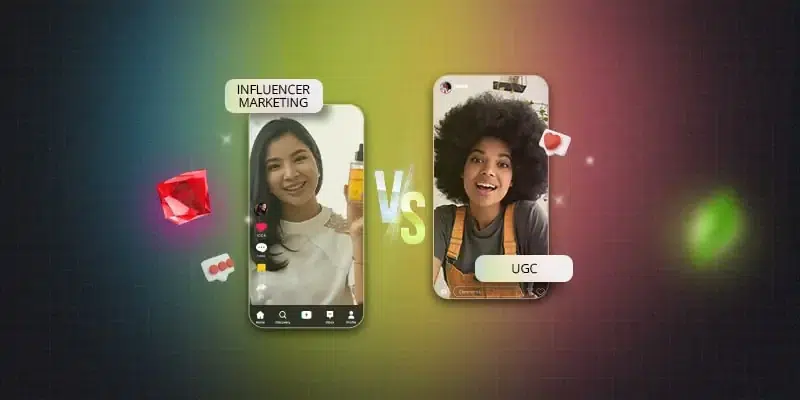
Influencer and User-Generated Content (UGC) marketing leverage content creators to authentically promote your game to their dedicated audiences.
- The Strategy Shift: Rather than spending massive budgets on a single macro-influencer, the 2026 trend favors activating hundreds of micro-influencers simultaneously.
- The Content Format: UGC-style ads, where creators record themselves reacting to gameplay, look native to platforms like TikTok and bypass ad fatigue.
A testament to this strategy is Mega Digital’s success with the TikTap Challenge, where they revitalized the game’s UA performance by deploying the following UGC-focused tactics:
- Creator Collaborations: Partnering with TikTok One creators to produce high volumes of organic-friendly, trend-based creatives.
- Viral Loop Creation: Utilizing these UGC-style ads to effectively bypass ad fatigue and reignite the game’s viral momentum.
- The Result: Achieved a massive 60–100% Day-0 ROAS, reached break-even three days faster than expected, and boosted user retention rates by 20%.
Community-Led Growth
Community-led growth is a strategy where a game’s active player base on platforms like Discord or Reddit becomes the primary source for acquiring new users. Word-of-mouth remains the highest-converting marketing channel, and a structured community facilitates this organically.
In 2026, top developers actively integrate the community into the game itself to create long-term brand advocates:
- Account Linking Rewards: Offering exclusive in-game items for connecting a Discord profile to the game ID.
- Direct Feedback Loops: Giving players a dedicated, incentivized space to share tips and report bugs directly to developers.
- Exclusive Events: Hosting community-only tournaments or AMAs (Ask Me Anything) to foster a deeply loyal cohort of players.
Cross-Promotion & Strategic Partnerships
Cross-promotion is the technique of advertising a new game within the ad inventory of an existing, established game owned by the same studio. Importantly, this is practically free user acquisition.
Pro Tip: Rather than relying on outdated popup ads, modern developers are building Unified Studio Ecosystems.
By creating a shared Studio ID or a universal in-game currency across their entire portfolio, publishers create a powerful retention effect. This seamless integration allows highly engaged players to transition between the studio’s new and old games naturally, without the company incurring additional costs on external ad networks.
Essential Marketing Metrics You Must Track
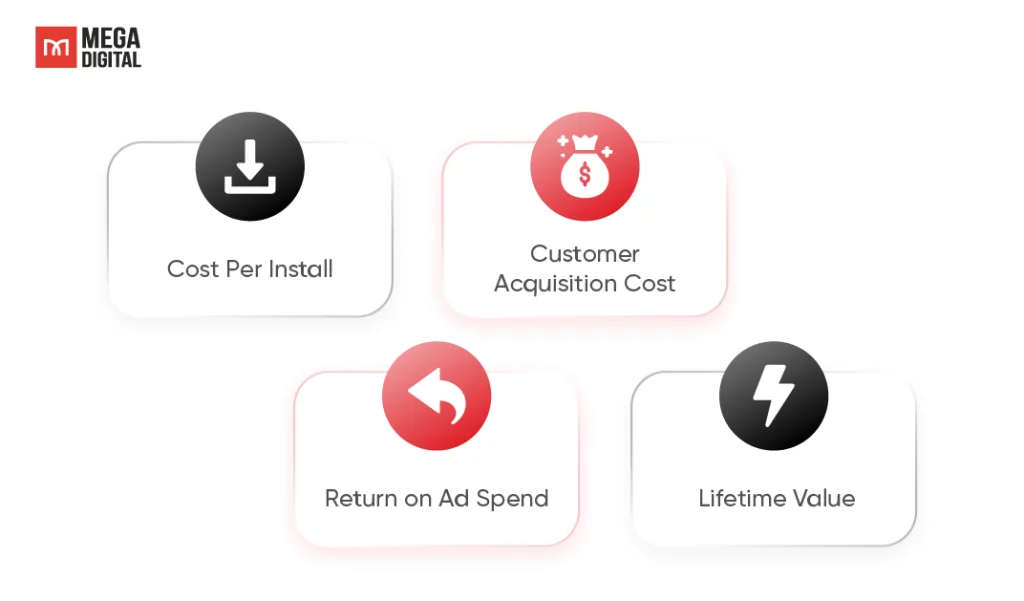
Monitoring these four core metrics prevents budget exhaustion and dictates your campaign’s scalability:
- Cost Per Install (CPI): The direct cost paid to an ad network for a single user to download and open the game.
- Customer Acquisition Cost (CAC): A broader metric that includes CPI plus the overhead costs of the marketing team, creative production, and agency fees.
- Lifetime Value (LTV): The total projected revenue a single player will generate throughout their entire time playing your game.
- Return on Ad Spend (ROAS): The revenue generated for every dollar spent on advertising, typically measured at specific intervals (e.g., Day-7 ROAS, Day-30 ROAS).
The fundamental principle of mobile game marketing is straightforward: Your LTV must be higher than your CAC. In 2026, AI predictive modeling allows marketers to estimate a user’s Day-180 LTV based purely on their Day-3 in-game behavior, allowing for rapid campaign adjustments.
How Hybrid Monetization Aligns Marketing with Revenue
Hybrid monetization is a revenue model blending In-App Purchases (IAP) and In-App Advertising (IAA) to maximize the total value of every acquired user. Aligning your marketing spend with this blended model is vital because a higher Lifetime Value (LTV) allows your marketing team to bid higher for paid UA, confidently outbidding competitors on platforms like TikTok and Google.
To maximize this competitive advantage in 2026, successful games rely on three core pillars:
- The IAP & IAA Blend: The lines between game genres have blurred. Mid-core games now include rewarded videos (IAA) for non-paying users, while casual games offer ad-removal options or cosmetic skins (IAP).
- Subscriptions & Battle Passes: Moving beyond one-off purchases, offering recurring subscriptions provides a highly predictable revenue stream, making long-term LTV forecasting much more accurate for marketing teams.
- Direct-to-Consumer (D2C) Web Shops: To maximize profit margins, top publishers now direct VIP players to external web shops. Bypassing the standard 30% app store tax creates massive budget surpluses that can be funneled directly back into aggressive user acquisition campaigns.
FAQs about Mobile Game Marketing
Generally, $3,000 to $5,000 per channel is recommended. This provides enough data points (installs and events) for algorithms like TikTok or Google to exit the learning phase and optimize effectively.
ASO changes typically take 1 to 4 weeks to fully reflect in App Store and Google Play search rankings. It’s a long-term strategy requiring continuous monitoring and tweaking.
TikTok’s short-form, sound-on format perfectly aligns with game mechanics, making it a primary discovery engine. Additionally, using TikTok Agency accounts (via partners like Mega Digital) ensures priority ad reviews, lower suspension risks, and access to exclusive beta features.
AI automates creative testing and powers predictive ROAS bidding. It estimates long-term player LTV based on very early in-game behavior, allowing you to bid aggressively on high-value users instead of wasting money on generic audiences.
With platforms actively banning deceptive gameplay ads in 2026, the safest and highest-converting alternative is UGC-style content. Real players reacting to real gameplay builds trust and avoids algorithmic penalties while maintaining low CPIs.
Conclusion
To overcome surging CPIs and privacy limits in 2026, developers must abandon volume-based tactics in favor of a retention-led, full-funnel strategy. By synergizing ASO, community building, AI-driven Paid UA on platforms like TikTok, and hybrid monetization models, publishers can sustainably lower acquisition costs and build a thriving player base. Stop wasting your budget on outdated tactics, contact Mega Digital’s experts to scale your game to the next level!