

Facebook Messenger ads can bring prospects directly into a conversation, but more messages do not always mean better leads. Without the right setup, message flow, and follow-up strategy, campaigns can quickly generate low-intent chats and wasted ad spend. This guide explains how to set them up, how to optimize them for better business results.
Quick summary:
- Facebook Messenger ads help businesses turn ad clicks into direct conversations with potential customers.
- The current setup focuses on choosing the right campaign objective, Messenger destination, audience, placements, and message template.
- A clear conversation flow and fast response process can help improve lead quality and reduce drop-off.
- Campaign performance should be measured by qualified conversations and business outcomes, not message volume alone.
What are Messenger Ads?
As the name suggests, Messenger Ads are a type of Facebook ad that appears in the Messenger app. They allow businesses to reach their audience directly in their Messenger inbox, providing a more personal and direct line of communication compared to traditional ad placements.
The cost of Facebook Messenger ads can vary greatly, but on average, businesses pay between $10 and $11 for every 1000 times their ad is shown. The cost per click (CPC) for raising awareness has been stable since 2020, costing around $2.15 per click. Please note that these are averages and the actual cost can vary based on factors like your target audience, ad quality, and bidding strategy.
Why You Should Use Facebook Messenger Ads?
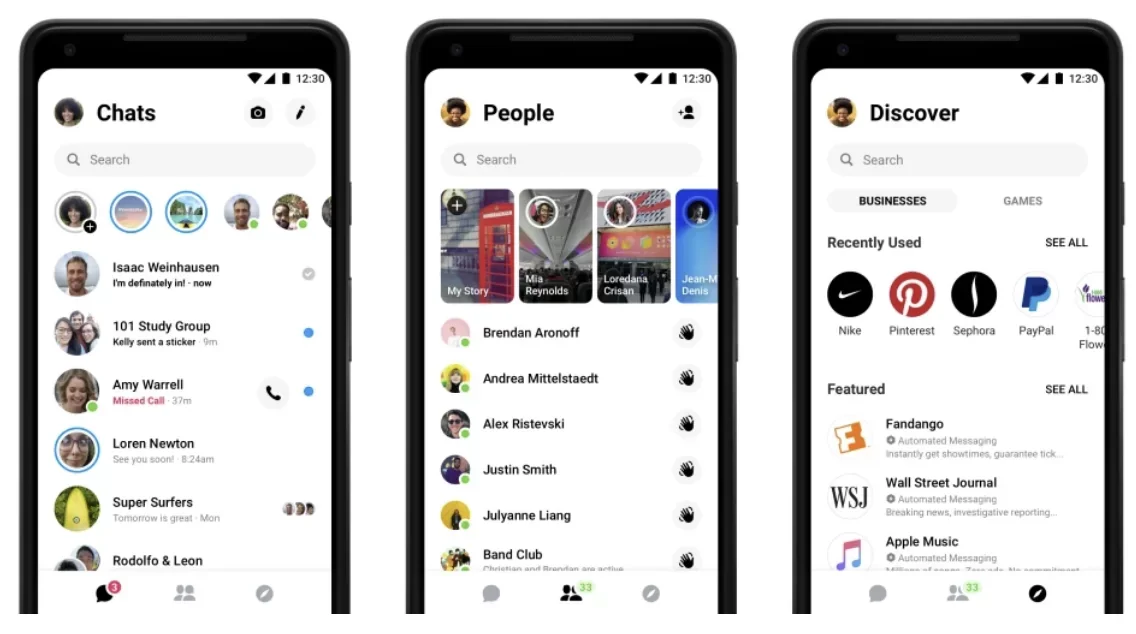
Facebook Messenger ads help businesses start direct conversations, answer questions, and move potential customers closer to conversion.
Increase Customer Engagement
Messaging has become a familiar way for people to interact with businesses, not just friends and family. Meta reports that there are 600 million conversations between people and businesses every day across WhatsApp, Messenger, and Instagram Direct, while nearly 80% of people globally message a business at least once a week.
Generate and Qualify Leads Faster
Click-to-Messenger ads take users straight into a conversation, allowing businesses to answer questions and collect relevant information without adding unnecessary steps. Meta’s lead-generation research found that Business Messaging delivered 53% higher conversion rates than SMS and 61% higher than email in the study cited in its guide
Scale Conversations with Messenger Automation
Follow these steps to set up Facebook Messenger ads in Meta Ads Manager and guide users directly into a Messenger conversation.
Step 1: Create a new campaign
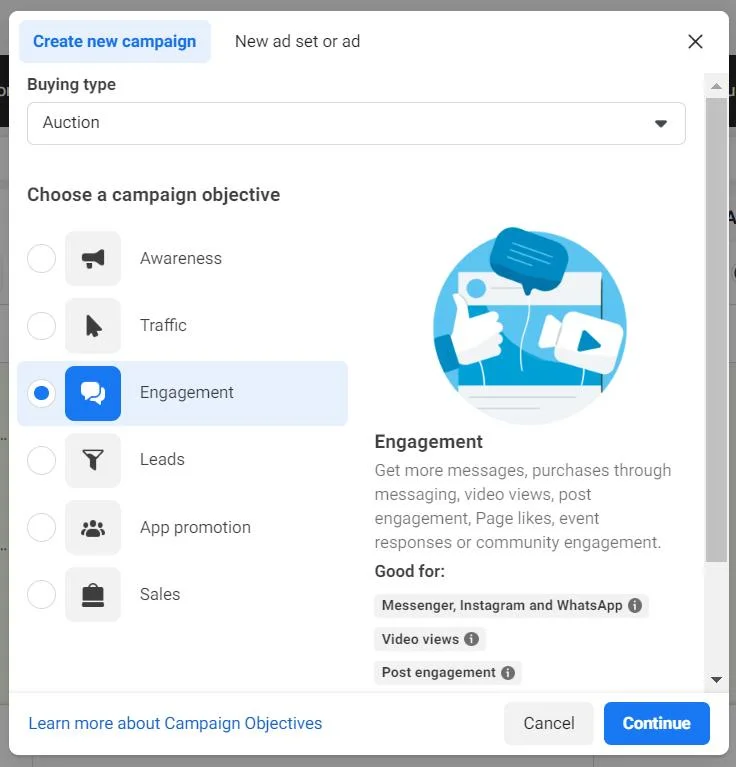
Go to Meta Ads Manager, click + Create, and select Engagement as your campaign objective.
Step 2: Choose Messenger as your messaging destination
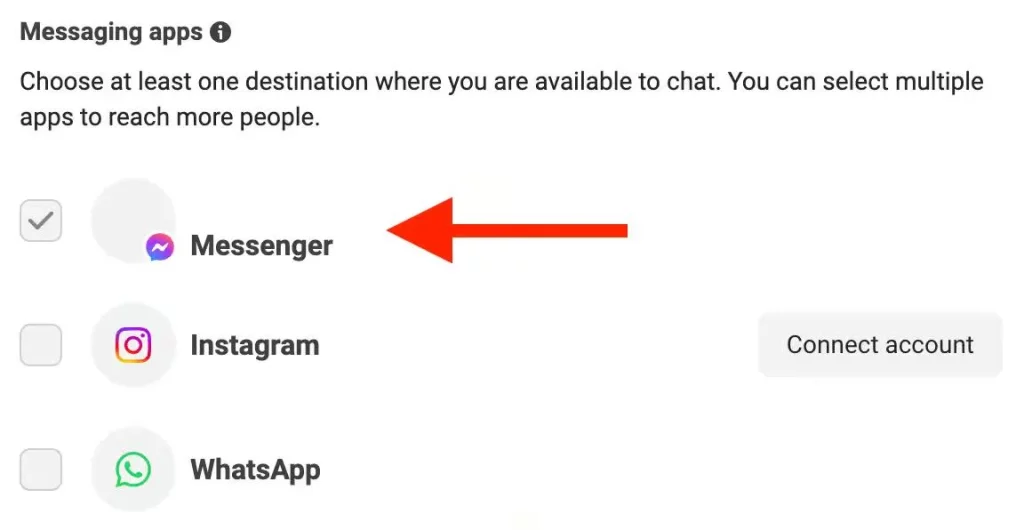
At the Ad Set level, select Messaging Apps as the conversion location and choose Messenger as the app where you want people to start conversations.
Step 3: Set your audience, budget, and schedule
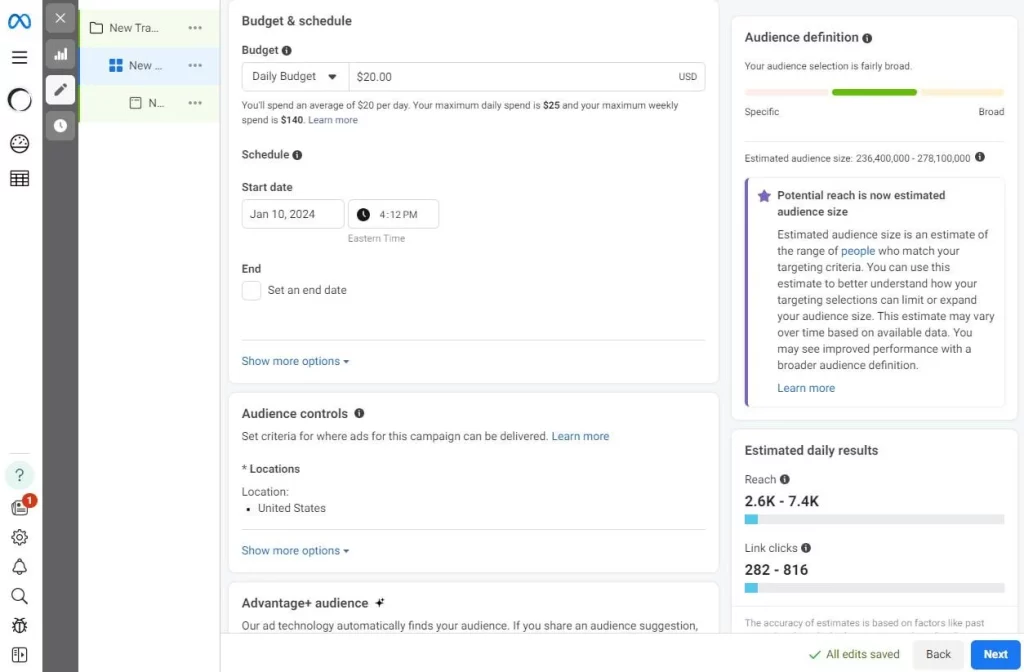
Define your target audience and set the budget and schedule based on your campaign goals. Make sure your audience is broad enough for Meta to find users who are likely to start meaningful conversations.
Step 4: Choose your placements
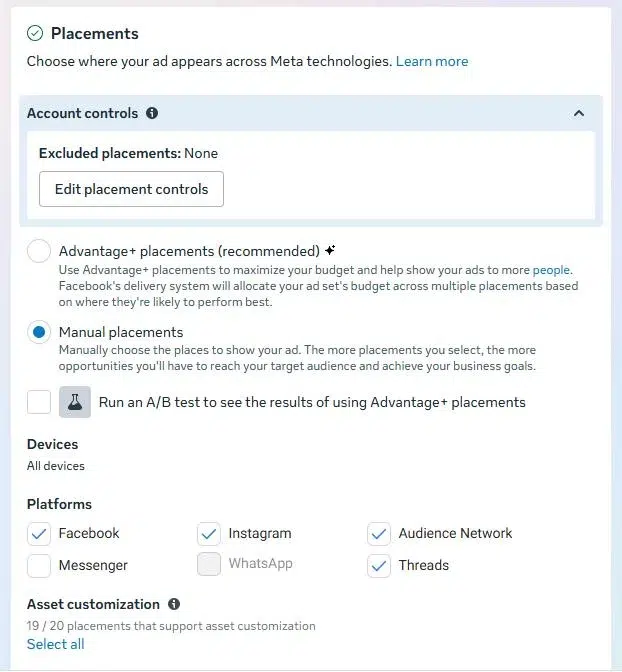
Use Advantage+ placements to let Meta distribute the ad across eligible placements, or select Manual placements when you need more control.
Step 5: Create your ad
Add your image or video, primary text, headline, and Send Message CTA. Make the reason to start a conversation clear before users click the ad.
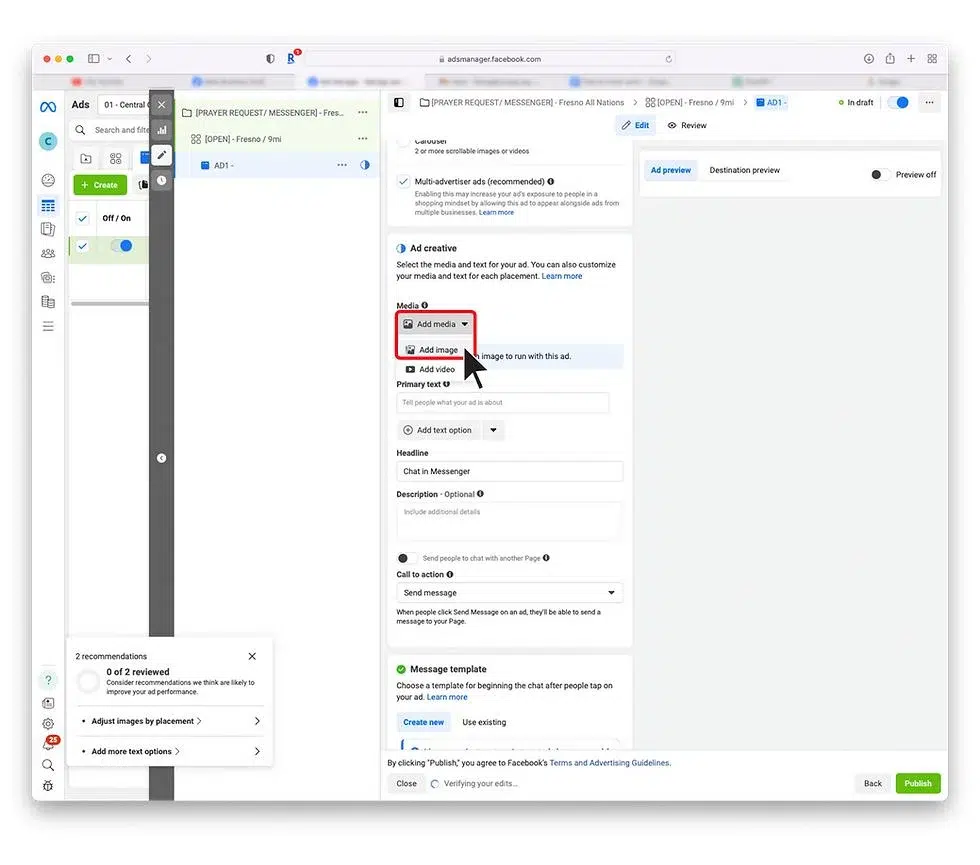
Step 6: Build your message template and publish
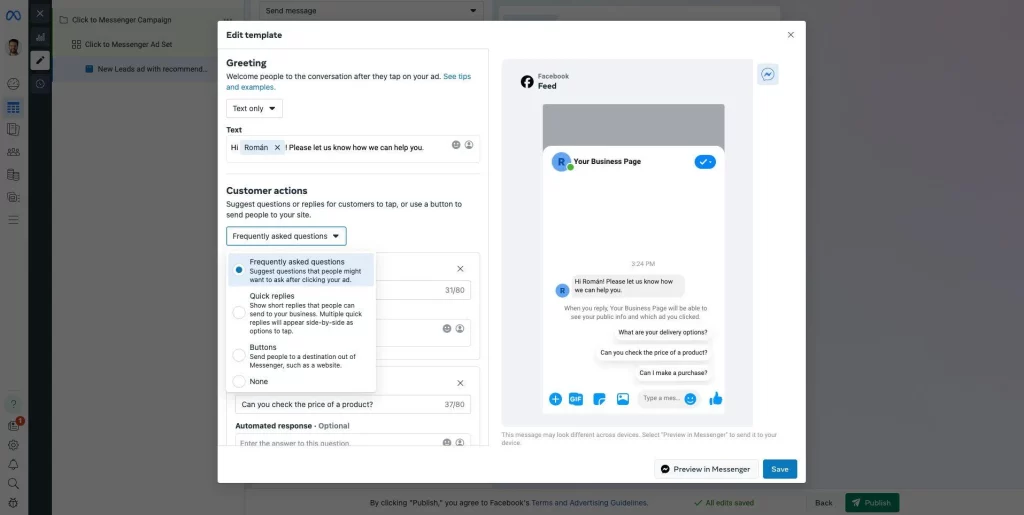
Create a welcome message and add a few relevant questions or quick replies to guide the conversation. Preview the complete ad-to-message experience, then publish your campaign.
Mega Digital’s Pro Tips for Optimized Messenger Ads on Facebook
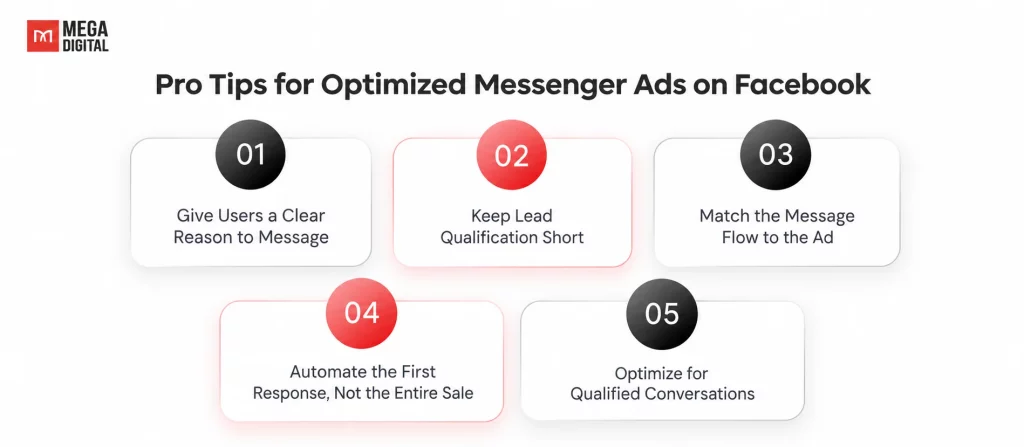
From Mega Digital’s perspective, a strong Messenger campaign should connect the ad promise, conversation flow, lead qualification, and sales follow-up as one continuous journey. Here are five practical ways to improve that journey.
Give Users a Clear Reason to Message
Avoid generic CTAs such as “Message us to learn more” because users still do not know what they will get after clicking. Instead, build the CTA around a specific outcome, such as getting a quote, checking availability, finding the right product, or receiving a personalized recommendation, then make sure the first Messenger response immediately delivers on that promise.
Mega Digital tip: If your ad says “Get a quote”, do not open the conversation with “How can we help you?” Start the quote flow immediately.
Keep Lead Qualification Short
Use the first few questions to collect only the information your sales team actually needs to assess intent, such as product interest, budget range, location, or purchase timeline. Mega Digital recommends keeping the initial qualification flow short and moving detailed questions to the sales conversation once the prospect shows stronger intent.
Match the Message Flow to the Ad
The Messenger conversation should feel like a continuation of the ad rather than a new interaction. If the ad promotes a specific product, discount, consultation, or pain point, repeat that context in the opening message and offer relevant quick replies so users can continue without explaining what they clicked for.
For example, an ad promoting a skincare consultation could open with options such as “Acne”, “Dry skin”, or “Sensitive skin” instead of asking a broad question like “What would you like to know?”
Automate the First Response, Not the Entire Sale
Use automation for greetings, FAQs, basic qualification, and routing so prospects are not left waiting for a reply. Once someone asks detailed product questions, requests pricing, shows strong purchase intent, or needs a customized solution, move the conversation to a real sales representative instead of forcing them through more automated steps.
Optimize for Qualified Conversations
Do not judge campaign performance only by cost per messaging conversation, because a cheap conversation may still produce no business value. Track what happens after the first message by tagging conversations as unqualified, qualified, booked, or converted, then compare metrics such as cost per qualified lead, booking rate, and sales conversion rate.
How to Measure Success and ROI
Messenger ad performance should be measured by what happens after the conversation starts, not just by clicks or message volume. At Mega Digital, we recommend connecting messaging metrics with lead quality, sales outcomes, and revenue to understand whether the campaign is actually creating business value.
Track these metrics across the funnel:
| Metric | What it tells you |
|---|---|
| Messaging conversations started | How many users begin a conversation after seeing or clicking the ad |
| Qualified conversation rate | The percentage of conversations that meet your lead criteria |
| Cost per qualified lead | How much ad spend is required to generate a sales-ready lead |
| Lead-to-sale conversion rate | How many Messenger leads eventually become customers |
| Attributed revenue | How much revenue comes from leads generated through Messenger ads |
| ROAS / ROI | Whether the revenue generated justifies your advertising and operating costs |
To calculate performance more accurately, tag Messenger leads in your CRM or sales tracking system and follow them through to appointment, opportunity, and purchase. This helps distinguish campaigns that generate cheap conversations from those that generate customers.
Mega Digital tip: If cost per conversation is falling but cost per qualified lead is rising, the campaign is becoming cheaper, not necessarily better. Optimize toward the metric closest to revenue.
For revenue-focused campaigns, use ROAS = attributed revenue / ad spend as a quick efficiency indicator. For a broader profitability view, calculate ROI = (revenue – total campaign cost) / total campaign cost, including relevant sales or operational costs where possible.
Frequently Asked Questions About Facebook Messenger Ads
Yes. Click-to-Messenger ads send users directly from the ad into a Messenger conversation, so a landing page or website is not required for the basic campaign flow.
Yes. Meta’s message templates can be configured to collect customer information through questions inside the Messenger conversation, allowing businesses to qualify leads without sending them to a separate form.
Yes. Businesses can give team members appropriate Page or task access to respond to messages and manage conversations through tools such as Meta Business Suite. This makes it easier for sales or support teams to handle Messenger leads without sharing one personal account.
Read More: 6 Facebook Messenger Ads Examples that Inspire Your Next Campaign
Wrap-up
Facebook Messenger Ads offer a unique and effective way to reach and engage your audience. With their ability to provide direct, personalized communication, they represent a powerful tool in any digital marketer’s arsenal. As with any marketing strategy, success with Messenger ads on Facebook requires careful planning and execution. But with the right approach, the results can be well worth your effort.