

Is your campaign struggling to spend its full budget despite a promising CPI? Or do your best performers decline after just a few days? Scaling TikTok ads for puzzle games requires more than increasing the budget; it demands strategic mastery of the creative, specifically the first three seconds. When Click-Through Rate (CTR) drops, the algorithm flags content as irrelevant and restricts reach. In this post, we analyze how to diagnose creative fatigue and A/B test visual hooks to achieve sustainable growth.
Quick Summary:
- A low Click-Through Rate restricts ad distribution because the TikTok algorithm prioritizes user experience above all else.
- Marketers can identify creative fatigue by monitoring specific metrics such as a decline in Hook Rate and a spike in ad frequency.
- The Fail Run concept effectively triggers a corrective urge that compels viewers to download the game and fix the mistake.
- ASMR and satisfying visual loops capture attention by tapping into the subconscious desire for order and stress relief.
- The A/B testing process involves isolating the first three seconds of the video to determine the most engaging introduction while keeping the gameplay constant.
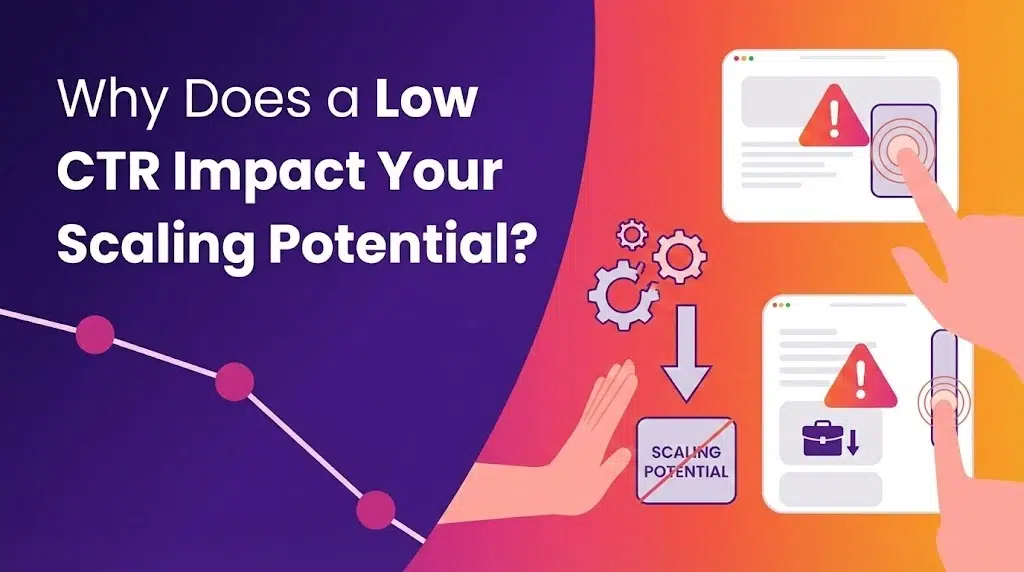
Why Does a Low CTR Impact Your Scaling Potential?
A low CTR is the primary bottleneck for scalability because the TikTok algorithm prioritizes user experience. When a puzzle game ad fails to generate clicks, the platform interprets this as a lack of relevance. If CTR falls below the industry threshold (typically <0.8% for puzzle games), the system effectively restricts ad distribution to prevent users from seeing unengaging content.
The mechanism relies on the eCPM formula:
To win an ad auction with a low CTR, advertisers must bid significantly higher to achieve a competitive eCPM. This causes CPA (Cost Per Action) and CPI (Cost Per Install) to increase, making profitable scaling mathematically impossible.
To fix CTR, one must understand the Hook. In the context of Puzzle Games, a hook is a Root Attribute of the creative: the singular moment of curiosity, frustration, or satisfaction packed into the very first 3 seconds. If this moment fails, the algorithm does not give the gameplay a chance to perform.
Identifying Creative Fatigue and Hook Performance
Identifying creative fatigue is a diagnostic process that involves analyzing specific metric trends to determine if visual hooks are no longer resonating with the audience. Instead of focusing solely on overall CPA, marketers must examine top-of-funnel metrics.
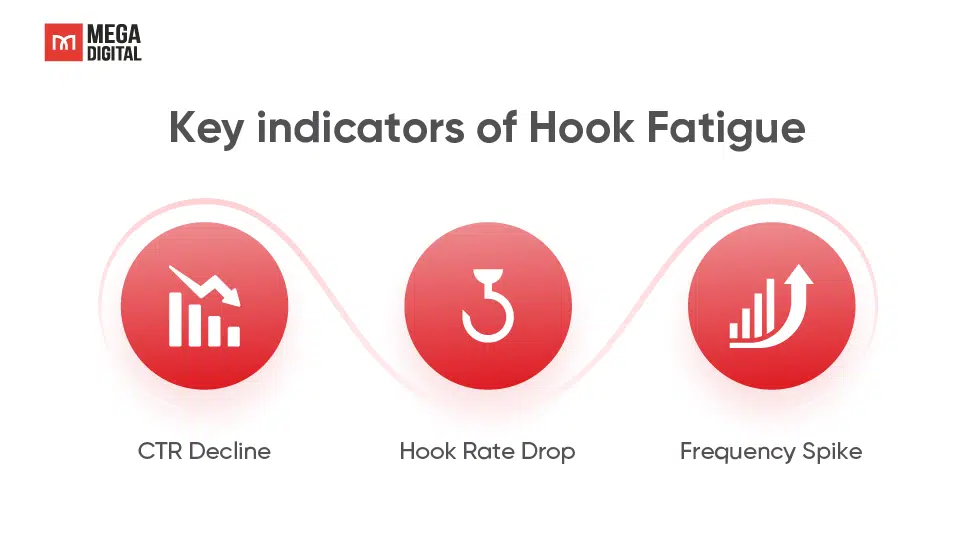
Key indicators of Hook Fatigue (According to Lebesgue):
- CTR Decline: A steady drop in CTR below the industry benchmark for puzzle games (typically 0.7% – 1.0%).
- Hook Rate Drop: The percentage of people who watch the first 3 seconds falls below 25-35% (target ideally >65% for strong performers).
- Frequency Spike: When frequency exceeds 5-7 per user (typically per week), users see the same hook too often, leading to banner blindness.
Pro Tip: The algorithm acts as a prediction machine. If your hook doesn’t stop the scroll instantly, TikTok predicts your content is irrelevant, rendering even the best bid strategy ineffective.
3 Winning Visual Hook Concepts for Puzzle Games
There are three dominant visual hook concepts that consistently perform well for the puzzle genre: The Fail Run, ASMR Loops, and The Impossible Challenge. These concepts leverage distinct psychological triggers to stop the scroll.
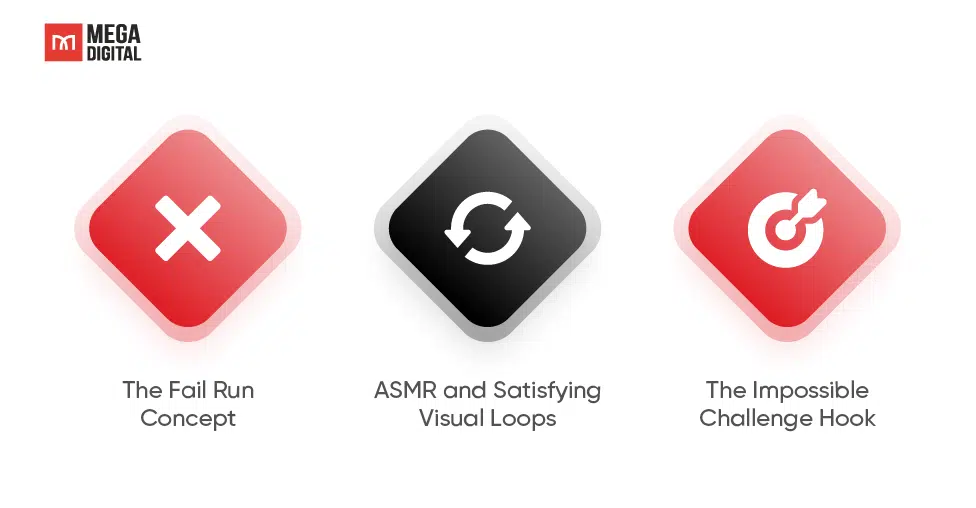
The Fail Run Concept
The Fail Run concept relies on the corrective urge. By showcasing a player failing a simple task, like moving the wrong pin in a pull-the-pin game or mismatching items, advertisers trigger a mix of frustration and superiority. Viewers instinctively feel they can perform better, creating an emotional reaction that translates directly into a click to download and prove their skill.
When to Use It
- Scaling Phase: When reaching a broad audience (Broad Targeting). This concept works best on mass audiences who may not identify as gamers but enjoy solving simple problems.
- Low CTR: When standard gameplay footage looks too easy and fails to generate clicks.
When NOT to Use It
- Retargeting Campaigns: Users who have already engaged with the game might find this approach inauthentic.
- Hardcore Puzzle Niches: If the game is a serious Sudoku or Chess app, a simple fail ad might insult the intelligence of the target audience and lower Lifetime Value (LTV).
Common Mistakes
- The Impossible Fail: Making the puzzle look genuinely unsolvable creates apathy instead of a corrective urge. The solution must be obvious to the viewer.
- Misleading Mechanics: Showing a mechanic that does not exist in the actual game leads to high installs but low retention and potential account penalties.
How to Execute
- The Near Miss Setup: Producing creatives where the player perfectly navigates 90% of the rhythm challenge, building anticipation and satisfaction.
- The Clumsy Fail: At the very last second, the player fails due to a hesitant tap or obvious mistake, breaking the flow.
- Audio Syncing: Instead of generic background music, syncing the visual failure with a distinct audio cue of disappointment (e.g., a gasp).
Case Study: This strategy was successfully applied in the TikTap Challenge campaign by Mega Digital. By utilizing fail moments in simple tapping mechanics to trigger user frustration, we helped the game achieve break-even by Day 4 and exceed ROAS targets by 60–100%, demonstrating that properly executed fail mechanics can drive massive scalability.
ASMR and Satisfying Visual Loops
ASMR (Autonomous Sensory Meridian Response) and Satisfying Visual Loops tap into the subconscious desire for order, symmetry, and stress relief. By combining high-fidelity audio (crunching, popping, sliding) with smooth, organized visual transitions, these hooks create a sensory satisfaction effect that positions the game as an escape from daily anxiety.
When to Use It
- Sub-genres: Ideal for Coloring, Merge, Sorting, or simulation games focused on organization.
- Time of Day: Effective for ads targeting users during high-stress or wind-down periods.
When NOT to Use It
- Action-Heavy Games: If the game involves timers, explosions, or intense logic, a relaxing hook sets the wrong expectation and leads to high churn.
- Competitive Audiences: Players looking for a challenge (PvP, Leaderboards) may find these ads unengaging.
Common Mistakes
- Poor Audio Quality: Using generic stock music instead of distinct Sound Effects (SFX). The satisfaction comes from the crisp sound of the action, not the background track.
- Jarring Cuts: Editing the video too fast. Satisfying loops require a smooth, uninterrupted flow.
How to Execute
- Texture Amplification: Increasing the volume on specific interaction sounds, the click of a block fitting in, the whoosh of liquid pouring, or the snap of a merge.
- Symmetry & Order: Ensuring the gameplay footage shows items being organized perfectly by color or shape. Visual harmony is key.
- Haptic Visualization: Using slight screen shakes or particle effects that sync perfectly with the audio to make the action feel tactile.
The Impossible Challenge Hook
The Impossible Challenge hook utilizes exclusivity and ego-bait to drive engagement. By presenting a level or scenario that claims to be solvable by only a select few, advertisers challenge the intelligence of the viewer and frame the game as a test of skill and status.
When to Use It
- Logic & IQ Games: Perfect for Sudoku, Pipe connection, or intricate puzzle RPGs.
- High-Skill Ceiling: When the game increases in difficulty, this hook prepares users for the challenge.
When NOT to Use It
- Luck-Based Games: If the outcome depends on RNG (Random Number Generation) rather than skill, this hook feels deceptive.
- Relaxing/Zen Games: It contradicts the motivation of players looking for a stress-free experience.
Common Mistakes
- The Pink Color Trap: Using fake text like “I can’t reach Pink Color” when the game has no such mechanic. This is a common trope that users increasingly ignore.
- Text Overload: Covering the gameplay with too much text. The visual must prove the difficulty; the text should only anchor it.
How to Execute
- Specific Overlays: Using precise quantitative claims like “Only 1% of players can pass Level 10” or “IQ > 150 Required.” Specific numbers feel more authentic than generic claims.
- Chaos vs. Control: Showing a screen filled with chaos (e.g., overwhelming enemies or mismatched blocks) and a player struggling to manage it. This visually validates the difficulty claim.
- The Stuck Narrative: Showing a player cursor hovering repeatedly over a move but not taking it, implying the solution is not obvious.
Step-by-Step Guide to A/B Test Visual Hooks
A/B testing visual hooks is a methodical process of isolating the first 3 seconds of the video ad while keeping the body content constant to determine which opening drives the highest engagement.
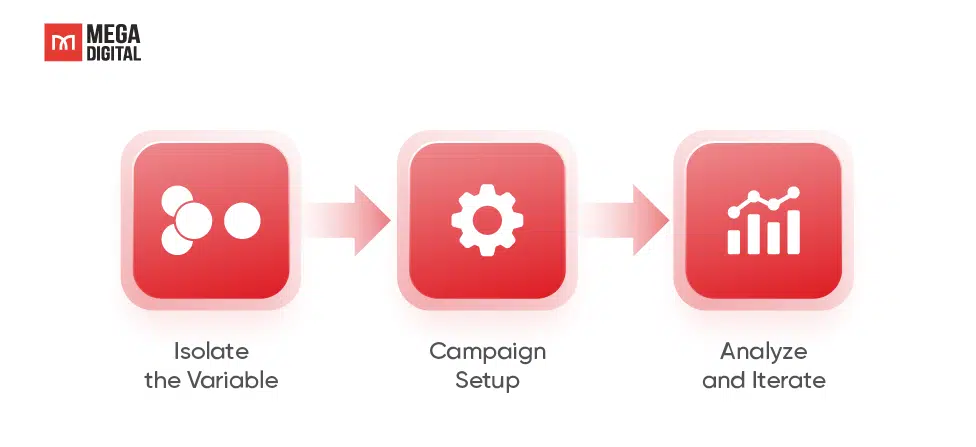
Step 1: Isolate the Variable
Create one Master video body (gameplay showcase, 15-20 seconds). Then, create 3-5 different variations of the first 3 seconds (The Hook) attached to that same body. Do not change the music or the CTA at this stage.
Step 2: Campaign Setup
Set up a dedicated testing campaign on TikTok Ads Manager.
- Budget: Set a daily budget of roughly 20x-50x the target CPI to ensure enough data density.
- Optimization: Optimize for Installs or App Events, but keep the focus on CTR comparisons.
Step 3: Analyze and Iterate
Run the test for 48-72 hours.
- Winner: The hook with the highest CTR and lowest Cost Per Click (CPC).
- Loser: Any hook with a Hook Rate (3s view) below 20%.
- Action: Take the winning hook and scale it into main campaigns. Then, produce 3 new variations of that winning hook concept for the next round.
Expert Advice: Creative fatigue on TikTok is faster than any other platform. A winning hook has a shelf life of days, not months. You are either testing, or you are dying.
FAQs
Given the rapid fatigue on TikTok, we recommend refreshing hooks every 1-2 weeks for stable campaigns, and every 3-5 days for high-spend scaling campaigns. Monitor your Frequency metric closely; if it crosses 5.0, your hook is likely losing effectiveness.
While Spark Ads build long-term brand equity, Standard (Non-Spark) Ads often perform better for direct response scaling in puzzle games. Standard ads allow for clearer CTAs and remove the distraction of clicking through to a profile.
When scaling a winning ad group, avoid doubling the budget overnight. A safe rule is to increase the daily budget by 20–30% every 24 hours.
>>> Read more: How to Scale TikTok Ads for Hyper-Casual Games Without Increasing CPI
Final Word
Scaling TikTok ads for puzzle games is a balancing act between capturing attention with aggressive hooks and delivering on that promise with engaging gameplay. By understanding the impact of CTR on the algorithm and rigorously A/B testing concepts like Fail Runs or ASMR loops, advertisers can lower CPI and unlock new levels of growth.
Ready to take your puzzle game to the top of the charts? Contact Mega Digital today!Curious why top studios like Falcon are shifting massive budgets from IAA to IAP in 2025? Get the full insider data in our exclusive Vietnam Gaming Outlook 2025 report.