


For developers, the ROAS Mobile Games metric is essential for scaling your User Acquisition efforts efficiently. In this blog post, we will provide the ROAS formula, distinguish it from ROI, and share proven strategies from Mega Digital to help you maximize your game’s profitability.
Quick Summary:
- ROAS measures gross revenue generated for every dollar spent on UA and is the primary metric for scalability, distinct from total business profitability.
- The most effective strategy for 2026 involves shifting focus to TikTok Ads x ROAS by combining high-frequency creative production with deep-funnel optimization to find high-LTV players.
- Ad creatives act as the number one lever for improving ROAS, where strategies like “Fail/Rescue” scenarios can drastically lower CPI and boost CTR.
- Developers should avoid obsessing over low CPI since cheap users often don’t pay, while ensuring they track Ad Revenue (IAA) to see the full LTV picture.
What is ROAS Mobile Games?
ROAS (Return on Ad Spend) measures the gross revenue generated for every dollar spent on user acquisition.
In mobile gaming, revenue isn’t instant, it accumulates over time through In-App Purchases (IAP) and Ads. Therefore, ROAS is tracked by cohorts (groups of users installed on the same dates) over specific timeframes like Day 7 or Day 30.

Example:
If you spend $1,000 on Facebook Ads to acquire players, and those specific players generate $1,500 in revenue by Day 30:
- Day 30 ROAS = 150%.
- Result: You earned $1.50 for every $1.00 spent. A high ROAS signals you to scale budget; a low ROAS demands immediate optimization.
While Facebook Ads remain a common benchmark for ROAS calculations, modern mobile game studios increasingly rely on TikTok Ads to scale ROAS faster through creative-driven optimization.
Reasons Why ROAS Matter for Mobile Games
Here are detail information about three reasons why ROAS matter for Mobile Games:
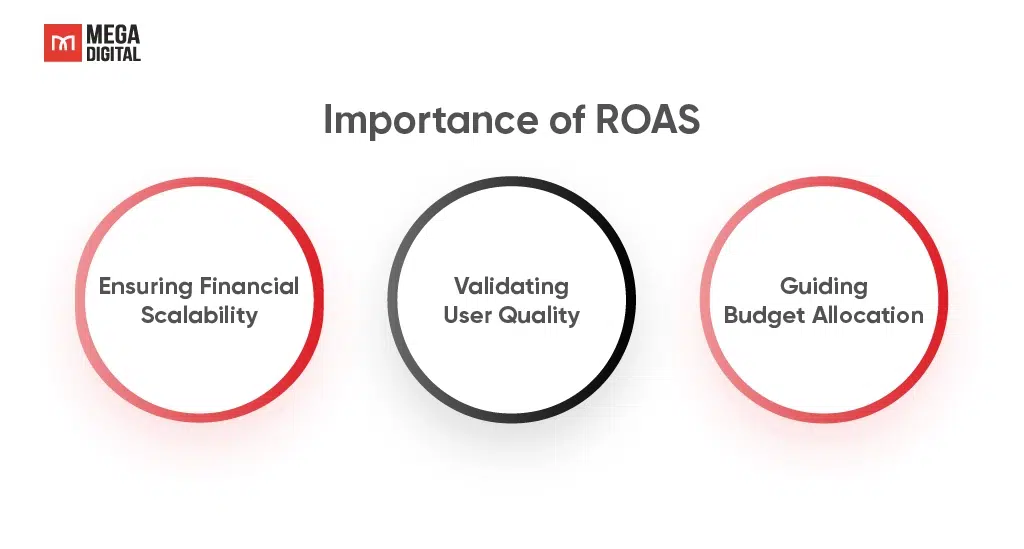
1. Ensuring Financial Scalability
ROAS determines if a game can scale. A game might have excellent retention, but if the cost to acquire users is higher than the revenue they generate, the studio cannot increase ad spend without accelerating losses. Positive ROAS allows developers to reinvest profits into acquiring more users, creating a “flywheel effect” of growth.
Case in Point: Mega Digital partnered with Alphabet Shooter: Rocket to tackle the challenge of volatile market costs. By shifting focus to ROAS – optimized campaigns on TikTok and utilizing rigorous A/B testing for creatives, we helped the studio identify high-value user segments.
The results were outstanding: The campaign achieved a 45% reduction in CPI and maintained a Day 7 ROAS of over 15% (a strong benchmark for hypercasual). This allowed the studio to confidently triple their daily ad budget while ensuring returns stabilized by Day 14.
2. Validating User Quality
ROAS acts as a quality filter. High install numbers (low CPI) can be deceptive if those users never monetize. A ROAS-focused approach forces developers to look at the value of players, not just the quantity.
3. Guiding Budget Allocation
ROAS dictates where to spend money. By comparing ROAS across different channels like TikTok vs. Google Ads or different creatives, UA managers can cut budget from underperforming sources and shift it to high-performing ones. This efficiency is vital when navigating tight budgets.
How to Calculate ROAS Mobile Games Formula?
The fundamental formula for calculating ROAS Mobile Games is:
ROAS = (Total Revenue from Cohort / Total Ad Spend) × 100%
To apply this effectively, developers must break down the equation into its core components involving LTV and CPI.
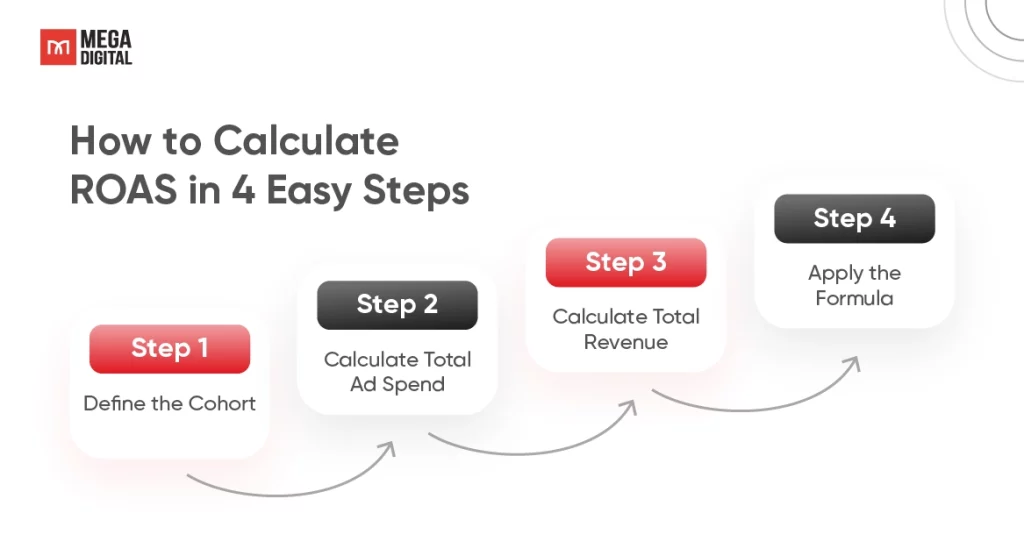
Step 1: Define the Cohort
You cannot calculate ROAS accurately for a mobile game without defining the time frame. You must select a specific group of users installed on a specific date range such as users installed between Jan 1st and Jan 7th.
Step 2: Calculate Total Ad Spend
Sum up the total marketing costs incurred to acquire that specific cohort.
Formula: Total Ad Spend = Total Installs × CPI (Cost Per Install).
Step 3: Calculate Total Revenue (LTV Context)
Sum up the revenue generated only by that specific group of users up to the current date. This includes:
- IAP (In-App Purchases): Gold, skins, subscriptions.
- IAA (In-App Advertising): Revenue from interstitial, rewarded video, or banner ads.
- Note: This accumulation of revenue per user over time is essentially the realized LTV (Lifetime Value) at that specific day.
Step 4: Apply the Formula
Divide the revenue by the spend and multiply by 100 to get the percentage.
The Developer’s Shortcut (LTV & CPI Relationship)
For a quick mental check, developers can also view ROAS through the lens of unit economics:
ROAS = (LTV / CPI) * 100%
- Scenario: You spend $2.00 (CPI) to acquire a user. By Day 30, that user has generated $3.00 (LTV).
- Calculation: ($3.00 / $2.00) * 100% = 150%.
- Result: You have made a 50% profit on your ad spend.
The goal is not just to be positive, but to reach the “breakeven point” as quickly as possible. For casual games, Day 7 ROAS is often the key indicator; for mid-core RPGs, it might be Day 30 or Day 60.
>>> Read more: CPI Mobile Game 2026: Benchmarks & ROAS Optimization Guide
What is the Difference Between ROAS and Other Metrics in Gaming?
While ROAS focuses strictly on media efficiency, ROI covers total business profitability, CPI measures acquisition cost, and Conversion Rate tracks funnel performance.
The table below outlines the key differences:
Metric | What It Measures | Formula | Key Difference vs. ROAS |
ROI (Return on Investment) | Total business profitability, accounting for all overheads (salaries, server costs, etc.). | (Total Revenue – Total Expenses) / Total Expenses | ROI looks at the entire business health, whereas ROAS only looks at ad campaign efficiency. A game can have positive ROAS but negative ROI. |
CPI (Cost Per Install) | The cost to acquire a single user through paid channels (Input metric). | Ad Spend / Total Installs | CPI measures the cost to get a user, while ROAS measures the value they bring. Optimizing for low CPI alone is dangerous if users don’t spend. |
CVR (Conversion Rate) | The percentage of users who install the game after visiting the store page (Funnel metric). | (Installs / Store Views) * 100% | CVR measures the appeal of your App Store page, while ROAS validates the monetization quality of the users that CVR captures. |
Factors Affecting ROAS for Mobile Games
There are four primary factors that directly influence the fluctuation of your ROAS: Creative Performance, Monetization Design, Audience Targeting, and Seasonality. Understanding these variables allows developers to diagnose why ROAS might suddenly drop or spike.
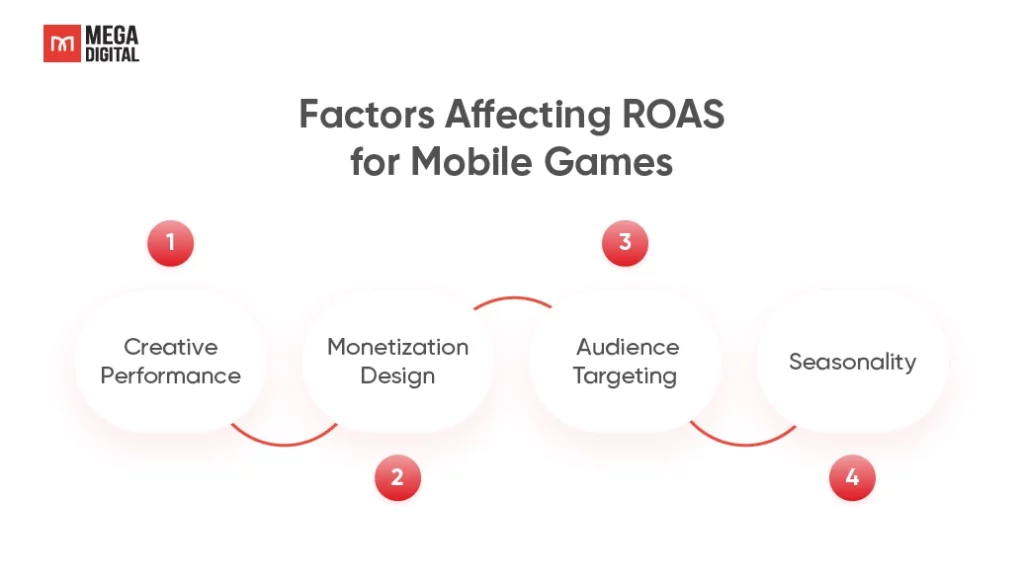
1. Creative Performance
The single biggest lever for ROAS is the ad creative, especially on visual platfóm like TikTok. Engaging creatives lower the CPI (because ad networks reward high CTR) and attract higher-quality users. If creatives cause “ad fatigue” (users get bored), CPI rises, and ROAS falls.
Example: In the TikTap Challenge campaign, Mega Digital refreshed creatives weekly, testing gameplay variations against live-action skits. This rigorous A/B testing strategy resulted in a 20% increase in Click-Through Rate (CTR) and a corresponding 15% decrease in CPI. Ultimately, these optimizations helped the game maintain a healthy Day 7 ROAS of over 12% throughout the scaling phase.
2. Monetization Design
Even the best ads can’t save a game with poor monetization. If IAP bundles are unattractive or ads are poorly placed, users churn before paying. This causes LTV to stagnate, dragging ROAS down regardless of how low your CPI is.
3. Audience Targeting
Broad targeting usually results in lower CPI but lower LTV. Niche targeting like Strategy gamers on iOS often has a higher CPI but significantly higher LTV, resulting in better net ROAS.
4. Seasonality
CPM (Cost Per Mille) fluctuates throughout the year. For instance, ad costs skyrocket during Q4 (Black Friday/Christmas) due to e-commerce competition. If LTV remains constant but ad costs double, ROAS will effectively be cut in half during these periods.
What is a “Good” ROAS by Genre?
A common mistake developers make is applying a “one-size-fits-all” benchmark to their games. A 10% Day 7 ROAS might be excellent for a Strategy game but disastrous for a Hypercasual title.
Below are the approximate industry benchmarks to help you gauge your performance.
Note: These are approximate global averages for Tier-1 markets (US, UK, CA). iOS typically delivers higher ROAS due to better LTV, while Android offers lower CPI for scale. Actual performance varies by subgenre and region.
Genre | Avg. CPI (iOS) | Avg. CPI(Android) | D1 Retention | D7 ROAS Target | D30 ROAS Target | Breakeven Point |
Hypercasual | $1 – $2.5 | $0.5 – $1.5 | 25% – 35% | 5% – 15% | 15 – 30%(iOS cao hơn) | Day 30 – 90 |
Casual / Puzzle | $1.4 – $4 | $1.0 – $3.0 | 25% – 35% | 7% – 12% | 15 – 47% | Day 90 – 180 |
Mid-Core / RPG | $4 – $8+ | $3.0 – $6.0 | 20% – 30% | 4% – 8% | 20 – 40% | Day 18 – 365+ |
(Source: Data compiled from AppsFlyer, Sensor Tower, and Liftoff report)
3 Common ROAS Mistakes Developers Make
Before diving into strategies, avoid these three critical pitfalls that often drain marketing budgets without delivering results:
- Obsessing Over Low CPI: Many developers chase the lowest possible CPI, assuming volume equals success. However, a $0.20 user who never watches an ad or buys a pack is worse than a $2.00 user who spends $10.00.
- Ignoring Ad Revenue: In the hybrid-casual era, looking only at In-App Purchase (IAP) data gives you a “false negative” on ROAS. For many games, ad revenue makes up 40-60% of total LTV.
- Judging Too Early: Ad algorithms like Facebook’s Learning Phase or TikTok’s Pangle need time and data events to optimize. Developers often panic and kill a campaign after 24 hours if the ROAS looks bad.
While both platforms require sufficient data, TikTok’s algorithm adapts more effectively when optimized toward deep-funnel ROAS events rather than installs, making it more suitable for ROAS-driven scaling.
Strategies to Improve ROAS for Mobile Games
Below are proven tactics Mega Digital uses to boost performance for our gaming clients.
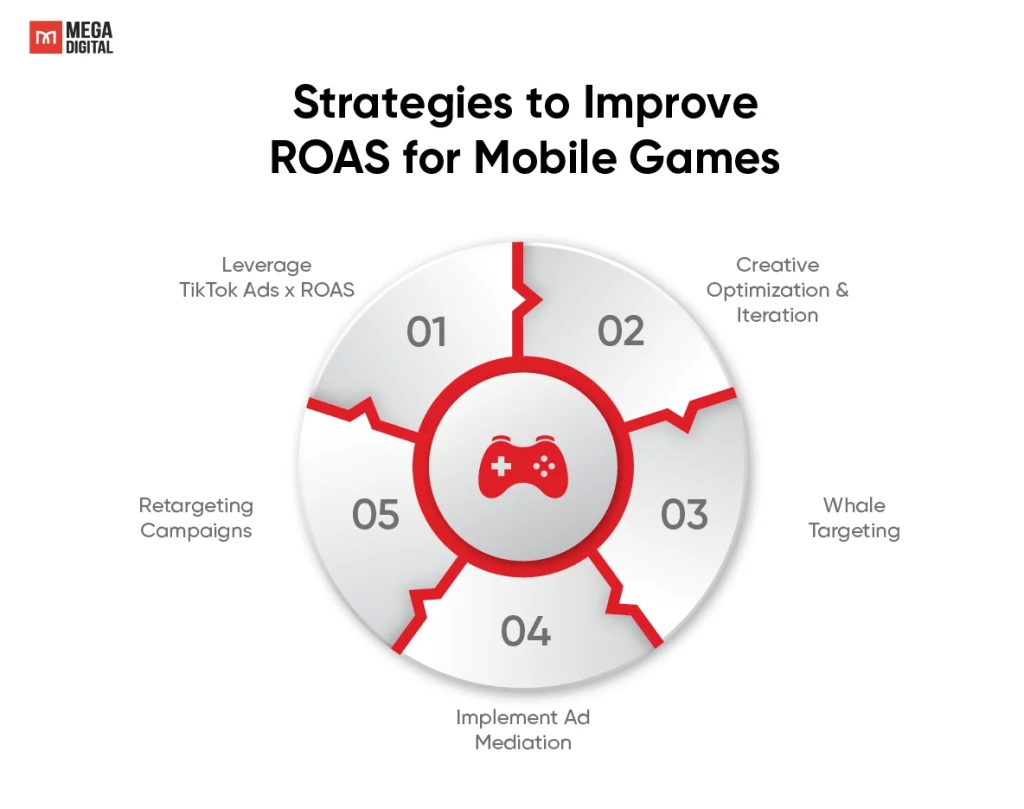
1. Leverage TikTok Ads x ROAS
TikTok is currently the most efficient channel for ROAS scaling, but it requires a specialized approach.
- The Challenge: Standard TikTok campaigns often optimize for installs, leading to low LTV.
- The Solution: Mega Digital’s TikTok Ads x ROAS service combines high-frequency creative production (UGC, 3D trends) with deep-funnel optimization (VO/AEO). We don’t just find users; we find payers. By training the algorithm to seek out ROAS-positive events, we help developers scale spend profitably where other channels fail.
2. Creative Optimization & Iteration
Don’t just run ads; evolve them. Use A/B testing to identify winning hooks.
- Playables: Allow users to try the game in the ad. These users often have higher retention (and LTV).
- UGC (User Generated Content): TikTok-style videos often have lower CPIs because they feel native to the platform.
Case Study: For Royal Match, instead of showing standard match-3 gameplay, they tested “save the king” scenarios. These high-stakes, emotional creatives drastically improved Click-Through Rates (CTR) and lowered CPI, proving that ad creatives don’t always need to mirror the core loop 1:1.
3. Whale Targeting
Stop targeting everyone. Upload the device IDs of your highest spenders (Whales) to platforms like Facebook or Google. Create “Lookalike Audiences” to find new users who share similar behavioral traits with your best players. This increases the probability of acquiring high-LTV users.
While Facebook and Google lookalikes rely heavily on historical user attributes, TikTok leverages content consumption behavior to discover new high-LTV users even at scale.
4. Implement Ad Mediation
For games relying on ad revenue (Hypercasual), use Ad Mediation platforms (like MAX or IronSource LevelPlay). These tools create a bidding war between ad networks for your inventory, ensuring you get the highest possible eCPM for every ad shown to your players, thereby increasing LTV.
5. Retargeting Campaigns
It is often cheaper to re-engage a lapsed player than to acquire a new one. Run retargeting campaigns offering a “Welcome Back Gift” to users who haven’t played in 7 days but previously made a purchase. This squeezes more LTV out of existing cohorts for a relatively low marketing cost.
>>> Read more: How to Improve ROAS in Mobile Games Without Higher UA Costs
FAQs
1. How to Estimate LTV for New Games
Estimating LTV for new games relies on early cohort behavior and benchmarking, usually using the “multiplier method.”
When a game is new, you don’t have 90 days of data to calculate Day 90 LTV. Instead, developers use Predicted LTV (pLTV).
- Benchmarks: If similar games in your genre have a Day 7 LTV that is typically 20% of their Day 180 LTV, you can project the future value.
- Formula: Projected LTV = Day 7 LTV * Multiplier.
- Retention Proxy: High Day 1 Retention is a strong predictor of high LTV. If retention is low, LTV will almost certainly be low.
2. How Does Privacy (SKAN/Privacy Sandbox) Affect ROAS Tracking?
Privacy frameworks like Apple’s SKAdNetwork (SKAN) and Google’s Privacy Sandbox reduce data granularity, forcing developers to rely on aggregated data rather than user-level data.
In the past, developers could track exactly which user spent $100. Now, with IDFA deprecated on iOS:
- Signal Loss: You might know a campaign generated 10 purchases, but you don’t know exactly who made them or when (due to reporting delays).
- Conversion Values: Developers must map in-game actions like “Completed Level 5” to Conversion Values to estimate revenue ranges.
- Impact: ROAS calculations become probabilistic (estimates) rather than deterministic (exact facts), requiring more sophisticated modeling tools or MMPs (Mobile Measurement Partners) to decipher the data.
3. Why is my ROAS dropping even though CPI is low?
Low CPI means you are acquiring users cheaply, but it doesn’t mean they are valuable. A drop in ROAS usually indicates:
- Poor Monetization: The game economy isn’t converting installs into payers.
- Wrong Audience: You are attracting “window shoppers” (low intent users) instead of players.
- Ad Fatigue: Your creatives are stale, attracting lower-quality clicks.
>>> Read more: TikTok Game Ads: A Winning Strategy for Boosting Downloads
Conclusion
A strong ROAS Mobile Games helps you balance between LTV and CPI. By distinguishing ROAS from ROI and utilizing superior channels like TikTok Ads, developers can build sustainable growth for any game genre. Mega Digital provides specialized performance marketing solutions to help you hit your LTV targets. Contact Mega Digital today to audit your ROAS strategy.