

In 2026, global mobile game Cost Per Install (CPI) has surged by up to 30% YoY, while average Day-1 retention hovers perilously around 25-27%. Without a bulletproof, data-driven user acquisition strategy, even the highest-quality games will struggle to break even. In this post blog, we break down the core definitions, 2026 benchmarks, top-performing channels, vital metrics, and advanced scaling tactics to help you survive and dominate the mobile gaming market.
Quick Summary
- Rising global acquisition costs require developers to implement highly targeted paid advertising campaigns instead of relying solely on organic discovery.
- Social media video platforms and dedicated gaming ad networks provide the most efficient pathways to scale top-grossing revenues.
- Continuous testing of user-generated content and playable ad formats directly combats ad fatigue and lowers installation costs.
- Modern privacy regulations demand that studios utilize predictive lifetime value modeling and automated machine learning for bid optimization.
- Sustainable campaign scaling relies on testing secondary geographical markets and aggressively expanding budgets only when return on ad spend is stable.
What is User Acquisition?
User Acquisition (UA) is the data-driven marketing process designed to generate new users for a mobile game through a combination of organic app store optimization and paid advertising campaigns.

To understand this better, it is crucial to recognize that UA goes beyond merely getting someone to click a download button. Specifically, it involves targeting the right demographic, analyzing player behavior, and optimizing ad creatives to ensure that the cost of acquiring a user is significantly lower than the revenue they will eventually generate for the game. For mobile game developers, a well-structured UA system is the primary engine for sustainable growth and market penetration.
Why is User Acquisition Important for Gaming Apps?
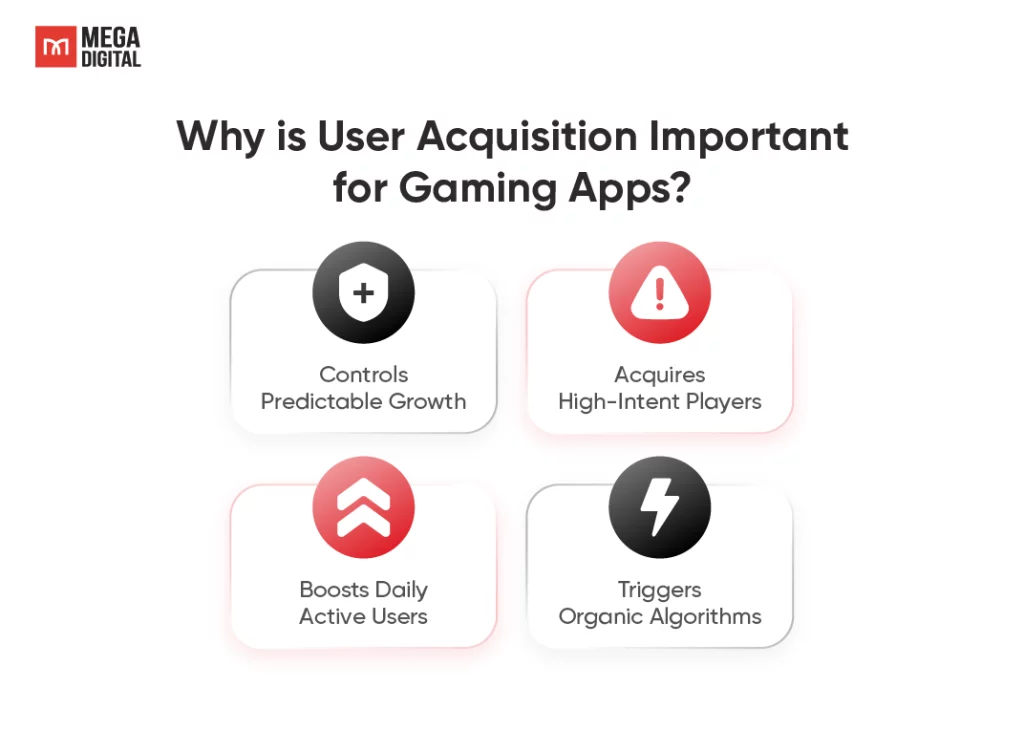
In a saturated market where relying solely on organic discovery is no longer viable, a robust user acquisition strategy is crucial for the following reasons:
- Controls Predictable Growth: It empowers developers to dictate their growth rate and scale revenue predictably through systematic budget allocation and data analysis.
- Acquires High-Intent Players: Targeted UA campaigns ensure you attract specific demographics who are most likely to engage, play long-term, and make in-app purchases.
- Boosts Daily Active Users (DAU): A continuous influx of new players maintains a healthy, active, and competitive in-game ecosystem.
- Triggers Organic Algorithms: The initial momentum generated by paid installs pushes the game higher in App Store and Google Play rankings, creating a profitable halo effect of free organic downloads.
The Mobile Game UA Funnel Explained
The mobile game UA funnel consists of four key stages: Impression, Click, Install, and Post-Install Event, ultimately leading to monetization and long-term player retention.
Next, let’s explore how potential players travel through this marketing pipeline.
- Impression: This is the top of the funnel where a user first sees your game’s ad on platforms like TikTok or Facebook. The goal here is immediate visual impact.
- Click: If the ad creative is compelling, the user clicks the call-to-action (CTA), transferring them to the app store page.
- Install: The user decides to download the game. App Store Optimization (ASO) plays a massive role in converting clicks into actual installs.
- Post-Install Event: The bottom of the funnel. The user opens the app, completes the tutorial, and ideally makes an in-app purchase (IAP) or watches rewarded ads.
Organic vs. Paid User Acquisition Growth
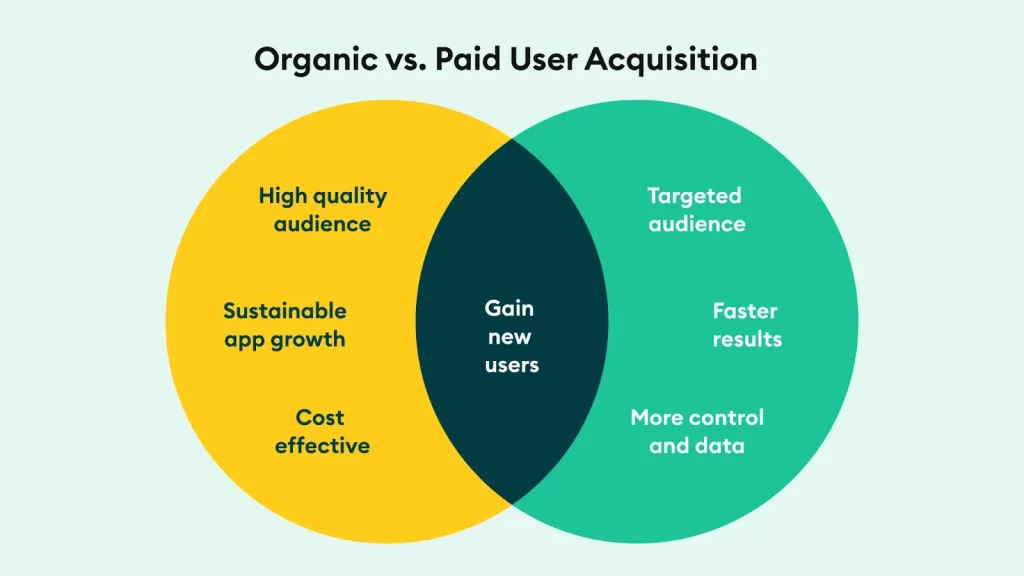
Organic growth offers cost-effective sustainability, while paid UA drives immediate, scalable volume. To dominate the charts, a hybrid approach is mandatory. Here is how they compare:
| Comparison Criteria | Organic UA | Paid UA |
| Direct Cost | Zero direct media spend. Highly cost-effective. | Requires a dedicated advertising budget. |
| Speed & Scalability | Exceptionally slow. Takes months to build momentum. | Immediate scalability. Generates rapid install volume instantly. |
| Targeting Precision | Broad reach, relies on natural search intent and store algorithms. | Highly targeted, forcefully pushes your game to specific demographics and behaviors. |
| Primary Methods | Strategic keywords, engaging screenshots, positive ratings. | Video ad creatives, playable ads on platforms like TikTok, UAC, Unity Ads. |
| Best Used For | Building long-term brand authority and sustainable baseline traffic. | Testing game mechanics rapidly and scaling top-grossing revenues. |
Ultimately, ambitious studios aiming for the top charts do not choose just one. They utilize Paid UA to drive initial traffic and algorithmic momentum, which in turn significantly boosts their Organic search rankings.
Top Mobile Game UA Channels in 2026
Below are the three primary UA channels for mobile games in 2026, categorized by their distinct targeting capabilities and player acquisition potential.
Social Media Video Ads
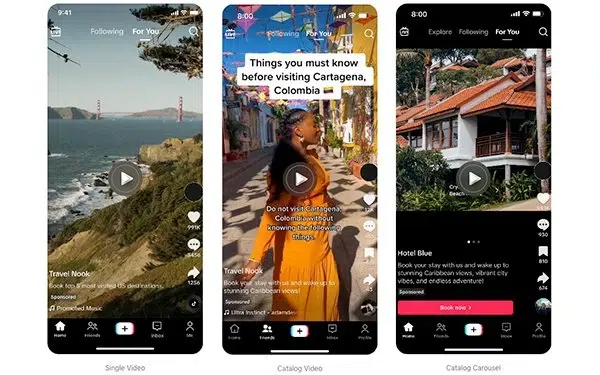
Social media platforms, particularly TikTok and Meta, dominate UA through short-form, highly engaging video content. These platforms excel at generating viral momentum and reaching massive, diverse audiences through advanced algorithmic targeting.
As a specialized TikTok Agency, Mega Digital highly recommends leveraging this channel, as demonstrated in our successful Alphabet Shooter: Survival FPS game campaign:
- Deployed Smart+ Campaigns: Expanded reach efficiently beyond restrictive default placements.
- Optimized Creatives: Developed specialized horizontal video templates to align perfectly with the gameplay aesthetics.
- Separated Testing & Scaling: Conducted multi-account testing to isolate creative trials from core scaling operations.
- Results Achieved: Successfully scaled the daily ad budget by 200–400% while maintaining highly stable ROAS.
Search Ads

These platforms capture high-intent users who are actively searching for specific game genres like “puzzle games” or “FPS shooters”.
Unlike social media interruption marketing, search ads rely on precise keyword matching and user queries, making them essential for capturing players at the exact moment they express a desire to download a new game. Consequently, this channel typically yields the highest LTV (Lifetime Value) users, albeit often at a premium CPI.
Gaming Ad Networks

These dedicated networks display your playable and video ads directly inside other mobile games. They are highly effective because the audience is already actively engaged in the mobile gaming ecosystem.
By utilizing advanced machine-learning bidding like App Event Optimization, these networks can seamlessly redirect players who enjoy similar mechanics right into your application, resulting in exceptional conversion rates and strong early retention.
User Acquisition Metrics You Must Track
To effectively measure campaign health and ensure profitability, you must constantly monitor four essential UA metrics:
- Cost Per Install (CPI): The total ad spend divided by the number of installs. This tells you how much it costs to acquire one player.
- Retention Rate (Day 1, Day 7, Day 30): The percentage of users who return to play your game after installing. High Day 1 retention indicates an engaging core loop.
- Lifetime Value (LTV): The total projected revenue a single player will generate during their time playing your game.
- Return on Ad Spend (ROAS): The ultimate metric. If your Day 7 ROAS is positive, it means your UA efforts are generating more money than they cost, signaling a green light to scale.
Strategic Advice: CPI is a vanity metric if analyzed in isolation. A high acquisition cost of $6.00 is perfectly acceptable, and highly profitable, if your predictive modeling shows that the player’s Lifetime Value (LTV) will be $12.00. Always prioritize ROAS over cheap, low-quality installs.
Current Mobile Game UA Benchmarks
To accurately assess campaign health, you must evaluate your metrics against specific regional and genre averages rather than broad industry numbers.
| Region | Game Genre | Average CPI | Day 1 Retention | Day 7 Retention | Day 30 Retention |
| North America (US & CA) | Hyper-casual | $0.70 – $0.90 | 25% – 28% | 7% – 9% | ~2% |
| Casual / Puzzle | $2.00 – $3.00 | 30% – 35% | 12% – 15% | 4% – 6% | |
| Mid-Core (RPG/Strategy) | $5.50 – $8.50 | 28% – 32% | 10% – 13% | 5% – 7% | |
| APAC (Asia-Pacific) | Hyper-casual | $0.30 – $0.50 | 22% – 26% | 6% – 8% | ~1.5% |
| Casual / Puzzle | $1.20 – $1.80 | 28% – 32% | 10% – 13% | 3% – 5% | |
| Mid-Core (RPG/Strategy) | $3.00 – $5.00 | 25% – 30% | 8% – 11% | 4% – 6% | |
| LATAM (Latin America) | Hyper-casual | $0.15 – $0.30 | 20% – 24% | 5% – 7% | ~1% |
| Casual / Puzzle | $0.50 – $0.90 | 26% – 30% | 8% – 10% | 2% – 4% | |
| Mid-Core (RPG/Strategy) | $1.20 – $2.20 | 24% – 28% | 7% – 9% | 3% – 5% |
Note: Global Day 1 retention averages have stabilized around 25-27% across all genres, highlighting the critical need for immediate in-game engagement.
With gaming CPIs rising by 30% YoY globally, the era of cheap installs is over. Success now requires a laser focus on LTV prediction and creative excellence.
Best practices & Strategies for Mobile Game UA
To maximize your return on ad spend (ROAS) in today’s algorithmic landscape, focus on four modern, actionable user acquisition strategies.
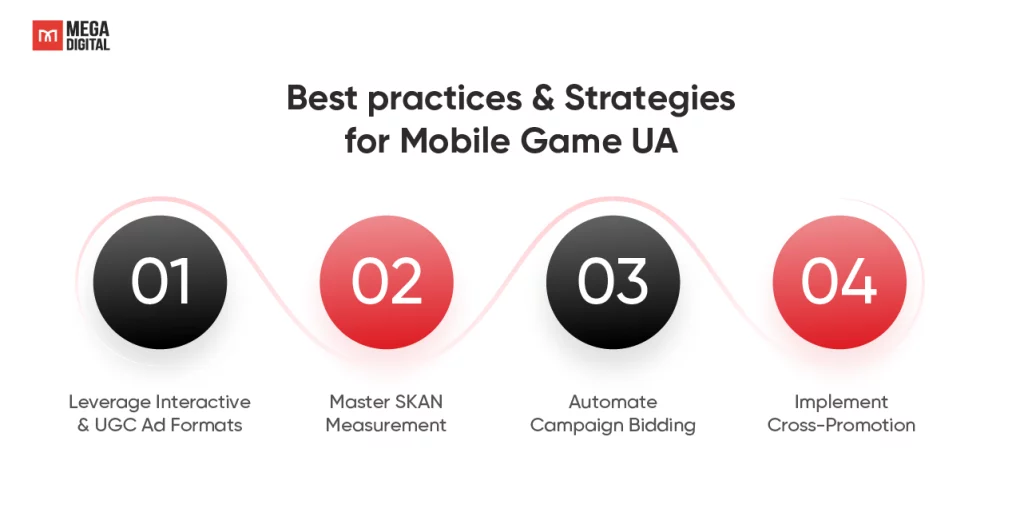
Leverage Interactive & UGC Ad Formats
Interactive Playable Ads and User-Generated Content (UGC) currently dominate conversion rates. They provide potential players with an authentic, hands-on preview of your core gameplay loop, feeling less like traditional advertising and more like entertainment.
To combat rapid ad fatigue on social platforms, relentless high-volume testing is essential. Top studios now leverage AI creative generation tools to quickly prototype fresh visual hooks and sustain long-term performance.
This exact high-volume approach was utilized to combat ad fatigue and revitalize ROAS in our campaign for Mini-games: Calm & Relax by Xgame Studio:
- Rapid Creative Testing: Produced and tested 20–30 new creative variations every week to prevent ad fatigue.
- Strategic Expansion: Maintained winning interactive concepts while constantly testing new visual hooks.
- Smart Bidding Integration: Combined high-volume creative testing with Smart+ tROAS campaigns to identify the most profitable users.
- Proven Results: Successfully improved the campaign’s overall ROAS by 10–20%, hitting the strict Day 7 KPI benchmarks.
Master SKAN Measurement
Mastering Apple’s SKAdNetwork (SKAN) measurement involves correctly configuring conversion values to track post-install events without relying on user-level IDFA data.
Since privacy regulations have completely changed the iOS landscape, developers must stop fearing SKAN and start embracing predictive LTV modeling. This involves analyzing early signals to forecast long-term revenue:
- Map Early Actions: Connect early in-game milestones (e.g., completing Level 3 or watching 5 rewarded ads within the first 24 hours) directly to SKAN conversion values.
- Predictive LTV Modeling: Use these early SKAN postbacks to feed your predictive models, allowing UA managers to accurately forecast the 30-day or 90-day Lifetime Value of a newly acquired cohort.
- Adjust Budgets Dynamically: Rely on these predictive insights to confidently adjust campaign budgets and scale winning creatives, even with restricted, anonymized data.
Automate Campaign Bidding
Automating campaign bidding utilizes machine learning algorithms provided by ad networks to dynamically adjust bids in real-time, targeting users most likely to achieve specific ROAS goals.
Manual bidding is obsolete in 2026. To ensure greater efficiency, developers should transition to automated frameworks:
- Adopt Advanced Strategies: Utilize App Event Optimization (AEO) or Value Optimization (VO) bidding strategies rather than basic install campaigns.
- Feed High-Quality Data: Supply the ad networks with rich, high-quality post-install data (like level completions or in-app purchases).
- Let the Algorithm Work: By doing so, the algorithms will automatically find players who are not just willing to install the game, but who are highly likely to monetize.
Implement Cross-Promotion
Implementing cross-promotion involves serving advertisements for your new mobile games directly inside your existing, successful titles to transfer your loyal user base at zero cost.
This strategy creates a self-sustaining ecosystem that insulates your studio from the volatile costs of external ad networks by following these principles:
- Leverage Existing Trust: For illustration, display interstitial ads for your newly launched word game to players who are already actively engaged in your hit puzzle game.
- Drive Phenomenal Conversions: Because these players already trust your brand and enjoy your specific game mechanics, the conversion rates are phenomenally high.
- Reduce Acquisition Costs: This zero-cost channel effectively lowers your overall blended CPI, giving you higher margins across your entire portfolio.
How to Build a UA Scaling Strategy
Building a UA scaling strategy involves identifying the most profitable combination of GEOs, ad creatives, and bids, and then aggressively increasing your ad budget without breaking the platform’s machine-learning algorithm.
Once your initial tests hit the target ROAS, the goal is to shift from cautious testing to rapid user acquisition. A prime example of this phased scaling approach is the successful campaign for the casual game TikTap Challenge by Xgame Studio:
- Strategic GEO Testing: Identified highly profitable Tier 2 and Tier 3 markets before scaling the budget.
- Creative Pipeline: Collaborated with TikTok One creators and maintained a high volume of fresh gameplay creatives to prevent ad fatigue.
- Phased Scaling: Systematically increased ad spend from just $100/day to $7,000–$10,000 per week using Smart+ tROAS bidding.
- Results Achieved: Exceeded the 40% Day-0 ROAS target (hitting 60–100%) and reached full campaign break-even by Day 4.
Scaling too fast on a single creative will lead to rapid ad fatigue and skyrocketing CPIs. The secret to sustainable scaling is a relentless pipeline of fresh, diverse ad creatives. – Mega Digital Ads Team.
FAQs about Mobile Game User Acquisition
No. You can begin a soft launch with a testing budget of just $2,000 to $5,000 per platform to gather initial metrics like CPI and Day-1 retention.
No. Always test on Android first in cheaper regions (Tier-2/Tier-3) to optimize the core game loop, then scale aggressively on iOS in Tier-1 markets for maximum revenue.
No. The app stores are heavily saturated. You must utilize paid UA to generate initial install volume, which in turn triggers organic store algorithms.
No. Manual bidding is obsolete. You must use automated machine-learning algorithms like App Event Optimization (AEO) to target high-value players efficiently.
Conclusion
Winning in the 2026 mobile gaming market requires moving beyond basic installs. A profitable UA strategy demands continuous creative testing, data-driven automation, and aggressive scaling across top channels like TikTok. If you are ready to elevate your mobile game’s success, partnering with an experienced agency like Mega Digital can provide the specialized ad accounts and strategic expertise needed to scale profitably.