

Switching a TikTok campaign to AEO often triggers an immediate CPI spike of 300 – 500%, creating a critical barrier to scaling profitable user acquisition. Solving this cost surge is essential when learning how to optimize AEO for mobile games without increasing CPI.
In this blog post, we break down a three-pillar optimization strategy tailored for TikTok Ads, covering Proxy Events, Native Creative IPM, and Micro-Bidding, to help you acquire high-value players while maintaining strict control over CPI.
Quick Summary:
- AEO campaigns naturally incur higher costs as advertisers compete for a limited pool of high-intent users rather than broad audiences.
- Shifting optimization to shallower proxy events provides the algorithm with more data signals to lower entry costs.
- High-performing native creatives significantly increase Installs Per Mille to discount the actual price paid in the auction.
- Incremental micro-bidding adjustments allow advertisers to find the lowest possible bid floor without resetting the learning phase.
Why AEO Naturally Increases CPI on TikTok
AEO increases CPI because the TikTok algorithm shifts bidding priority from install volume to action probability, forcing campaigns to compete in a high-intent, high-cost auction pool.
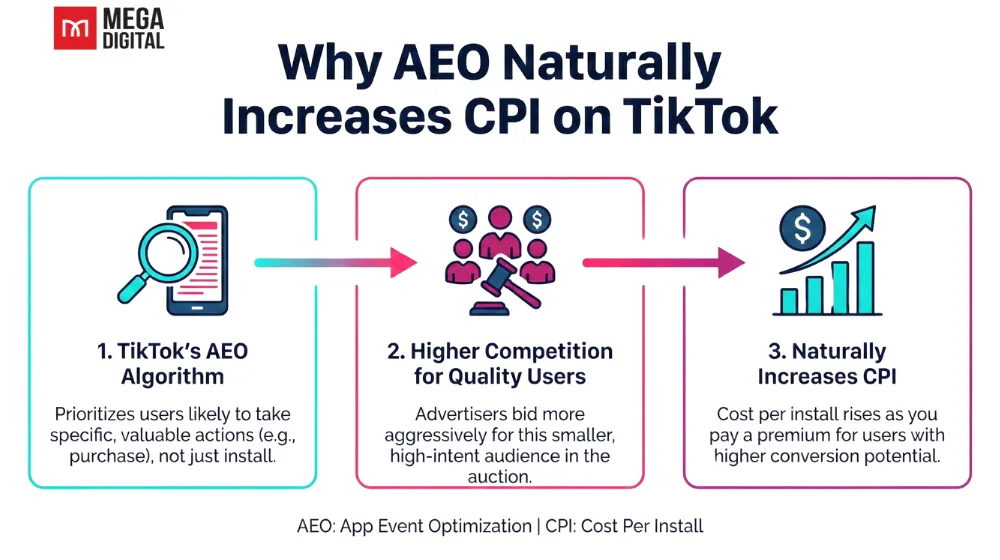
The mechanism behind this lies in the platform’s user segmentation. In standard App Install campaigns, TikTok targets a broad audience segment, often users who rapidly scroll and install apps but churn quickly. This inventory is abundant, resulting in low eCPM and low CPI.
Conversely, AEO targets specific user clusters with a history of post-install engagement. This audience is highly contested by advertisers across all verticals. Consequently, the eCPM to win an impression in their feed is significantly higher.
Since CPI is mathematically derived from CPM divided by conversion rate, a spike in competition (CPM) combined with a steady conversion rate inevitably leads to a higher CPI. Understanding this cost dynamic is the first step to mitigating it.
Strategies to Optimize AEO Without Increasing CPI
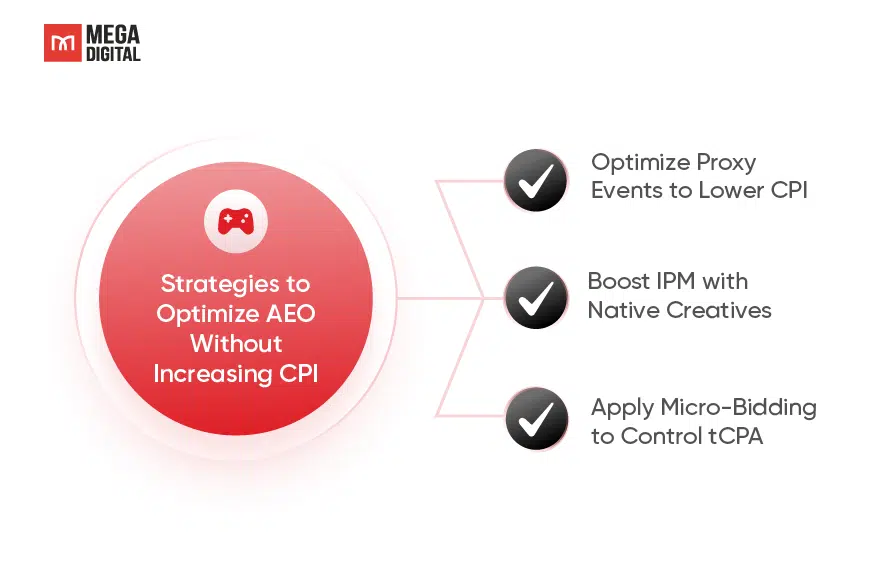
This below has three strategies to optimize AEO without increasing CPI that Mega Digital’s experts recommendation:
1. Optimize Proxy Events to Lower CPI
The most effective method to control CPI in TikTok AEO campaigns is shifting the optimization target from deep funnel events to Proxy Events. This approach prioritizes data density over direct value targeting to stabilize the algorithm.
When to Use Proxy Events
- Limited Budget or High CPI: When direct Purchase optimization yields a CPI that exceeds your target by >50%, making unit economics unsustainable.
- Cold Start Phase: When launching a new campaign that lacks the historical data (50+ weekly conversions) required for deep event optimization.
- iOS/SKAN Campaigns: On iOS, deep funnel data is often delayed or redacted due to privacy thresholds. Optimizing for proxy events that occur within the first 24 hours ensures conversion values are captured before the SKAN timer expires.
When NOT to Use Proxy Events
- High Volume Products: If your game already generates 50+ purchases per week per ad group at a profitable ROAS, switching to a proxy event is unnecessary and may degrade user quality.
- Low Correlation Scenarios: If the proxy event does not strongly predict monetization (e.g., “App Launch” users rarely convert to “Purchasers”), optimizing for it will waste the budget on non-paying users.
Common Mistakes
- The “Vanity Metric” Trap: Optimizing for an event simply because it is cheap, resulting in high install volume but zero ROAS because the event requires no real user commitment.
- Failure to Graduate: Sticking to Proxy Events indefinitely. Once the campaign scales and gathers sufficient purchase data, you should test switching back to Purchase AEO or Value Optimization to maximize efficiency.
Mega Digital Pro Tip: Proxy Events are a stepping stone, not a destination. Once your ad group stabilizes with ~50 weekly purchases, duplicate it and switch back to Purchase or ROAS optimization to unlock true scale.
How to Implement
To execute this strategy effectively, follow this data-driven correlation protocol (illustrated with a generic FPS Game logic):
- Analyze Correlation: Review internal data to identify an event that balances volume and quality. For instance, you might find that users who reach “Level 5” have a 60% probability of making a purchase, whereas “Tutorial Complete” users only have a 10% probability. “Level 5” represents the sweet spot, high correlation but typically 5x more volume than Purchase events.
- Configure the Trigger: Configure “Level 5 Complete” as the primary optimization event in your MMP and TikTok Pixel. This feeds the algorithm faster signals than waiting for purchases.
- Launch & Monitor: Launch the AEO campaign targeting this proxy. In many scenarios, this strategy can lower CPI by 30-40% compared to direct Purchase campaigns while maintaining a stable ROAS, allowing for earlier scaling in competitive markets.
2. Boost IPM with Native Creatives
Reducing CPI on TikTok requires increasing Installs Per Mille (IPM) via high-performing, native ad creatives. This mathematically forces the ad network to lower the actual cost per install required to win the auction.
When to Focus on Creative IPM
- High CPM Markets: In Tier 1 regions (US, UK) where media costs are naturally high, improving IPM is the only non-bid lever to lower CPI.
- Low CTR Performance: When your ads have a Click-Through Rate (CTR) below 0.8%, indicating that your “hook” is failing to grab attention, leading to an algorithm penalty.
- Scaling Fatigue: When a campaign that was previously performing well sees a sudden spike in CPI due to audience saturation.
When NOT to Rely Solely on Creative IPM
- Strict Brand Guidelines: If your IP holder prohibits the use of UGC-style, meme-based, or “lo-fi” content (common with major licensors), forcing you to use polished assets that naturally have lower IPM on TikTok.
- Technical Bugs: When high CPI is caused by tracking errors or deep-link failures, no amount of creative optimization will fix the cost.
Common Mistakes
- The “Resize” Trap: Simply resizing a 16:9 TV Commercial into a 9:16 vertical video. TikTok users instantly recognize this as “an ad” and scroll past, destroying your IPM.
- Misleading Gameplay: Using “fake playable” footage that drives huge click volume (High IPM) but results in massive churn immediately after install. This lowers CPI initially but destroys ROAS and eventually hurts your ad account quality score.
- Ignoring Audio: TikTok is a “sound-on” platform. Using generic stock music instead of trending audio or voiceovers reduces engagement significantly.
Mega Expert Insight: Native ads mean “platform-relevant”, not amateur. Follow the 3-Second Rule: Hook with emotion to grab attention, then immediately show gameplay to filter for relevancy. High CTR without intent is just wasted.
How to Implement
For our client Mini Games: Calm & Relax, faced with creative fatigue and declining performance in a saturated market, Mega Digital executed a Creative Volume Strategy:
- Massive Testing: Instead of relying on a few polished ads, we expanded production to test 20–30 new creative concepts weekly.
- Native Focus: We shifted focus to TikTok native placements using ASMR and UGC-style recordings. This aligned with the “Emotional Value” trend identified in our 2025 Outlook.
- Result: This high-velocity testing allowed us to find winning concepts faster, stabilizing the ROAS by 10–20% and maintaining consistent performance even as we scaled budgets between $500–$1,000 daily.
Looking ahead to 2026 trends, combining native creatives with playable ads and AI-driven personalization tools (as highlighted in TikTok’s Next 2026 Trend Report) can further amplify IPM, with reports indicating CPI reductions of up to 25-40% in mobile gaming UA campaigns.
3. Apply Micro-Bidding to Control tCPA
Setting tCPA (Target Cost Per Action) bids on TikTok requires a Micro-Bidding strategy: starting with a competitive bid to secure data, then incrementally reducing the target cost to find the lowest possible floor without resetting the learning phase.
When to Use Micro-Bidding
- Scaling Phase: When you have exited the learning phase and want to increase profit margins by trimming acquisition costs.
- Volatile Auctions: During peak seasons like Q4 when daily CPI fluctuates wildly, tCPA helps cap your risk exposure.
- Strict Budget Constraints: When cash flow is tight, and you cannot afford to pay $10 for a user even if their LTV is high.
When NOT to Use Micro-Bidding
- Learning Phase: During the first 3-5 days of a new ad group. Touching the bid here will reset the algorithm’s learning, leading to performance crashes.
- Volume-First Goals: If your primary goal is maximizing chart ranking (Top Free) regardless of cost, “Lowest Cost” or “Max Conversion” bidding strategies are more effective than tCPA.
Common Mistakes
- Suffocating the Bid: Launching with a tCPA bid equal to or lower than your desired goal. This usually results in zero impressions because the bid is too low to enter the premium AEO auction.
- Panic Adjustments: Changing bids by >20% or multiple times within 24 hours. This shocks the system and often triggers a complete delivery stop.
- Ignoring the Floor: Continually lowering the bid until delivery stops completely, then failing to raise it back up quickly enough to revive the ad group.
How to Implement
We applied a rigorous Phased Bidding Strategy for TikTap Challenge, a game facing intense competition and unstable ROAS.
- Phase 1 (Identification): We used bid testing to identify profitable GEOs (Tier 2 & Tier 3) and determine the “winning bid” that balanced volume with cost.
- Phase 2 (Optimization): By applying tROAS bidding and strictly managing bids based on LTV data, we achieved a D0 ROAS of 60–100% (exceeding the 40% target).
- Result: The game reached break-even by Day 4 (3 days faster than expected), allowing us to scale the budget from $100 to $10,000 per week while keeping acquisition costs within a profitable margin.
Mega Digital Pro Tip: Avoid “Panic Pausing” on single-day spikes. TikTok’s auction is volatile. Apply the 48-hour rule: only cut bids or pause if the negative trend persists for two consecutive days.
When to Stick With AEO vs Switch to VO
While the core strategies above focus on stabilizing CPI within AEO, understanding when to evolve toward Value Optimization (VO) can unlock further scale without sacrificing control.
| Feature | AEO (App Event Optimization) | VO (Value Optimization) |
| Primary Focus | Action Volume (e.g., Purchase) | Return on Ad Spend (ROAS) |
| CPI Stability | Moderate to High (Stable). Predictable costs. | Extremely Volatile. Can bid 10x higher for a “Whale”. |
| Ideal For | Broad payer base games or Hybrid IAA. | Hardcore/Mid-core games relying on high-LTV Whales. |
| Risk Level | Medium. Easier cash flow management. | High. Ignores CPI constraints to chase value. |
| Scaling Limit | Hits a ceiling when user quality saturates. | Unlocks higher scale (via Smart+) by finding users AEO ignores. |
Mega Digital Case Study: Scaling with Value-Based Bidding
While AEO controls costs, sometimes scaling requires moving to VO (tROAS). For Alphabet Shooter, Mega Digital transitioned from standard scaling to Smart+ Campaigns with tROAS bidding to overcome data limitations.
- The Challenge: The game struggled to scale beyond $100/day without ROAS dropping significantly.
- The Strategy: We implemented Smart+ campaigns to automate placement optimization and applied a D0 ROAS target to find high-quality users instantly.
- The Result: This approach allowed the game to scale daily spend by 200–400% while maintaining a stable ROAS, proving that advanced bidding strategies can unlock volume even when standard AEO hits a ceiling.
If the primary constraint is CPI or cash flow, AEO with Proxy Events is the optimal choice. Switch to VO/tROAS (like in the Alphabet Shooter case) when you need to maximize scale and have a sufficient budget cushion.
For more comprehensive insights on the strategic shift from IAA to IAP and future trends, you can refer to our full industry report below.
FAQs
No. Broad targeting is more efficient for AEO. Narrowing the audience limits the auction pool, forcing the algorithm to bid higher to win impressions, which unnecessarily drives up CPI.
Yes. They target different user segments. Install campaigns capture volume (cheap users), while AEO captures value (quality users). Running both creates a balanced funnel without significant cannibalization.
Yes. Drastic budget changes (>20%) shock the algorithm, triggering re-learning and temporary CPI spikes. Always scale budgets incrementally (10–20% every 24 hours) to maintain stability.
Conclusion
Mastering AEO optimization on TikTok is not about sacrificing volume for quality, but engineering efficiency. By shifting to data-dense Proxy Events, deploying High-IPM Native Creatives, and executing disciplined Micro-Bidding, you can acquire high-value players without the “quality tax” of inflated CPIs. Contact Mega Digital, a leading TikTok Partner, to build your scalable AEO strategy today.To complete your user acquisition toolkit, don’t miss our essential guides on maximizing ROAS on TikTok, lowering CPI with ASO, and calculating LTV accurately.