

Many UA managers face a critical issue where Return on Ad Spend remains stagnant or declines despite achieving a low Cost Per Install. This disconnect occurs because advertising algorithms often prioritize cheap traffic over high-value users, masking poor profitability with efficient vanity metrics.
In this blog post, we break down the core mechanisms behind ROAS stagnation, how to improve ROAS without raising UA costs, and a step-by-step framework to sustain profitability in the scaling phase.
Quick Summary:
- Sustaining profitability requires shifting your strategy from acquiring cheap installs to targeting high-value user segments.
- Algorithmic misalignment and creative fatigue are the primary drivers causing ROAS to drop despite stable costs.
- Optimizing the post-click funnel ensures high-intent clicks convert into engaged players with substantial lifetime value.
- A proactive creative rotation strategy maintains user engagement and prevents performance degradation in saturated markets.
- Smart bidding strategies leverage machine learning to predict user value and outperform manual tactics in real time.
Why Mobile Game ROAS Drops Even Without Higher UA Costs
The decline in mobile game ROAS, even when User Acquisition (UA) costs remain stable, stems from a degradation in user quality driven by three primary factors supported by recent 2025-2026 industry data:
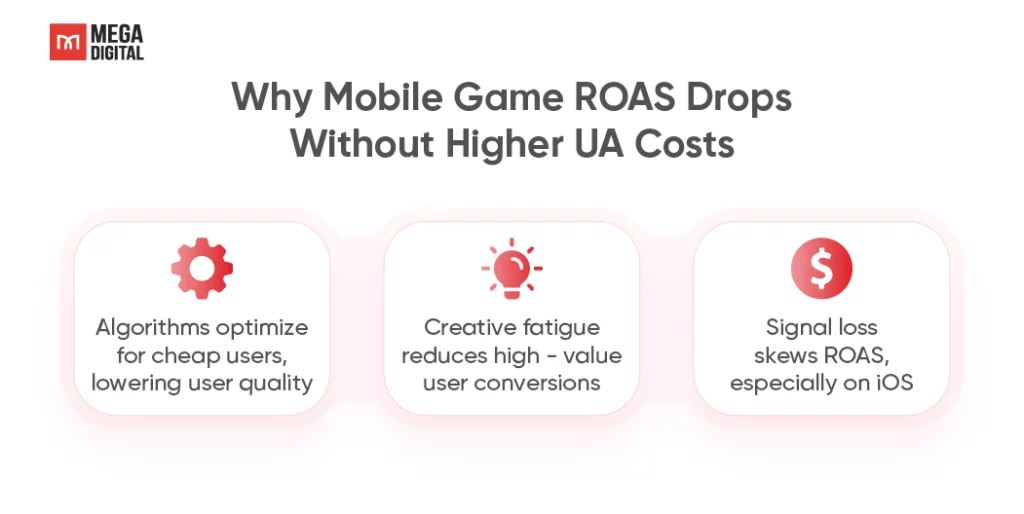
- Algorithmic Misalignment: Ad platforms prioritize low-cost conversions to meet CPI targets at the expense of LTV. According to AppsFlyer’s 2025 Data Trends Report, while Mid-core CPIs moderated, total ad spend in this category actually dropped by 21%. This indicates algorithms often maximize cheap inventory that fails to monetize, forcing managers to pull back spend rather than waste it on low-quality users.
- Creative Fatigue & Format Shift: Stale assets kill ROAS faster than bad targeting. Insightrackr’s 2025 UA Landscape Report reveals a massive shift where Video + Playable ad combinations now outnumber image + video formats by 10.9x. This proves static assets are insufficient as users demand interactivity to convert at a high value.
- Platform Disparity (Signal Loss): Privacy frameworks continue to skew ROAS visibility. Udonis’s 2025 Mid-Core Games Market Report highlights that Android Mid-core games achieve nearly double the Day-7 ROAS (6.1%) compared to iOS counterparts. The lack of granular attribution on iOS causes algorithms to optimize blindly towards users who look cheap but generate zero ROAS.
Core Strategies to Improve ROAS Without Increasing UA Costs
This below has five strategies to improve ROAS without increasing UA costs that Mega Digital’s experts recommendation:
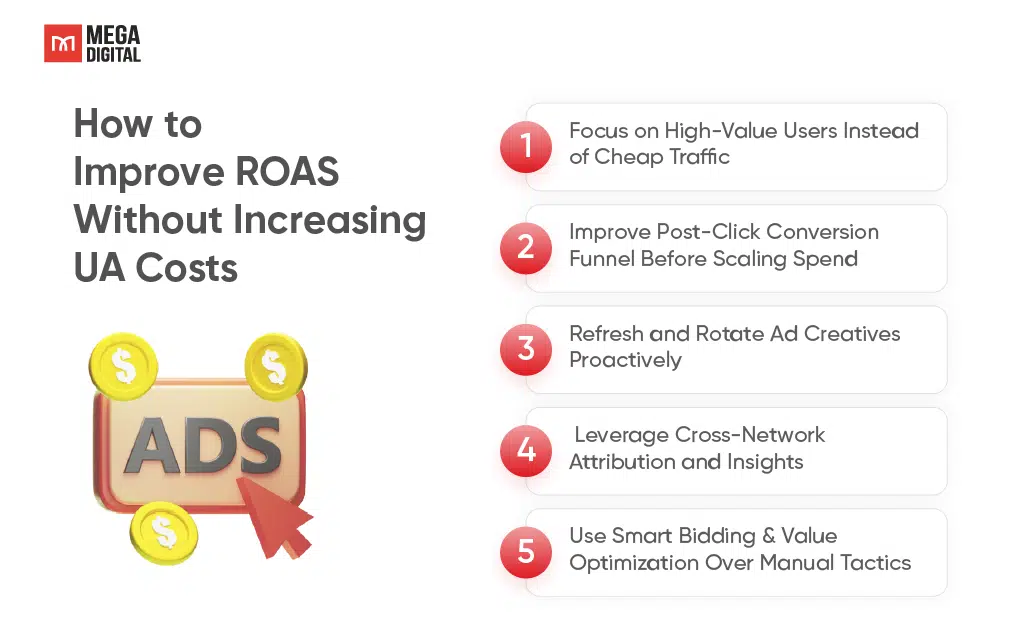
1. Focus on High-Value Users Instead of Cheap Traffic
Shifting focus to high-value users means prioritizing high spenders and moderate spenders over non-spenders. This strategy requires specific conditions to work effectively without killing your volume.
When to Apply This Strategy
- Shift to value-based targeting only after your campaign has exited the initial learning phase.
- Ensure you have accrued sufficient data, typically exceeding 50 purchase events per week.
- Apply this when observing stable CPIs but a declining LTV curve, indicating saturation of the cheap audience.
- Use this approach when you need to qualify users more strictly rather than just acquiring volume.
When NOT to Apply
- Do not force this strategy during a soft launch or the first week of a new account due to lack of historical data.
- The algorithm lacks the necessary signal to identify high-value users without a conversion history.
- Targeting Purchase events too early results in skyrocketing CPIs and zero delivery.
- Rely on broader targeting by optimizing for Installs or early proxy events like Tutorial Complete to feed the pixel initially.
Common Mistakes
- Narrowing the audience too aggressively before the budget allows is a frequent error limiting scalability.
- Targeting only the top 1% of spenders with a small budget often leads to audience exhaustion.
- Ignoring users who generate revenue through ads is a critical mistake in hybrid-monetization games.
- Targeting only IAP purchasers causes you to miss out on users who generate significant revenue through ads.
Specific Execution
In the Alphabet Shooter: Rocket of Mega Digital, the team tackled the challenge of volatile market costs which made profitable scaling difficult.
- The Pivot: Mega Digital shifted focus to ROAS-optimized campaigns on TikTok and utilized rigorous A/B testing for creatives to identify and target high-value user segments.
- The Result: The campaign achieved a ROAS exceeds KPI by 10 – 20% and scale the budget by 200 – 400% while maintaining stable ROAS, allowing the studio to confidently triple their daily ad budget while ensuring returns stabilized by Day 14.
2. Improve Post-Click Conversion Funnel Before Scaling Spend
Improving the post-click conversion funnel involves optimizing every touchpoint after the ad interaction to ensure that high-intent clicks turn into high-LTV users.
When to Apply This Strategy
- Apply immediately when observing a high Click-Through Rate but a low Install Rate or low Day-1 Retention.
- This discrepancy signals a gap in expectations where the store page fails to deliver on the ad’s promise.
When NOT to Apply
- Do not prioritize deep funnel optimization like late-game mechanics if you are still testing Product-Market Fit.
- Focus on validating the core loop rather than micro-optimizing store page colors in the earliest stages.
Common Mistakes
- Using misleading creative such as fake gameplay ads drives cheap clicks but results in angry users who churn immediately.
- This practice destroys organic ranking and hurts long-term ROAS.
- Neglecting the First-Time User Experience wastes UA spend if users get stuck in a tutorial before seeing an ad or shop offer.
Specific Execution
- Ensure visual alignment by matching the key selling points of your top-performing creative with the first 3 screenshots on the App Store.
- Your store icon and first screenshot must showcase combat rather than a menu screen if your winning ad emphasizes PVP Battles.
- Streamline the tutorial to reach the core value proposition within the first 3 minutes.
- Offering a New Player Starter Pack within the first session triggers an early conversion event to boost Day-0 ROAS.
3. Refresh and Rotate Ad Creatives Proactively
Refreshing and rotating ad creatives proactively is the systematic process of introducing new visual concepts to combat ad fatigue and maintain high engagement rates.
When to Apply This Strategy
- Start rotating creatives the moment you see CTR dip below your historical benchmark or when CPM starts rising.
- This typically happens 1-2 weeks into scaling a winning ad and is essential for maintaining performance volume.
When NOT to Apply
- Do not change successful elements unnecessarily or pause a creative performing exceptionally well at scale just for rotation.
- Let the creative run until performance naturally degrades while testing new concepts in a separate ad group.
Common Mistakes
- Refreshing creative assets does not mean simply changing a button color.
- Testing minor variations that don’t change the user’s psychological trigger is a common mistake.
- You must test new hooks in the first 3 seconds or entirely new gameplay angles.
- Avoiding testing too many variables at once ensures you know exactly what drove the performance change.
Mega Digital Pro Tip: Avoid starting from scratch every time. Instead of creating entirely new ads, use modular testing, keep the winning gameplay footage but swap the first 3-second intro. This simple tweak can yield a 20-30% performance uplift with minimal production effort while keeping ad relevance high.
Specific Execution
In Mega Digital’s campaign for Mini Games: Calm & Relax, the team faced rapid creative fatigue due to the casual nature of the game and a saturated market.
- The Pivot: The team executed a strategy of producing 20–30 new creatives weekly, testing fresh concepts alongside winning variations to combat saturation.
- The Expansion: They expanded testing beyond Pangle to TikTok placements using Smart+ campaigns, allowing the algorithm to find efficient conversions in new inventory pools.
- The Result: This rigorous rotation and expansion strategy improved ROAS by 10–20%, effectively restoring the game’s Day-7 profitability benchmarks despite the downtrend.
4. Leverage Cross-Network Attribution and Insights
Leveraging cross-network attribution involves using Mobile Measurement Partners (MMPs) to track the full user journey and allocate budget to channels that drive incremental lift.
When to Apply This Strategy
- This strategy is critical when running UA on multiple channels simultaneously like TikTok, Google, and Facebook.
- It is essential when your game has a Hybrid Monetization model combining IAP and Ads.
- You need a holistic view to understand true ROI across all platforms.
When NOT to Apply
- Cross-network attribution tools may add unnecessary complexity and cost if running on a single channel with a small budget.
- Stick to platform-specific data until you diversify your mix.
Common Mistakes
- Relying solely on Last-Click attribution creates a fatal error that undervalues discovery channels like TikTok.
- Ignoring Ad Revenue data causes you to undervalue users who watch ads but don’t buy IAP.
- You must pass this data back to your UA networks to optimize effectively.
Specific Execution
- Integrate your Mediation Platform such as MAX or IronSource with your MMP like AppsFlyer or Adjust to track Ad Revenue at the user level.
- Configure your MMP to send a Total Revenue postback including IAP and Ad Revenue to your ad networks.
- This allows TikTok or Google to bid higher for users who watch many ads per day.
- This tactic unlocks a segment of high-ROAS users that competitors optimizing only for IAP are ignoring.
5. Use Smart Bidding & Value Optimization Over Manual Tactics
Using Smart Bidding and Value Optimization (VO) allows machine learning algorithms to predict user value and adjust bids in real-time, outperforming manual adjustments.
When to Apply This Strategy
- Switch to Smart Bidding like tROAS or VO once your campaign has exited the learning phase.
- Achieve a stable volume of conversion events, typically more than 50 purchase events per week.
- This approach is the standard for the scaling phase.
When NOT to Apply
- Do not use Smart Bidding during the initial data gathering phase.
- The algorithm cannot predict value effectively if a pixel has no data history.
- Using tROAS on Day 1 often leads to zero spend because the system is too risk-averse without data signals.
Common Mistakes
- Setting an unrealistic ROAS target too early is a common mistake.
- Setting a tROAS target of 50% when your historical ROAS is 10% will simply kill delivery.
- Start with a target slightly below your actual performance to encourage the algorithm to spend before gradually inching it up.
Mega Digital Pro Tip: Patience is profit. When scaling budget on a high-performing campaign, follow the 20% rule, never increase your daily budget or bid target by more than 20% in a 24-hour window. Exceeding this threshold often resets the algorithm’s learning phase, causing CPI to spike and ROAS to destabilize for days.
Specific Execution
For the viral hit TikTap Challenge, manual bidding failed to capture viral spikes efficiently.
- The Pivot: Mega Digital implemented TikTok Smart+ campaigns utilizing tROAS bidding instead of manual tactics to navigate the volatile market.
- The Logic: This automated approach leveraged machine learning to identify high-value users and optimize bids dynamically across different auction pressures.
- The Result: The campaign achieved a Day-0 ROAS of 60–100%, surpassing the 40% target, and reached the break-even point by Day 4, successfully scaling weekly spend to $10,000.
Contextual Factors That Affect ROAS Interpretation
Contextual factors affect ROAS interpretation including game genre, seasonality, operating system (OS), and campaign maturity.
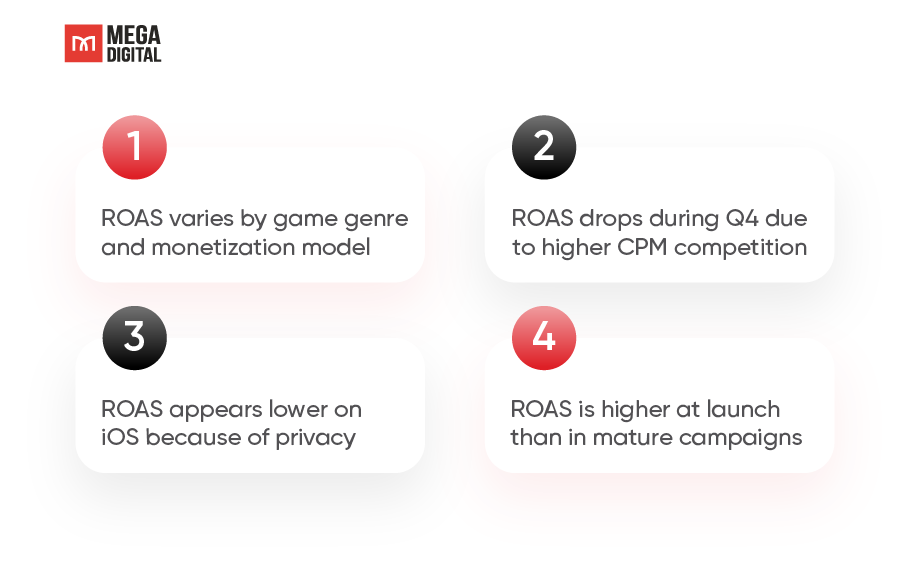
- Genre: Industry benchmarks from Udonis suggest that a Hyper-casual game might aim for a Day-7 ROAS of 50%, relying heavily on ad revenue turnover, while a Hardcore Strategy game might accept a Day-7 ROAS of 10%, knowing the LTV curve extends over 2 years.
- Seasonality: During Q4, CPMs rise across the board due to e-commerce competition causing ROAS to drop simply because media is more expensive.
- OS: iOS campaigns often show lower reported ROAS due to SKAdNetwork privacy limitations masking data compared to Android’s accurate tracking.
- Maturity: A launch campaign often has better blended ROAS due to high organic lift compared to a mature campaign.
Step-by-Step ROAS Optimization Framework for Mobile Games
The Step-by-Step ROAS Optimization Framework consists of three phases: Audit, Stabilization, and Scaling.
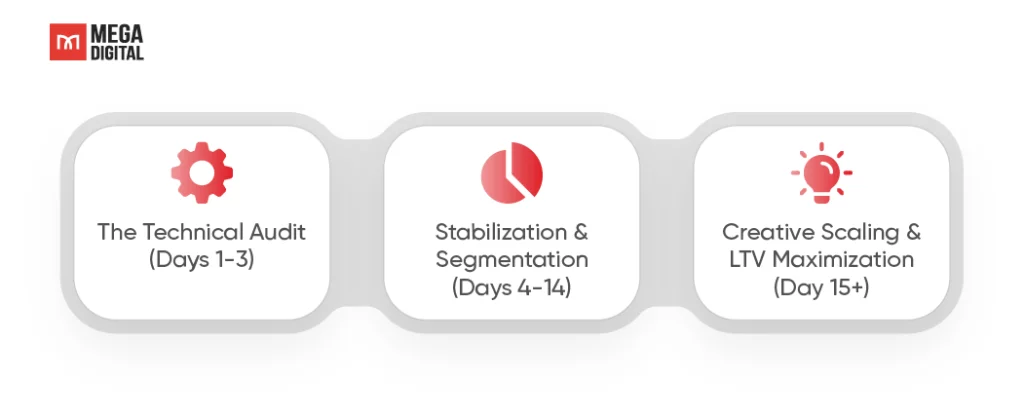
Phase 1: The Technical Audit (Days 1-3)
Before changing any bids, ensure your data is clean.
- Verify MMP Integration: Are all purchase events and ad revenue events passing back to the ad network correctly?
- Check Fraud Rates: Use fraud protection tools to ensure you aren’t paying for bot installs (which have 0 ROAS).
- Analyze Cohorts: Identify which specific creatives or ad groups have the highest Day-7 Retention.
Phase 2: Stabilization & Segmentation (Days 4-14)
Shift the budget away from underperforming assets to high-performing ones.
- Pause Low-ROAS Creatives: Pause ads with high spend but low ROAS below your breakeven threshold.
- Audience Refinement: Exclude Past Installers to avoid wasting money on retargeting users who already churned.
- Bid Strategy Shift: If you have enough data, switch from App Event Optimization (AEO) to Target ROAS (tROAS).
Phase 3: Creative Scaling & LTV Maximization (Day 15+)
Expand without lowering the bar.
- Creative Iteration: Take the winning concept from Phase 2 and produce 5 variations with different hooks.
- Lookalike Expansion: Create LAL audiences based on your top 5% of spenders.
- LiveOps Alignment: Coordinate UA pushes with in-game events like Weekend XP Boost to artificially inflate LTV for acquired users.
FAQs
You can improve ROAS without increasing your budget by reallocating spend from underperforming ad sets to those with higher LTV, narrowing your targeting to exclude low-quality users, and optimizing your creatives to improve conversion rates, getting more value from the same impressions.
Yes, targeting high-LTV users is the most effective way to improve ROAS. Although the initial Cost Per Install (CPI) for these users is often higher, their long-term spending behavior significantly outweighs the acquisition cost, resulting in a healthier profit margin compared to cheap, low-quality traffic.
A creative refresh should not hurt long-term performance, though a temporary volatility is normal as the algorithm enters a “learning phase.” To minimize risk, test new creatives in a separate ad group or campaign before rolling them out to your primary scaling campaigns.
You should reassign spend based on ROAS changes on a weekly basis rather than daily. Daily metrics can be volatile due to reporting delays or natural user behavior variances; a 7-day rolling window provides a more accurate trend for making budget decisions.
>>> Read more: ROAS Mobile Games: Calculation, LTV & UA Strategies for Developers
Conclusion
Improving ROAS isn’t about spending more; it’s about spending smarter by prioritizing high-value users, optimizing creative rotation, and leveraging smart bidding. Shift your focus from cheap installs to quality players to break the low-profitability cycle.
With extensive practical experience and a seasoned team of experts, Mega Digital is ready to help you unlock profitable growth and dominate the charts. Contact us today to transform your game’s performance!