

Running tiktok ads for hyper casual games often feels like a trap: you find a winning creative with a $0.20 CPI, double the budget, and suddenly costs spike to $0.50 without a proportional lift in ROAS. This volatility destroys the thin margins that the IAA model relies on. In this post blog, we break down the specific mechanisms causing these price hikes and the step-by-step strategies to scale your ad spend while keeping unit economics profitable.
Quick Summary:
- Scaling failures on TikTok often result from auction overlap and broad audience exhaustion rather than poor creative quality.
- Horizontal scaling succeeds by leveraging Smart+ automation to test new creative concepts and placements without manual duplication.
- Vertical scaling requires shifting from manual bid controls to tROAS strategies that prioritize user value over cheap installs.
- Timing is critical because scaling before exiting the learning phase triggers algorithm resets that waste budget.
Why Scaling Often Spikes CPI on TikTok
Scaling often spikes CPI on TikTok due to Auction Overlap and the algorithm’s shift from high-intent audiences to broader inventory to fulfill aggressive budget demands.
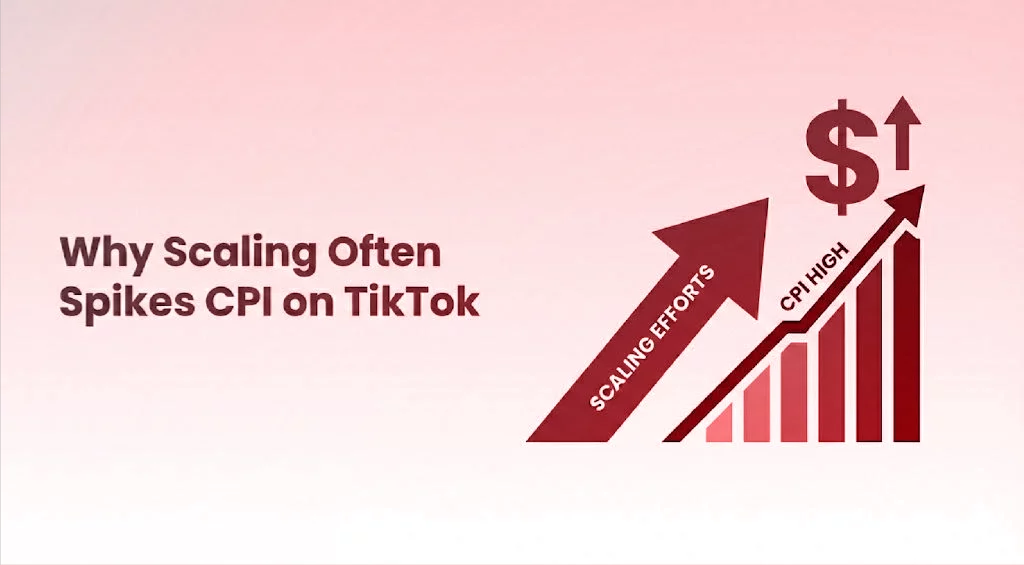
To control costs, advertisers must understand the underlying mechanisms causing inefficiencies. When scaling aggressively, either by duplicating ad groups or significantly raising budgets, the TikTok algorithm prioritizes spending volume over unit efficiency.
The Mechanics of Auction Overlap
In the TikTok Ads ecosystem, Auction Overlap occurs when multiple ad groups from the same account target similar audiences and compete against each other in the same auction. This internal competition artificially inflates the bid required to win impressions.
- The Scenario: An advertiser duplicates a high-performing ad group multiple times to scale volume.
- The Result: Instead of reaching unique users, these ad groups compete for the same pool of accessible users. The floor price rises, causing an immediate spike in CPI.

The Broad Audience Expansion
Hyper-casual games rely on broad targeting. When daily spend is low ($50-$100), TikTok’s algorithm efficiently selects users most likely to install within that budget cap. However, as spend scales to $500 or $1,000 per day, the algorithm exhausts the most relevant audience segment.
- Expansion Cost: To fulfill the increased budget, the system must expand delivery to users with lower conversion probabilities (lower CTR) or higher competition (higher CPM).
- Efficiency Drop: As relevance scores decrease, the system charges more per impression to maintain delivery pace, directly impacting CPI.
Key Strategies for Scaling without High CPI
This below has strategies for scaling tiktok ads for hyper-casual games that Mega Digital’s experts recommendation:
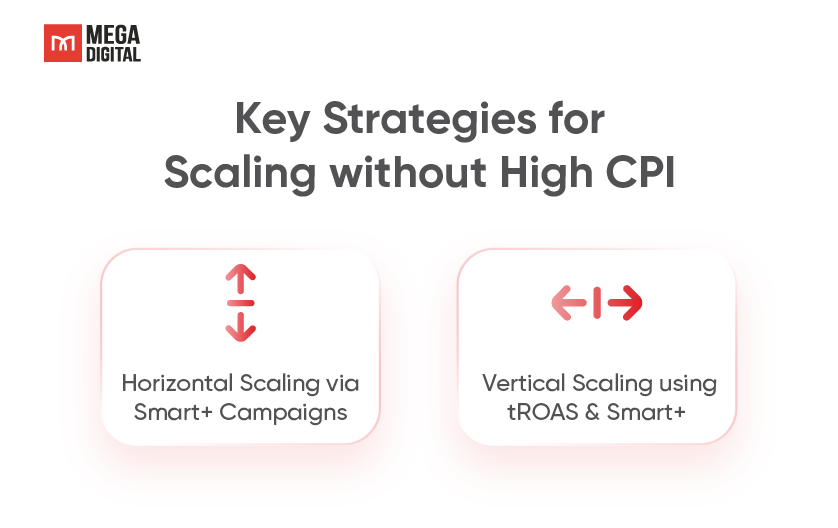
Horizontal Scaling via Smart+ Campaigns
Horizontal scaling focuses on expanding reach through automation and creative diversity rather than just bid pressure. This strategy requires shifting from manual tinkering to a system driven by creative volume and machine learning.
When to Apply
- Need for Placement Expansion: You want to access Pangle or broader inventory but lack the manual data to do it efficiently.
- High Creative Output: Your team has the capacity to produce 20 – 30 new creative concepts per week.
- Broad Targeting Goals: You aim to discover new user pockets outside of your current manual lookalikes.
When to Avoid
- Limited Creative Resources: If you can only produce 1-2 videos a week, Smart+ campaigns will exhaust them quickly, leading to fatigue and high frequency.
- Strict Manual Controls: If you require absolute granular control over every bid and placement site (though Smart+ offers efficiency, it reduces manual levers).
Common Mistakes
- Manual Duplication: “Spamming” or duplicating ad groups manually creates Auction Overlap. Smart+ avoids this by automating the distribution.
- Starving the Algorithm: Launching Smart+ without enough creative breadth limits the system’s ability to optimize, forcing it to bid higher for the same few users.
Expert Advice: True horizontal scaling requires conceptual variety, not just visual tweaks. Rotating the same gameplay footage with different music is not “new creative” to the algorithm, it will still fatigue quickly.
Specific Execution
For our client Alphabet Shooter, Mega Digital implemented a structured automation workflow:
- Smart+ Deployment: We replaced manual ad group duplication with TikTok’s Smart+ campaigns. This allowed the system to automatically test placement and audience combinations far more efficiently than human management.
- Creative Templating: To feed the Smart+ system, we built a horizontal video template that allowed us to churn out high volumes of assets. With the latest Smart+ upgrades (Q1 2026), you can now leverage Creative for Smart+ with Auto-select. This feature uses AI to automatically scan and recommend high-performing creatives from your existing library and TikTok One creator content, significantly speeding up scaling without the manual grind.
- Multi-Account Strategy: We used a separate Testing Account for aggressive creative testing and moved only winners to the Scaling Account, where Smart+ managed the budget with a flexible ROAS target (allowing 10-20% fluctuation).
Result: This approach allowed daily ad budgets to increase by 200 – 400% while maintaining stable ROAS.
Vertical Scaling using tROAS & Smart+
Vertical scaling involves increasing the budget on winning campaigns. Instead of focusing on cheap installs (which often leads to low quality), the modern approach uses tROAS (Target Return on Ad Spend) combined with Smart+ to maximize value.
This strategy is validated by global publishers like Voodoo, where Smart+ combined with value-based optimization helped achieve +12% Day-1 ROAS and +10% Day-7 ROAS.
When to Apply
- Established LTV Data: You know exactly what a user is worth on Day 0 vs Day 7, allowing you to set a realistic ROAS target.
- High Volume Needs: You need to spend substantial budgets ($500-$1,000+ daily) without micromanaging individual bids.
- Pixel Maturity: Your ad account has recorded at least 500+ conversion events, giving the algorithm enough data to identify high-value users.
When to Avoid
- Fresh Accounts: Without historical purchase or ad revenue data, the tROAS algorithm has no baseline to optimize against.
- Unrealistic KPIs: Setting a 100% Day-0 ROAS target when your game historically achieves 40% will cause the campaign to stop delivering entirely.
Common Mistakes
- Suffocating the Bid: Setting the tROAS target too high (e.g., aiming for 80% when reality is 50%) forces the algorithm to bid too conservatively, killing volume.
- Panic Pausing: Stopping a Smart+ campaign during its “learning” fluctuation phase. The system needs room to test different value segments.
Mega Digital Pro Tip: When vertical scaling with tROAS, avoid doubling budgets overnight. A safe scaling cadence is increasing the daily budget by 30 – 50% every 48 hours. This keeps the ad group within the stability zone while aggressively pushing volume.
Specific Execution
In the TikTap Challenge case study, XGame Studio faced volatile performance when scaling. Mega Digital shifted their strategy from rigid manual controls to value-based automation:
- tROAS Implementation: We switched the bid strategy to tROAS with a Day-0 target of 40% (based on historical data). Target ROAS within Smart+ now offers enhanced controls for Day-0 or Day-7 optimization. This partial automation helps balance volume with user quality, a critical factor as the industry shifts toward hybrid monetization (IAA + IAP) in 2026.
- GEO Expansion: We utilized Smart+ to automatically test and expand into Tier 2 & Tier 3 markets. The algorithm identified profitable pockets in these regions that manual targeting had missed.
- Scaling Protocol: Once Day-0 ROAS stabilized at 60-100% (exceeding the target), we scaled budgets from $100 to $7,000–$10,000 per week.
Result: The game achieved break-even by Day 4 (3 days faster than expected) and significantly increased retention rates.
The Right Timing to Scale TikTok Ads Without Spiking CPI
Scalability should only be attempted when the ad group has successfully exited the learning phase (50+ conversions) and maintained a stable Day-0 ROAS for at least 48 hours.
Premature scaling is a primary cause of campaign inefficiency. A single day of low CPI does not indicate readiness for significant budget increases; statistical significance is required to ensure performance sustainability.
In the 2026 landscape, with longer payback periods due to the hybrid monetization shift, prioritize predictive LTV models (if available) to set realistic tROAS targets, rather than relying solely on generic Day-0 benchmarks.
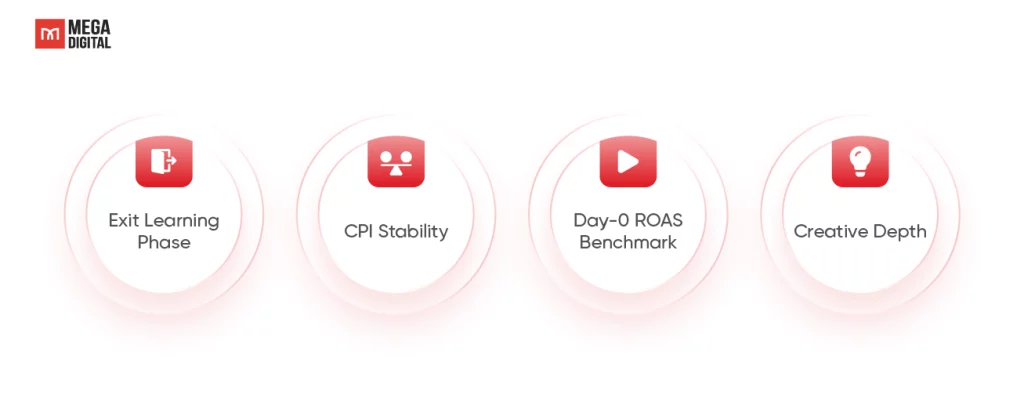
Before increasing budgets or duplicating ad groups, verify the following criteria:
- Exit Learning Phase: The ad group must have generated at least 50 conversion events (installs) within 7 days. For Hyper-Casual, volume accumulates fast, so ensure this stability holds for at least 2 consecutive days.
- CPI Stability: Cost Per Install should not fluctuate by more than 15% over the last 48-72 hours. In the IAA model, even a $0.05 increase in CPI can wipe out profit margins.
- Day-0 ROAS Benchmark: For IAA-heavy games, Day-0 ROAS is the most critical early signal. Ensure Day-0 ROAS consistently hits your breakeven threshold (typically 40-50% to break even by Day 7-14) before scaling.
- Creative Depth: Maintain at least 3-5 winning creatives in rotation. Hyper-Casual creatives fatigue extremely fast; scaling with only 1 winner is risky as performance can degrade within hours of a budget hike.
Mega Digital Pro Tip: Timing is a metric in itself. Scaling 24 hours too early can trigger a learning phase reset that wastes 3 days of budget. Patience pays.
FAQs
Yes, utilize ACO to automatically combat fatigue. It rotates combinations of videos and text to refresh user experience, extending ad lifespan and maintaining a stable CPI without manual intervention.
Yes, leverage the new “Creative for Smart+ with Auto-select”. It uses AI to recommend top-performing assets from your library and allows pre-launch preview combinations, significantly speeding up scaling while reducing manual workload.
Yes, Broad Targeting is superior for scaling. Unlike Lookalikes which have limited pools and higher CPMs, broad targeting gives TikTok’s sophisticated algorithm the freedom to find the cheapest conversions across its massive user base, essential for high-volume HC games.
Pause and revert immediately. If CPI spikes >30% for more than 24 hours, revert to the previous budget level. This typically signals a learning phase reset; wait for performance to stabilize before attempting a smaller incremental increase (10-15%).
>>> Read more: Scaling TikTok Ads for Puzzle Games: Testing Visual Hooks to Boost Low CTR
Conclusion
Scaling TikTok ads for hyper-casual games boils down to efficiency over volume. By leveraging Smart+ for horizontal reach and tROAS for vertical stability, you can scale spend without sacrificing margins. As 2026 pushes towards AI-driven automation, the winners will be those who balance creative depth with algorithmic discipline.
Ready to scale profitably? Partner with Mega Digital, TikTok Performance Agency of the Year 2025, to optimize your campaigns today. To further refine your strategy, don’t miss our essential guides on maximizing ROAS on TikTok, lowering CPI, and optimizing AEO campaigns.