

Understanding LTV Mobile Games is the key to sustainable app growth. Lifetime Value (LTV) measures the total revenue a single user generates throughout their entire lifecycle in your app, serving as the definitive metric for profitability and budget planning.
In this blog post, Mega Digital breaks down LTV Mobile Games, the calculation formula, and shares actionable strategies to maximize user value.
Quick Summary:
- Lifetime Value measures the total revenue a user generates and acts as the maximum bid ceiling for acquisition campaigns.
- Accurate LTV data empowers developers to allocate budgets efficiently and forecast revenue with high precision.
- Predictive calculation methods allow marketers to optimize ad spend based on early user behavior signals.
- Retention rates and monetization stability serve as the primary drivers for increasing long-term user value.
- Hybrid monetization models are currently helping developers exceed standard industry benchmarks across various genres.
- Mega Digital recommends focusing on value-based bidding and truthful creatives to maximize overall profitability.
What Is LTV in Mobile Games?
In mobile gaming, Lifetime Value (LTV) defines the total revenue a single user generates throughout their entire journey with your app, from the first install to the final stop playing. It is not just a historical record of sales, it is a predictive metric that forecasts the future value of your players.
From a Performance Marketing perspective, LTV acts as your “Bid Ceiling”. It dictates exactly how much budget you can allocate to User Acquisition (UA) campaigns while ensuring every dollar spent yields a profit.

Example:
If predictive analysis determines that a user’s LTV is $5.00, this sets our absolute upper limit for acquisition costs. It means you can technically spend up to $4.99 to acquire that user (CPI) and still be profitable. However, strategies typically aim for a CPI significantly lower (e.g., $1.50) to ensure a healthy ROAS and cover operational costs.
Why LTV Mobile Games Matters?
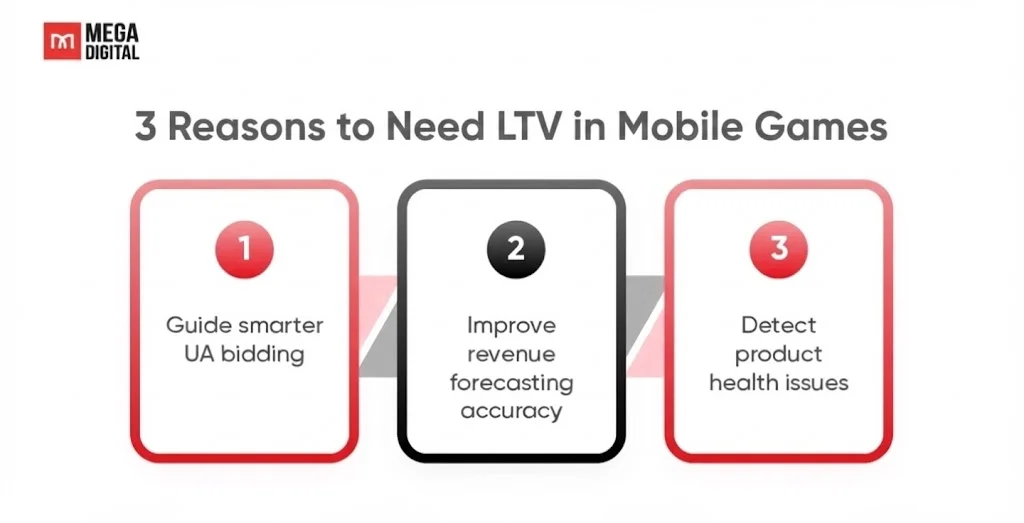
Lifetime Value is important for Mobile Games and Performance Marketing. Here are some reasons why LTV in Mobile Apps matters:
- UA Efficiency & Bidding: You cannot bid intelligently on ads without knowing your LTV. Your Max Bid should always be calculated based on your LTV targets (e.g., Max Bid = LTV * Target ROAS). If you know a “Whale” is worth $100, you can confidently bid $20 to acquire them on channels like TikTok or Google Ads.
- Forecasting: LTV helps predict cash flow. By analyzing cohort behaviors, studios can estimate revenue months in advance, allowing for better resource planning.
- Product Health: A dropping LTV indicates issues with retention or monetization mechanics, acting as an early warning system for game designers.
How to Calculate LTV for Mobile Apps?
The method to calculate LTV for mobile apps involves combining three key variables: Monetization (ARPU), Retention, and Virality. However, successful UA campaigns require distinguishing between Historical LTV and Predictive LTV.
1. Standard Formula (Historical)
The most standard formula used by top publishers is:
LTV = ARPU * Average User Lifespan
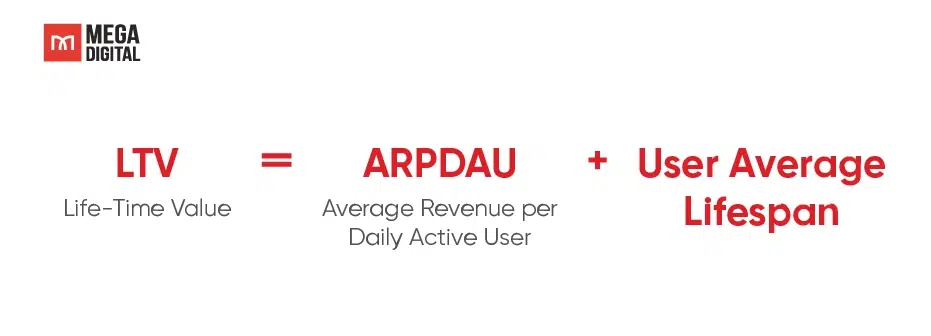
To break this down further:
- Average Revenue Per User (ARPU): Total Revenue / Total Users.
- Average User Lifespan: 1 / Churn Rate.
Example Calculation:
If your game generates $10,000 in a month with 5,000 active users, your ARPU is $2.00. If your monthly churn rate is 20%, the average lifespan is 5 months (1 / 0.2).
- Calculation: 2.00 * 5 = $10.000 LTV
2. Predictive LTV
Waiting months to calculate Historical LTV is too slow for modern UA. Advanced UA managers utilize Predictive LTV based on early signals (Day 1 to Day 7 data) to optimize campaigns in real-time.
The Formula to Calculate LTV:
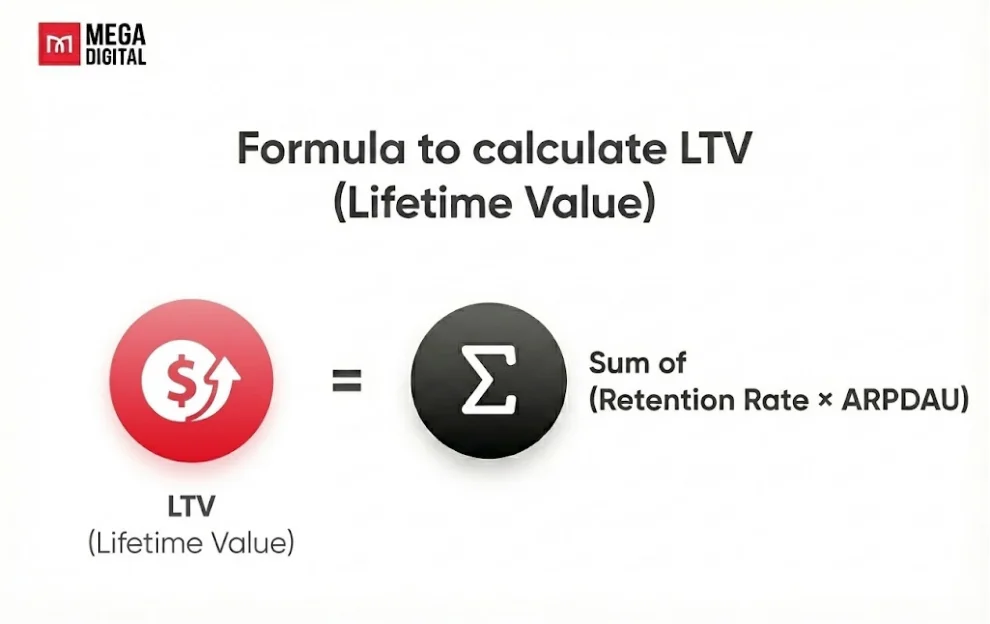
This method sums up the daily revenue of a specific group of users over time (Day 1, Day 7, Day 30, etc.). By using predictive modeling, you can estimate Day 180 LTV based on Day 7 retention and monetization behavior.
Factors Affecting LTV Mobile Games
Below are three factors that affect LTV in Mobile Games from Retention Rate, Monetization Model, to User Segmentation.
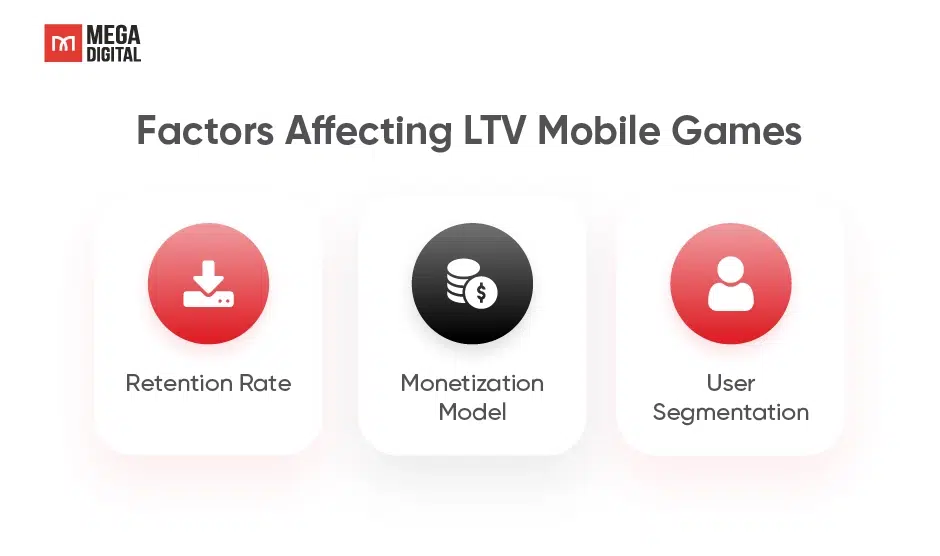
- Retention Rate: It is mathematically impossible to have a high LTV with high churn. Even a small increase in Day 30 retention can double LTV because it gives the user more time to view ads or make purchases.
- Monetization Model: How you make money matters. Games relying heavily on annoying interstitial ads might have high short-term revenue but kill retention (lowering LTV). Conversely, a balanced Hybrid Monetization model (IAP + Rewarded Ads) tends to yield higher LTV.
- User Segmentation: Not all users are equal. It is crucial to segment LTV by Traffic Source (e.g., Organic vs. TikTok Ads). Often, organic users have higher retention, while paid users from specific targeted campaigns might have higher IAP spend. Analyzing this allows you to cut budget on low-LTV channels and double down on high-LTV ones.
LTV Mobile Games Benchmarks by Genre
According to the Mistplay and Business of Apps, LTV varies significantly by region, platform, and monetization model. Recent data from Segwise and AppAgent highlights the growing impact of hybrid models. Below are estimated averages for the US/Tier 1 market, aggregated from these lates
Genre | Average LTV (US/Tier 1) | Key Revenue Driver | Strategic Insight |
Hypercasual / Hybrid-Casual | $0.50 – $1.50 | Ad Revenue (70-90%+, hybrid increasing) | Focus on massive scale and low CPI (<$0.50). Short lifespan, but hybrid meta boosts retention and LTV. |
Casual & Puzzle | $2.00 – $8.00 | Hybrid (Ads + IAP, high retention) | Value accumulates slowly over months. D30 retention >15% is the deciding factor. |
Mid-core & RPG/Strategy | $10.00 – $50.00+ | In-App Purchases (whale-driven) | Strong whale economy; accepts high CPI ($5-$15+). Loyalty and LiveOps drive long-term LTV. |
Social Casino | $30.00 – $100.00+ | High-frequency IAP | Highest LTV but fierce competition and the most expensive CPI. |
Mega Digital Insight: While the global average LTV is generally lower (around $2-3), it is rising due to hybrid monetization and loyalty programs. Based on our experience, segmenting traffic sources and optimizing predictive LTV can help you beat these benchmarks by 20-50%.
Common Mistakes When Calculating LTV
Here are the most common pitfalls that you must remember:
- Ignoring Ad Revenue: Many developers only count In-App Purchases (IAP). For casual games, ads can contribute 40-60% of total LTV. Failing to attribute this leads to underbidding in UA campaigns.
- Mixing Organic and Paid Users: Calculating a “Blended LTV” is dangerous. If you use organic LTV to bid for paid users, you will likely overspend, as organic users typically retain better than paid ones.
- Sample Size Too Small: Calculating LTV based on a cohort of 50 users is statistically insignificant. Ensure you have enough data points for accuracy.
4 Strategies to Increase LTV Mobile Games
After understanding the common mistakes, let’s check 4 strategies that Mega Digital recommend to increase LTV in Mobile Games:
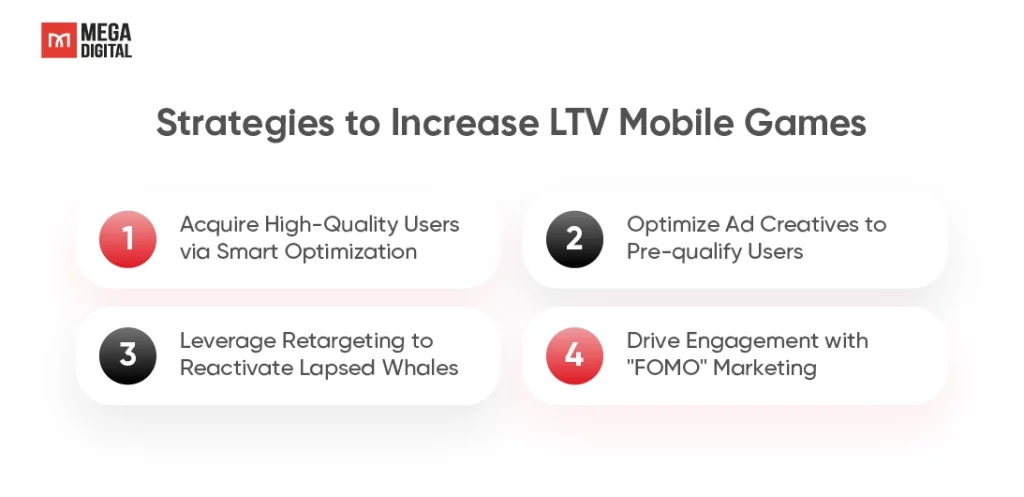
1. Acquire High-Quality Users via Smart Optimization
Instead of purely optimizing for cheap installs (low CPI), modern UA strategies must focus on ROAS and Quality. Platforms like TikTok offer advanced automation tools that help advertisers find users most likely to generate value.
An example of this success is the Mini Games: Calm & Relax project. By leveraging Smart+ Campaigns and conducting rigorous weekly creative testing, Mega Digital was able to improve ROAS by 10 – 20%, effectively proving that acquiring the right users is far more profitable than acquiring the most users.
2. Optimize Ad Creatives to Pre-qualify Users
Your ad creative serves as your first retention filter. While misleading ads might lower CPI, they often destroy LTV because users churn immediately upon realizing the discrepancy.
The superior approach is to use “Truthful Creatives” that showcase the core loop or satisfying moments of the game. This ensures that every user who installs is genuinely interested in your specific genre, leading to longer lifespans and better monetization.
3. Leverage Retargeting to Reactivate Lapsed Whales
Since acquiring a new user is significantly more expensive than bringing back an old one, paid retargeting campaigns are essential to re-engage high-value users who haven’t logged in for 3-7 days.
One effective tactic is to target “Cart Abandoners”, users who clicked on an IAP item but didn’t buy, with a special discount ad on social media. This intervention can instantly convert a non-payer into a payer, directly increasing their LTV.
4. Drive Engagement with “FOMO” Marketing
Marketing shouldn’t stop at the install; it must use external channels to drive users back into the game. For TikTap Challenge, Mega Digital executed a Spark Ads strategy utilizing native-style creator content and trending audio.
By positioning the game as a viral social challenge rather than a product, they triggered a massive “FOMO” effect. This not only drove new user volume but also re-engaged existing players who saw the game trending on their “For You” feeds, significantly extending the game’s lifecycle.
>>> Read more: How to Increase LTV in Hybrid Mobile Games Without IAP Loss
FAQs about LTV Mobile Games
1. What is the difference between LTV and ARPU?
ARPU (Average Revenue Per User) measures revenue over a specific period, usually a month for all users active in that period. LTV measures the total revenue a single user generates over their entire life in the app. ARPU is a snapshot; LTV is the full story.
2. How long does it take to calculate an accurate LTV?
It depends on the genre. For Hypercasual games, Day 7 LTV is often enough to predict total value. For RPGs, you may need 90 to 180 days of data to get a precise LTV curve. However, predictive modeling is often used to estimate LTV as early as Day 3.
3. Can LTV change over time?
Yes, LTV is dynamic. Game updates, seasonal events, or changes in the economy (inflation of game currency) can increase or decrease LTV. Continuous monitoring is required.
Final Word
Mastering LTV is the cornerstone of a profitable mobile game business, requiring a delicate balance of retention mechanics and smart User Acquisition. To move beyond theory and start scaling your game with data-driven performance marketing strategies, contact Mega Digital. Let our experts conduct a free audit of your current UA strategy and help you unlock the full potential of your player value.