

A Google Ads Manager Account helps you manage multiple Google Ads accounts from one dashboard. Instead of switching logins, tracking separate reports, and risking billing or access errors, you can monitor performance, manage users, and streamline account operations in one place. This guide explains how MCC works and how to use it efficiently.
Quick summary:
- A Google Ads Manager Account acts as a centralized master dashboard to oversee multiple individual ad accounts.
- You can instantly switch between different client campaigns without needing separate usernames or passwords.
- The system allows agencies to consolidate billing and invoicing to simplify financial management across all clients.
- Setting up cross-account conversion tracking prevents redundant code on your website and unifies your performance data.
- Integrating automated rules and AI tools across your manager account drastically reduces manual optimization time.
What is a Google Ads Manager account?
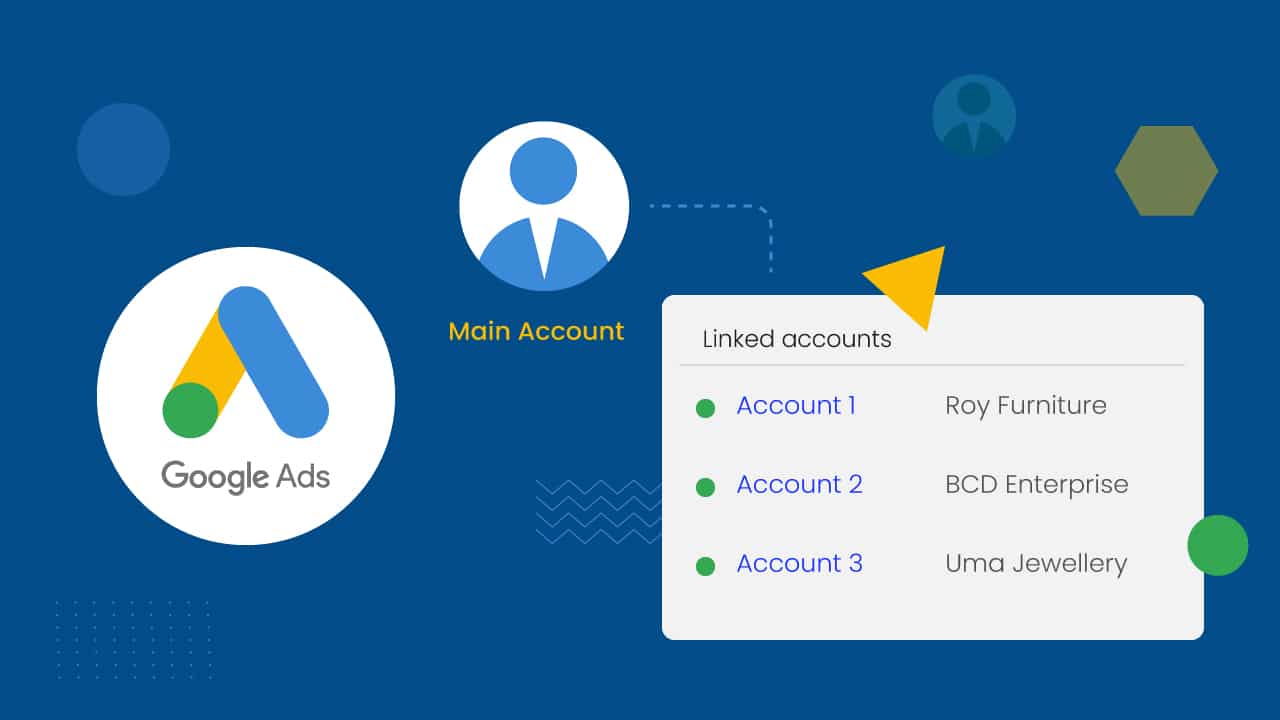
How to manage multiple Google Ads accounts? A Google Ads Manager account (formerly My Client Center or MCC) is a Google Ads account that lets you manage multiple Google Ads accounts in one place. It helps users sign in to many accounts with numerous usernames and passwords.
Why use a Google Ads Manager account?
Managing separate Google Ads accounts can make reporting, access control, and campaign monitoring unnecessarily time-consuming. A Google Ads Manager Account brings these tasks into one central dashboard, making multi-account management more efficient.
Research shared by WordStream found that over 90% of digital marketing agencies spend at least one hour per week on reporting for each client. Centralized account management can simplify this workload by allowing teams to review and compare performance in one place.
With a Google Ads Manager Account, you can:
- Access and manage linked accounts through a single sign-in.
- Create and edit campaigns directly from the manager dashboard.
- Compare performance and generate reports across multiple accounts.
- Create or link new Google Ads accounts without switching dashboards.
- Organize accounts with labels and monitor them through centralized alerts.
- Assign different access levels to employees, partners, or clients.
- Use consolidated billing for eligible accounts on monthly invoicing.
Who should use an MCC account?
An MCC account is best suited to advertisers and teams that regularly manage multiple Google Ads accounts, especially when centralized reporting and access control are needed.
- Digital marketing agencies managing campaigns for multiple clients.
- Freelancers and media buyers working across several advertising accounts.
- Large companies operating separate accounts for brands, regions, or business units.
- In-house marketing teams that need shared access with different permission levels.
- Advertisers with many accounts who want cross-account reporting and monitoring.
- Organizations using monthly invoicing, which requires a manager account.
How does a Google Ads Manager account work?
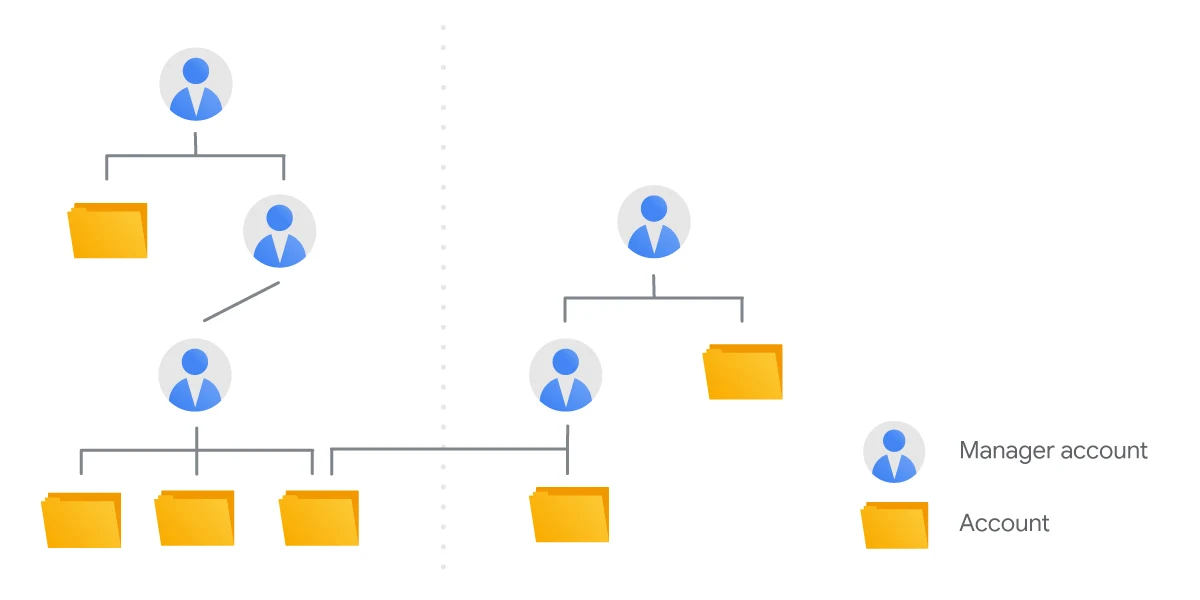
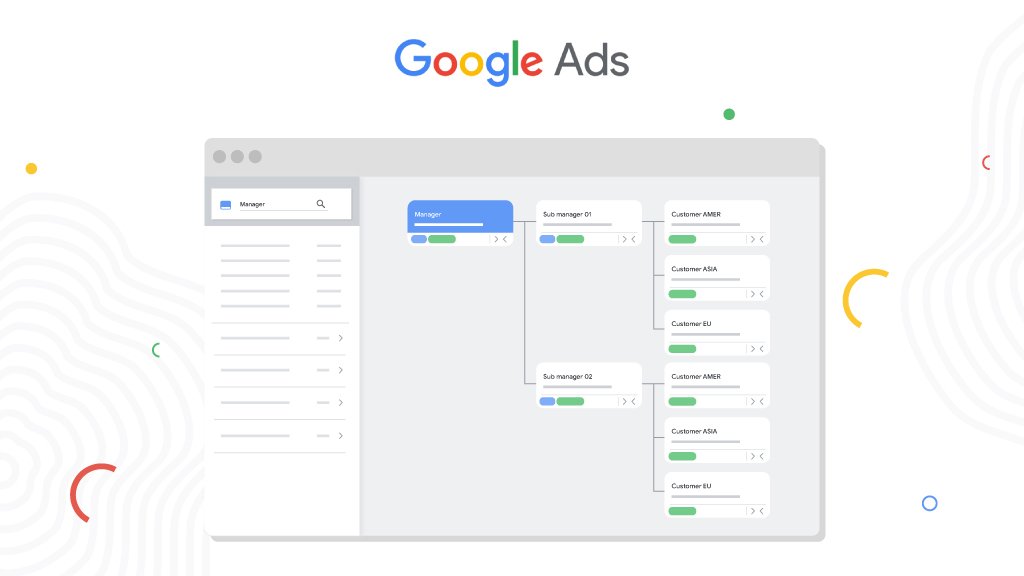
A Google Ads Manager Account uses a hierarchical structure to connect and manage multiple individual or manager accounts from one dashboard.
Here’s how it works:
- Link accounts: Connect existing accounts or create new ones without affecting their history, billing, or current users.
- Manage access: Assign different permission levels based on each team member’s role and responsibilities.
- Review performance: Compare clicks, costs, conversions, and other metrics across linked accounts in one place.
- Share tools and assets: Apply features such as cross-account conversion tracking, audience segments, and negative keyword lists after proper setup.
AI and Automation in MCC Management
A Google Ads Manager Account centralizes multiple accounts, while automation helps teams monitor and manage them at scale. As Brad Geddes notes, “Repeated inputs can be replaced by a machine; thought strategy cannot be easily replaced”. This reinforces the need to combine automation with human judgment and strategic oversight.
Modern MCC management strategies include:
- Cross-account scripts: Use manager account scripts to monitor performance, detect broken URLs, send alerts, or apply predefined actions across linked accounts. Scripts can process up to 50 accounts in parallel, while larger portfolios require multiple batches.
- Performance Max governance: Manage Performance Max campaigns using consistent conversion goals, naming conventions, budget rules, and reporting standards. Since asset libraries are account-specific, creatives must still be managed within each linked account.
- Automated monitoring: Set up rules, scripts, and alerts to identify unusual spending, tracking issues, or performance declines before they affect multiple accounts.
- Human oversight: Regularly review conversion tracking, budgets, recommendations, and campaign goals instead of applying automated changes across every account without evaluation.
How to create a Google Ads Manager account
It only takes a few minutes to create a Google Ads Manager account. Here is a step-by-step guide to setting up one:
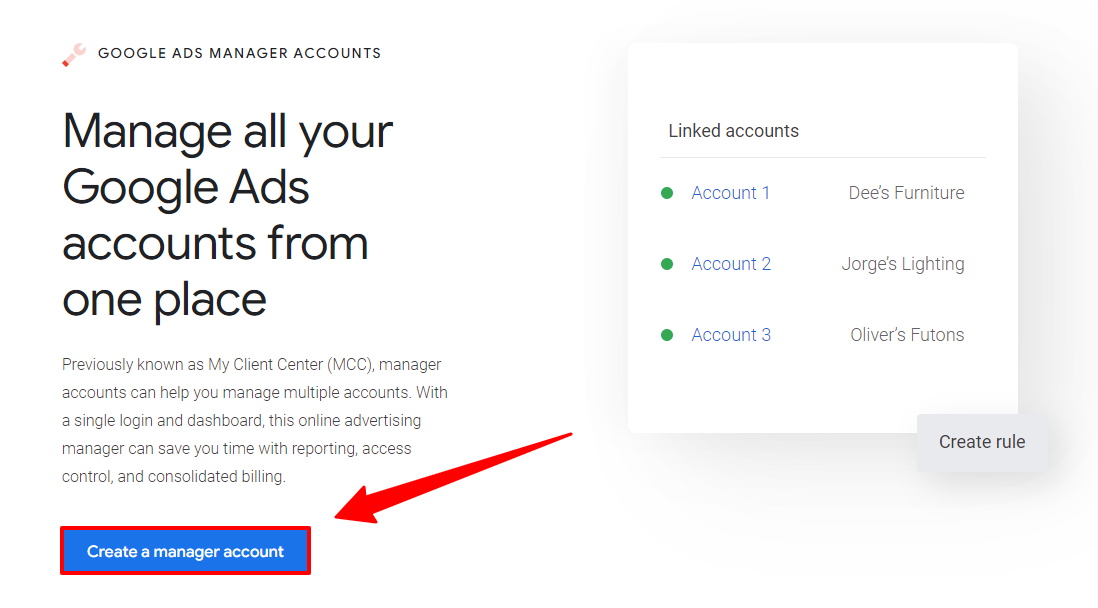
- Visit https://ads.google.com/intl/en/home/tools/manager-accounts/
- Click on the “Create a manager account” button.
- Sign in using the email that you plan to use for your Google Ads account. If you’re not already signed in, you’ll be prompted to sign in to your Google account.
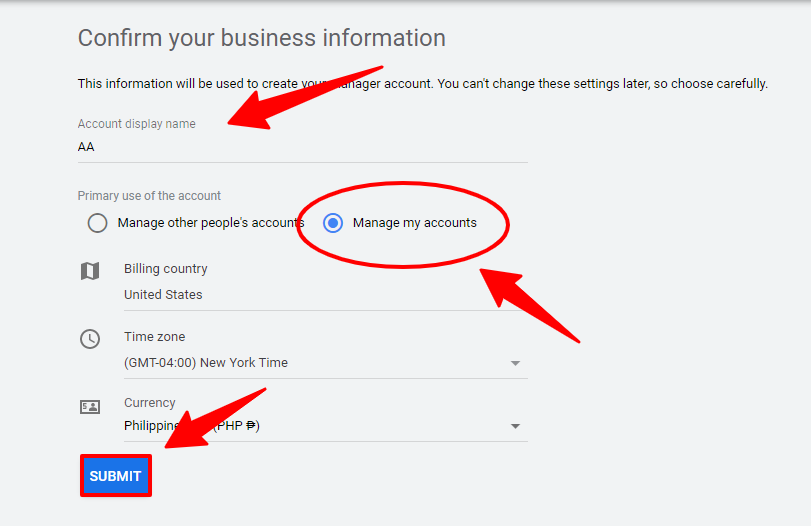
- Give your manager account a name.
- Decide how you want to use the manager account:
- Option 1: Manage your own accounts.
- Option 2: Manage third-party accounts.
- Provide your country and time zone information.
- The time zone you choose will be used for reporting and billing.
- Keep in mind that this choice cannot be changed later, so it’s advisable to select the time zone where your business is located.
- Choose a billing currency for your account.
- Each connected account will be billed in its own currency.
- We recommend selecting the currency used for your business.
- Sub-accounts will be billed in their own currencies.
- Click the “Submit” button to initiate your new account setup.
How to link multiple Google Ads accounts
Once your Google Ads Manager account is ready, you can start to link your ad accounts or those of your clients:
- Click on Settings > Sub-account settings.
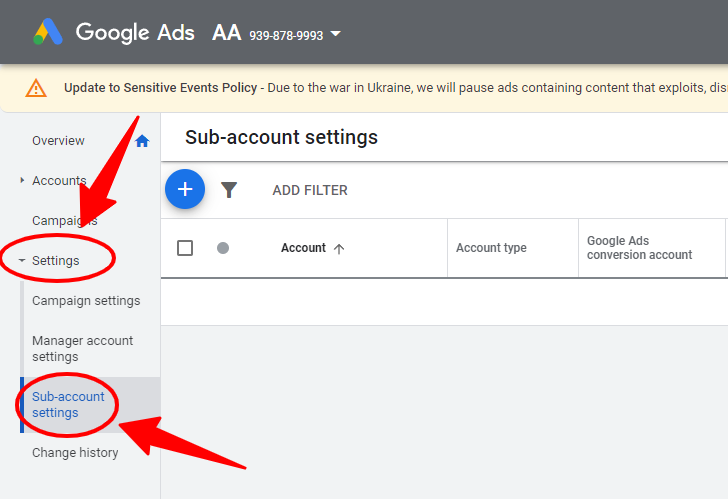
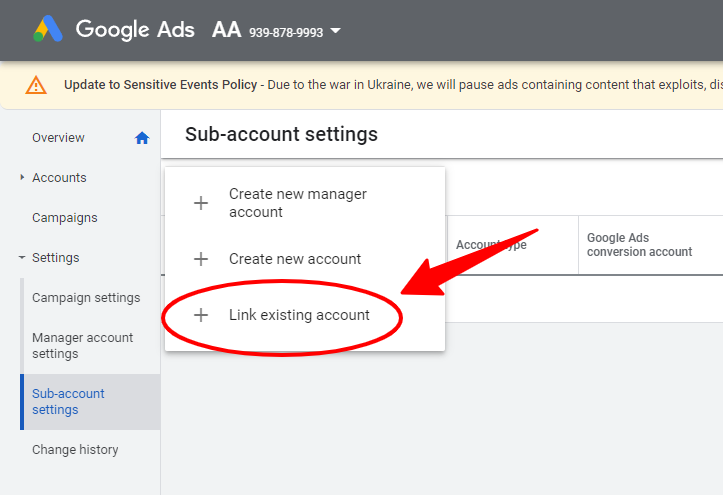
Then, click the blue “+” button, and select “Link existing account.”
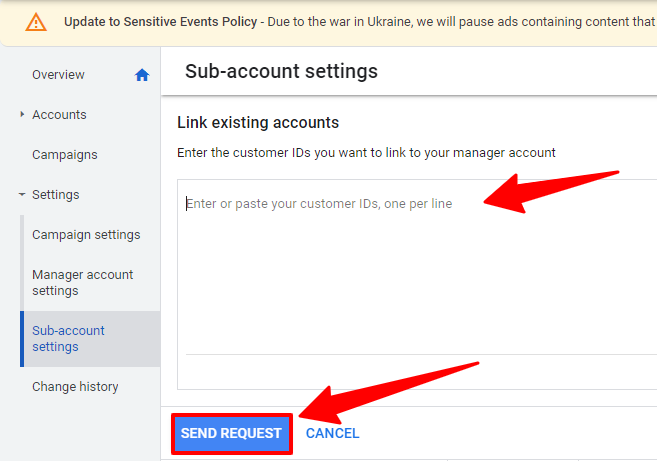
- Enter the client account’s Google Ads ID (this is the ten-digit number in the top-right corner).
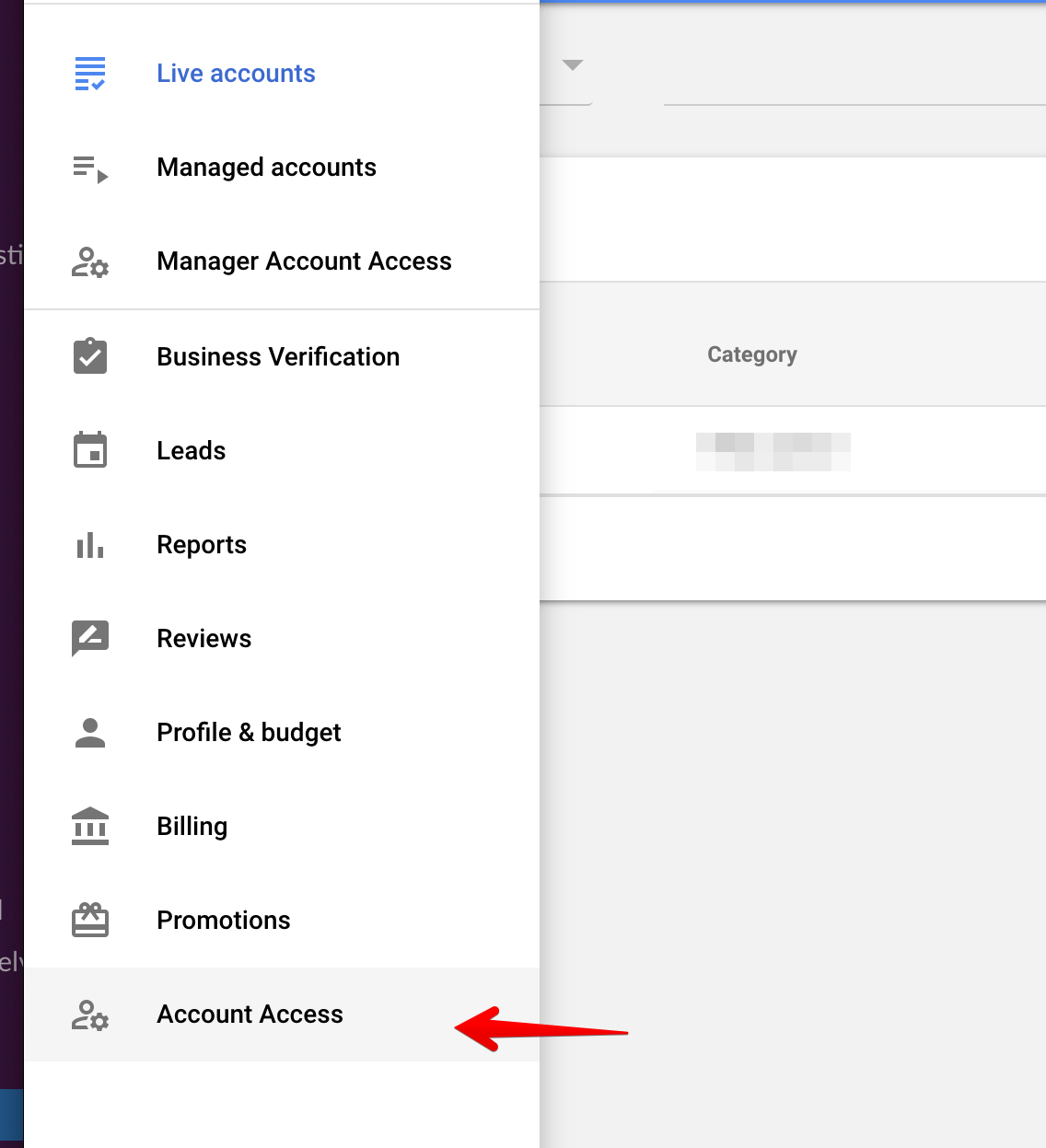
- The client account will receive a request to link to the Ads Manager in its account. They will go to the sidebar menu and select “Account Access”.
- The client account needs to accept the request.
They click the “Managers” tab, look under the “Link request” section to find the request, and click “Accept”. The client account also chooses the level of access: Administrative, edit, or view.
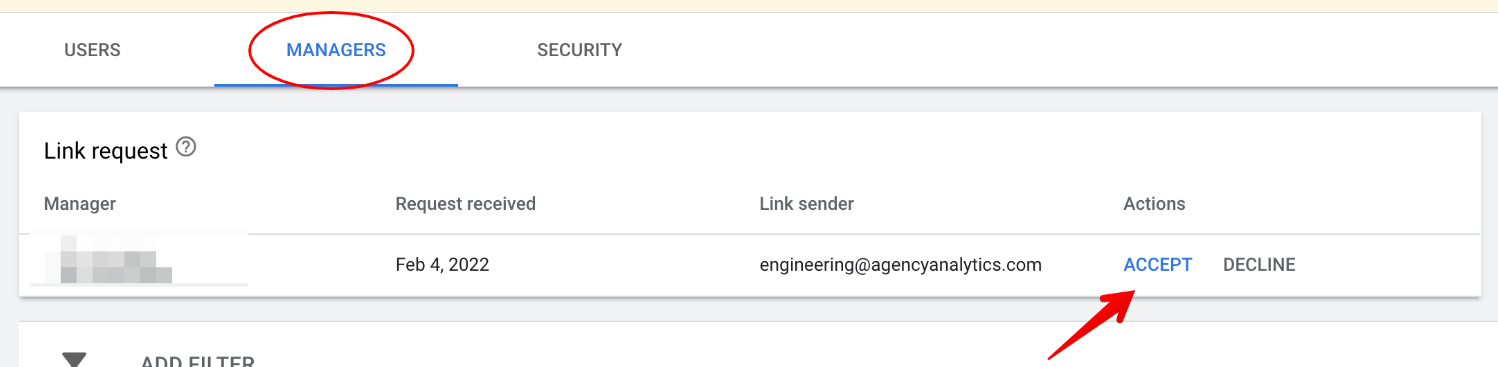
You can manage that Google Ads account once the client accepts the request and grants administrative access.
Setting Budgets and Bidding Strategies for Google Ads MCC
When setting up an MCC ads account, it’s essential to establish budgets and bidding strategies for each linked ad account. Here’s how to do it:
- Set budgets for each ad account: This will help ensure you stay within budget and allocate resources effectively. To set budgets, go to the “Settings” section of each ad account, select “Budgets”, and set a budget for each account.
- Choose bidding strategies: Bidding strategies determine how much you bid for specific keywords and determine how often your ads appear. The following bidding strategies are available in Google Ads:
- Automatic bidding: Google will automatically adjust your bids to reach the target cost per action (CPA) or return on ad spend (ROAS).
- Manual bidding: You can set a specific bid amount for each keyword or placement.
- Enhanced cost per click (CPC): Google Ads will automatically adjust your bids to reach the target cost per click.
Verifying and Claiming Website
To get started, you must ensure you have administrative access to the website you want to verify and claim. Here are the steps:
- Go to the “Tools & Settings” section in your Google MCC account and select the “Business Information” option.
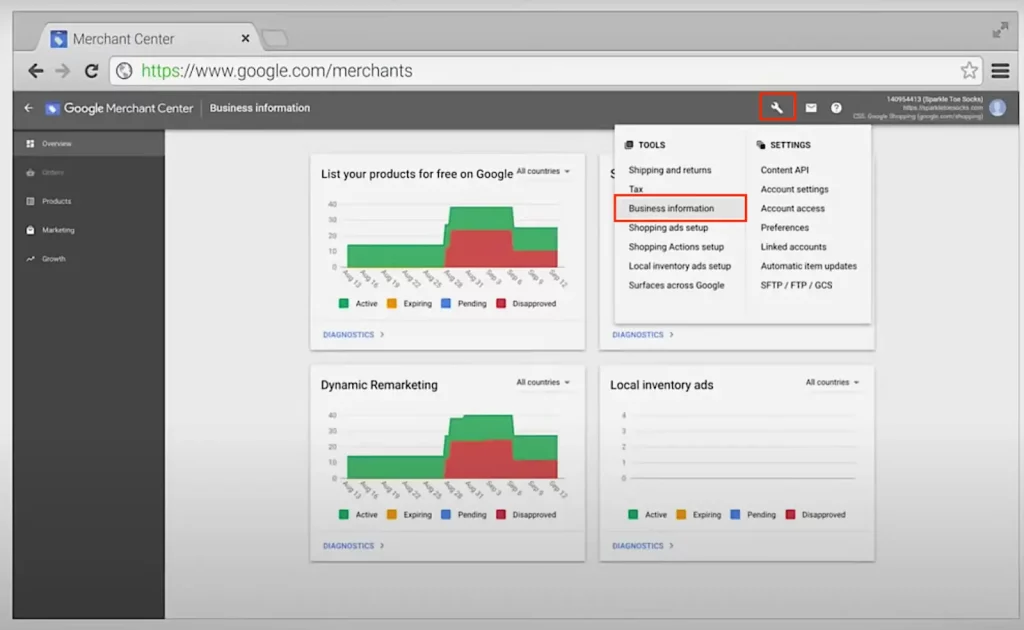
- Enter the website URL you want to verify and claim.
- Choose the preferred verification method by adding an HTML file to your website or a meta tag to your website’s HTML code.
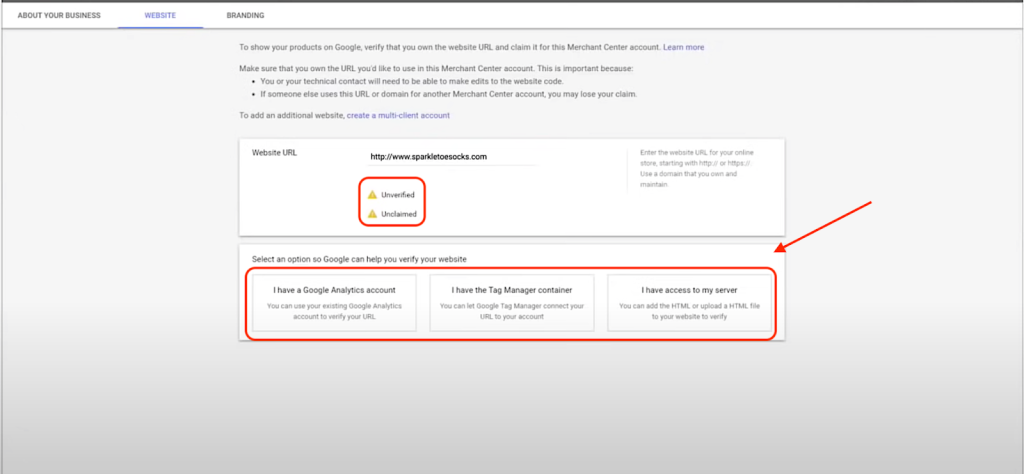
- Once you have completed the verification process, your website will be officially claimed in your Google Ads MCC.
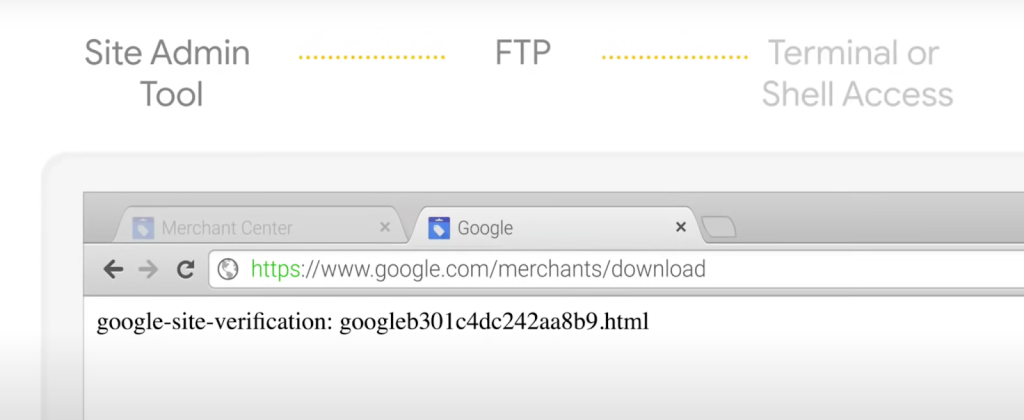
Verify and claim your website with a Google Manager account to track conversions and measure campaign performance accurately. This gives you access to more data and insights.
Setting up Conversion Tracking
Conversion tracking is an essential aspect of your Google Ads Manager account setup. It allows you to track the performance of your campaigns and make decisions to optimize your campaigns. Here’s how to set it up:
- Create conversion actions in your manager account by going to Tools > Conversion.
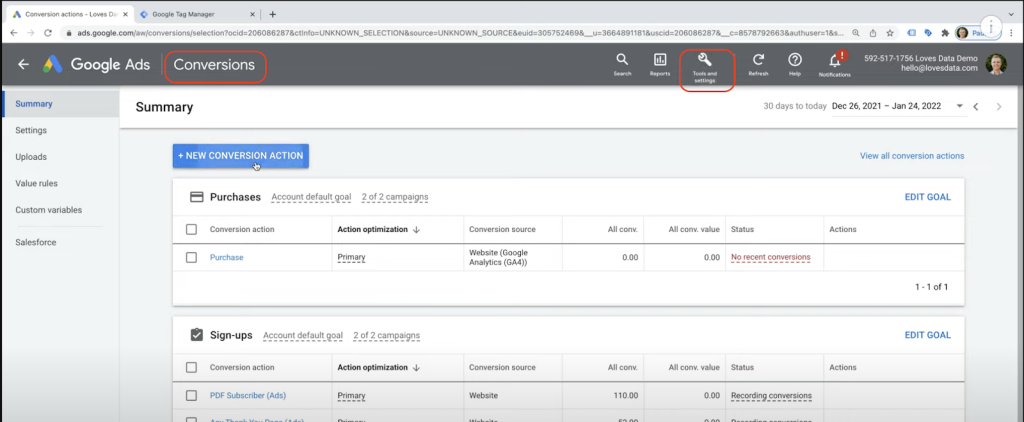
Identify the conversions you want to track, such as leads, sales, or sign-ups.
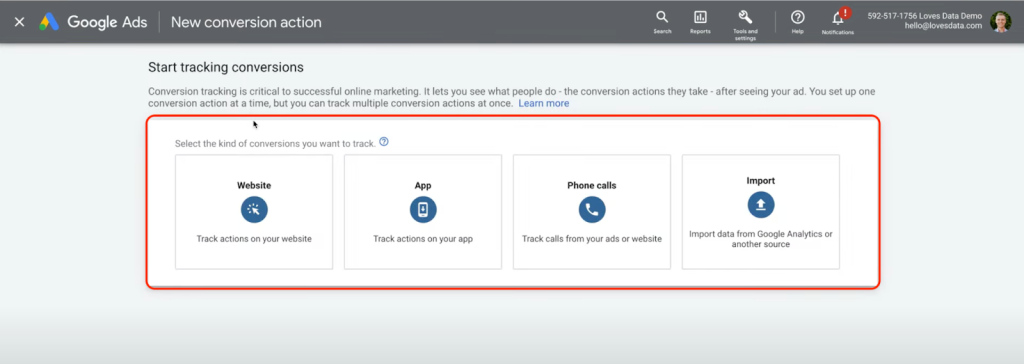
- Add the conversion tracking code to your website or use a Google Tag Manager.
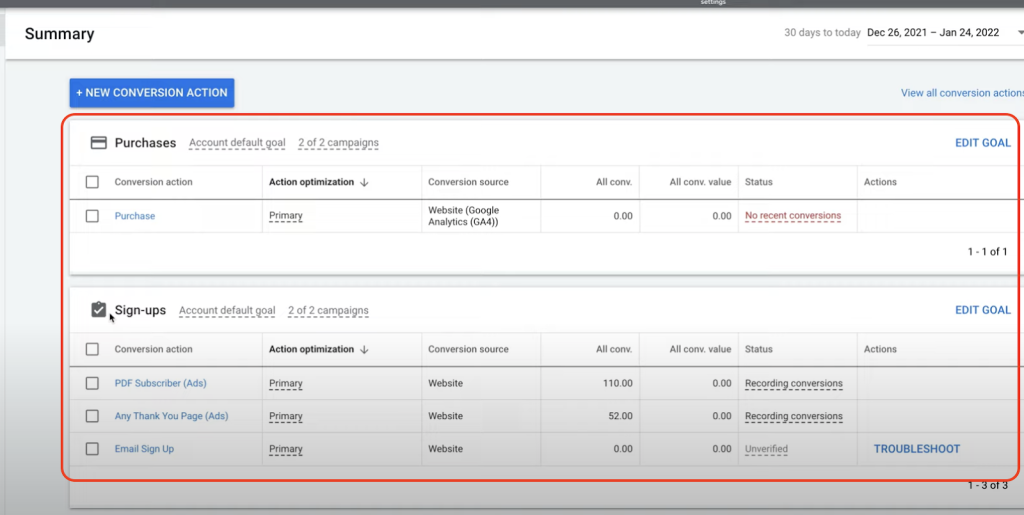
- Verify that the tracking is working properly by checking the conversion reports in your manager account.
Tips for Optimizing a Google Ads Manager Account
Focus on structure, settings, ad quality, and controlled testing to manage multiple accounts more efficiently.
Setting the right structure
Group accounts by client, brand, market, or business unit, then use a consistent naming format such as Brand – Country – Channel – Goal. Add labels like Scaling, Tracking Issue, or Needs Review to prioritize accounts during weekly checks.
Optimizing campaign settings
Use cross-account reports to track spend, conversions, CPA, conversion value, and ROAS over the last 7 and 30 days. Review accounts where costs rise without conversion growth, tracking stops, or performance falls below target.
Check budgets, bidding, targeting, schedules, and conversion goals at the account level rather than applying the same settings everywhere.
Pro tip: Set email alerts for unusual spend, zero-conversion campaigns, disapproved ads, and tracking issues before automating account changes.
Improving ad quality
Review ads, assets, search terms, and landing pages in each linked account. Replace weak messaging, remove outdated offers, and ensure the landing page matches the keyword and ad intent.
Do not judge ads by CTR alone. Also compare conversion rate, lead quality, and conversion value.
Testing and iteration
Test one major variable at a time, such as bidding, match type, ad copy, or landing page. Start with a small group of similar campaigns before rolling changes out across the MCC.
Record the test period, affected accounts, baseline metrics, and results. Wait for conversion delays and bidding performance to stabilize before making a final decision.
Pro tip: Test bulk changes on two or three representative accounts first, then scale only when results remain consistent.
FAQs about Google Ads Manager accounts
In your manager account, go to Accounts > Sub-account settings, select the account, then choose Edit > Unlink. After unlinking, the MCC can no longer access that account, but its campaigns and historical data remain intact.
A manager account can link up to 85,000 non-manager accounts, including active, inactive, and canceled accounts. However, the number of active accounts allowed depends on the total monthly spend across the hierarchy over the previous 12 months.
Yes. You can link manager accounts to create sub-manager structures for different clients, regions, or teams. Google Ads supports hierarchies up to six levels deep, and each manager account can be directly managed by only one higher-level manager.
No. Users who access an individual client account cannot automatically view the MCC or other linked accounts. Their visibility depends on the specific account and access level assigned to them.
Final word
As mentioned, Google Ads Manager account helps marketers or business owners to maximize performance and improve their advertising results. We hope this tutorial has provided you with a complete knowledge of the system and how it helps you manage your Google Ads account.