

Irrelevant search queries can waste your Google Ads budget, even when you’re running automated Performance Max campaigns. Negative keywords help you exclude unwanted searches and gain more control over where your ads are eligible to appear.
In this guide, Mega Digital explains how Performance Max negative keywords work, how to add them at the campaign or account level, and how to choose exclusions without unnecessarily blocking valuable traffic.
Quick summary:
- How PMax negative keywords work: Block unwanted search queries on Search and Shopping inventory.
- 2 ways to add exclusions: Set negative keywords at the campaign level or across eligible campaigns at the account level.
- Choose the right match type: Use negative broad, phrase, or exact match based on the searches you want to exclude.
- Optimize your exclusions: Review Search Terms, monitor conversions, and avoid blocking valuable traffic.
What are Performance Max negative keywords?
Performance Max negative keywords are terms or phrases you exclude from eligible Search and Shopping queries in your Google Ads campaigns. You can apply these exclusions to a specific Performance Max campaign or across your account.
Negative keywords use broad, phrase, or exact match rules to determine which search queries should be blocked. Unlike audience targeting, these exclusions control matching search terms rather than excluding particular groups of people.
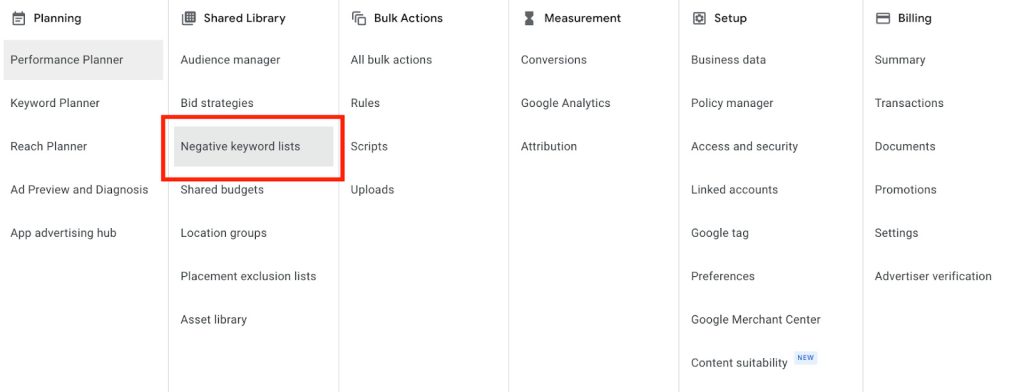
Important: Performance Max negative keywords apply to Search and Shopping inventory only. They do not directly exclude placements across YouTube, Display, Discover, Gmail, or other Performance Max inventory. These channels have different suitability and exclusion controls.
Well, a target keyword helps your ads appear on search engines for the right audience. Meanwhile, a negative keyword, also known as a negative match, does the exact opposite. That’s why it allows you to exclude certain search phrases from your campaigns, excluding audiences who search for that phrase in the search engine.
Adding Performance Max negative keywords benefits
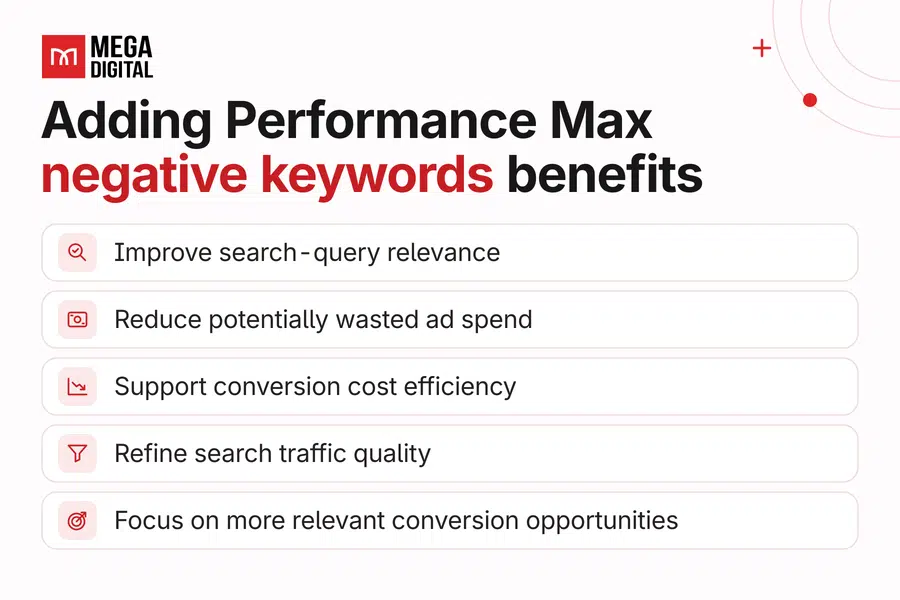
Excluding keywords in your Performance Max campaigns offers several advantages that can benefit your advertising efforts as follows:
- Improve search-query relevance
- Reduce potentially wasted ad spend
- Support conversion cost efficiency
- Refine search traffic quality
- Focus on more relevant conversion opportunities
Improve search-query relevance
Negative keywords can help prevent your Performance Max ads from appearing for Search and Shopping queries that don’t match your products or services.
For example, if your business sells premium gaming desks but not school desks, excluding clearly irrelevant school-desk searches may help keep your search traffic more relevant.
However, negative keywords do not directly control audience targeting across all Performance Max channels, and excluding searches does not guarantee more qualified clicks or conversions.
Reduce potentially wasted ad spend
When a search query is clearly unrelated to your business, paying for clicks from that query may waste part of your advertising budget.
Adding a relevant negative keyword can prevent future ad delivery for matching searches on Search and Shopping inventory.
However, removing irrelevant queries doesn’t automatically lower your average CPC or total campaign spending. Performance Max may continue allocating your budget to other eligible inventory and searches. Monitor actual costs and conversion results to understand the impact.
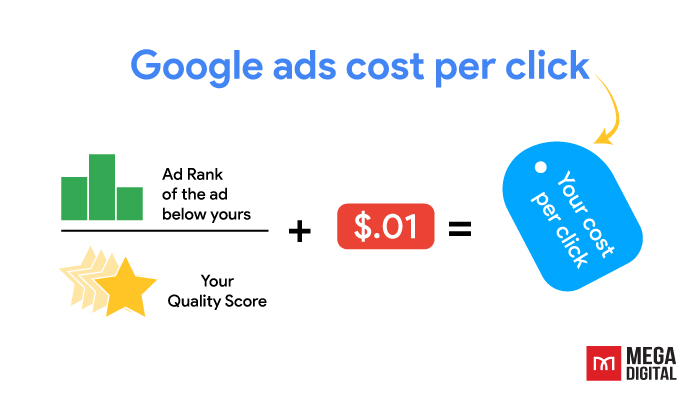
Read more: What Is Google Ads Quality Score and How to Increase It
Support conversion cost efficiency
Negative keywords may help improve conversion cost efficiency when they remove searches that are unrelated to your offer and unlikely to generate meaningful results.
However, lower CPA is not a guaranteed outcome. Excluding a query can also remove potential customers who might have converted.
Before adding negative keywords, consider the search intent, previous conversion activity, and the potential business value of the excluded traffic. After making changes, monitor CPA, conversion volume, and conversion value to evaluate the results.
Refine search traffic quality
Negative keywords give advertisers more control over which search queries can trigger their Performance Max ads on eligible inventory.
By excluding irrelevant searches, you may reduce impressions and clicks that don’t reflect genuine interest in your products or services.
This can influence CTR, but the direction and size of any change depend on the searches excluded and the traffic that remains. A higher CTR alone does not prove that the campaign is attracting more valuable customers.
Focus on more relevant conversion opportunities
The goal of using Performance Max negative keywords is not to exclude as many queries as possible. It’s to identify searches that don’t support your advertising objectives while preserving relevant conversion opportunities.
A carefully selected exclusion may help you avoid unsuitable traffic, but it can also limit reach and remove potential conversions if applied too broadly.
Review actual search terms and business results before making changes, then monitor campaign performance to confirm whether the exclusions are helping.
How to add negative keywords to Google Performance Max campaigns?
Can you add negative keywords to performance max campaigns? Yes, you can use negative keywords, but you may need help to set them up correctly.
There are two main ways to add Performance Max negative keywords directly in Google Ads:
- Account-level negative keywords: Apply exclusions across eligible Search and Shopping inventory in relevant campaigns throughout your Google Ads account.
- Campaign-level negative keywords: Exclude specific search queries from the Search and Shopping inventory of a selected Performance Max campaign.
You no longer need to contact Google Support as the standard method for adding campaign-level Performance Max negative keywords. Both options can be managed through Google Ads, although the appropriate choice depends on how widely you want the exclusions to apply.
Option 1: Add Performance Max negative keywords at the account level
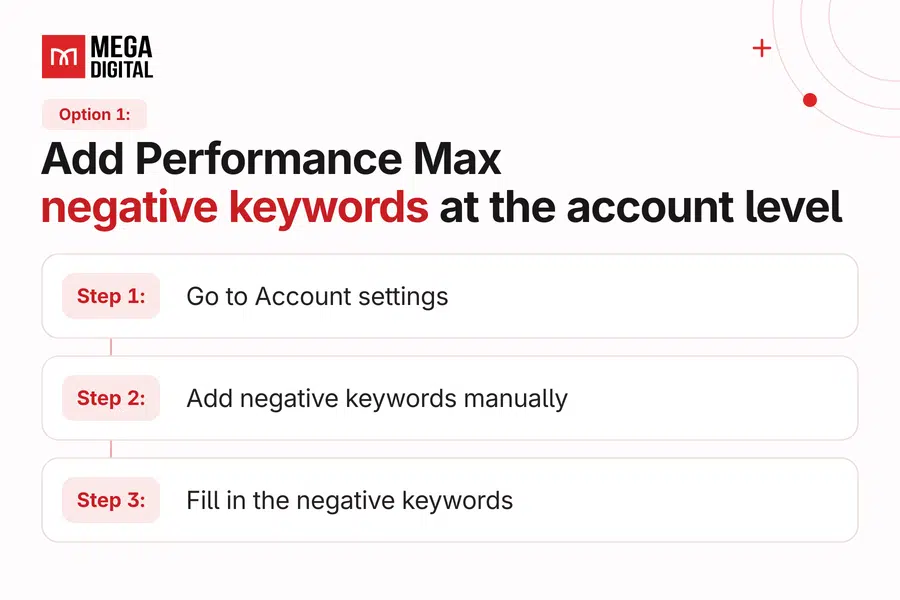
Account-level negative keywords are useful when you want to exclude the same search terms across eligible Search and Shopping inventory throughout your Google Ads account.
Unlike campaign-level exclusions, these negative keywords can affect multiple campaign types, including Search, Shopping, and Performance Max.
Only use this option for terms that are genuinely irrelevant across your account. If an exclusion applies to just one Performance Max campaign, use campaign-level negative keywords instead.
Here’s how to add account-level exclusions directly in Google Ads.
Step 1: Go to Account settings
Sign in to your Google Ads account.
- Click Admin in the main navigation.
- Select Account settings.
- Expand the Negative keywords section.
This section contains the account-level exclusions that apply across eligible Search and Shopping inventory.
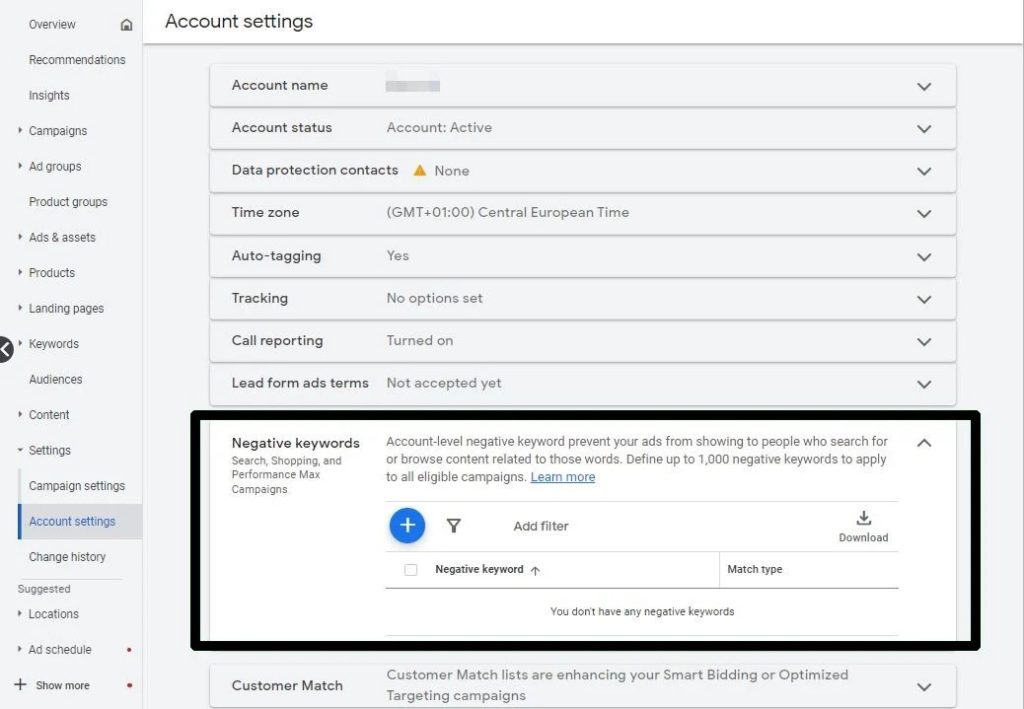
Step 2: Add negative keywords manually
Click the plus (+) button in the Negative keywords section.
Enter the negative terms you want to exclude, placing each keyword or phrase on a separate line.
Before adding them, make sure the exclusions are appropriate for every eligible campaign affected by account-level settings.
Account-level negative keywords are managed separately from shared negative keyword lists that you can apply to selected campaigns.
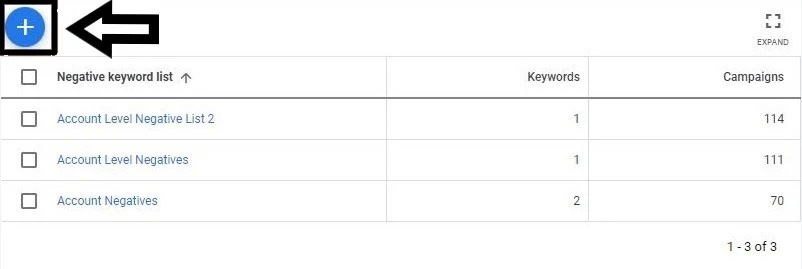
Step 3: Fill in the negative keywords
Review the negative keywords you’ve entered and click Save.
After saving, check their match types in the account-level Negative keywords table. Where supported, use the Match type dropdown to select broad, phrase, or exact match for each exclusion.
For example:
- Negative broad match:
study desks - Negative phrase match:
"study desks" - Negative exact match:
[study desks]
Review the complete list before leaving Account settings. Remember that account-level exclusions can affect eligible campaigns beyond the Performance Max campaign you’re currently optimizing.
Option 2: Add Performance Max negative keywords at the campaign level
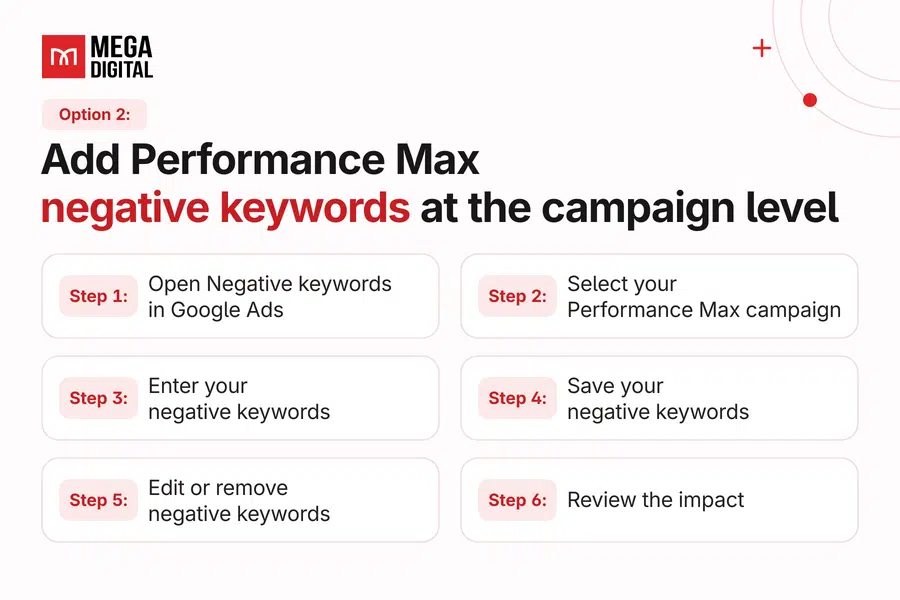
Google Ads now allows advertisers to add negative keywords directly to individual Performance Max campaigns, without contacting Google Support.
This option is useful when a search term is irrelevant to a particular campaign but may still be valuable to other campaigns in your account.
Step 1: Open Negative keywords in Google Ads
- Sign in to your Google Ads account.
- Open Campaigns → Keywords.
- Select the Negative keywords tab.
- Click the plus (+) button to add new negative keywords.
The exact navigation labels may differ slightly depending on your account interface and language.
Step 2: Select your Performance Max campaign
Choose the Performance Max campaign where you want to apply the exclusions.
Make sure you’ve selected the correct campaign. Campaign-level negative keywords affect that campaign’s Search and Shopping inventory, not every campaign in your account.
Step 3: Enter your negative keywords
Enter the keywords you want to exclude, one per line.
You can use the following match-type syntax:
- Negative broad match:
study desks— excludes searches containing all specified terms, regardless of order. - Negative phrase match:
"study desks"— excludes searches containing the terms in the same order, including queries with additional words. - Negative exact match:
[study desks]— excludes searches containing only the specified terms in the same order, without additional words.
For example, if your campaign promotes premium gaming desks, you may want to exclude searches for school desks that your business doesn’t sell.
Choose the match type based on the search intent you want to block. Avoid excluding broad terms that might also appear in valuable searches.
You can also select an existing negative keyword list if you want to apply a reusable set of exclusions.
Step 4: Save your negative keywords
Review the selected campaign, keyword terms, and match types.
Click Save to apply the exclusions.
After saving, return to the Negative keywords tab and verify that the new terms are associated with the intended Performance Max campaign.
Step 5: Edit or remove negative keywords
If you need to update an exclusion:
- Open the Negative keywords tab.
- Select the keywords you want to modify.
- Click Edit → Change keyword text.
- Update the negative keywords and their match-type syntax.
- Click Apply.
To remove exclusions, use the available removal controls and confirm the changes before saving.
Review your exclusions carefully, especially if a keyword is preventing relevant traffic from reaching your campaign.
Step 6: Review the impact
After adding your negative keywords, monitor the campaign’s search traffic and conversion performance.
Review Search terms reporting, conversion volume, conversion value, and cost efficiency to understand whether the exclusions are helping.
Where available, Google Ads also provides a Preview impact feature that estimates how adding negative keywords may affect conversions or conversion value.
Treat these estimates as forecasts, not guaranteed results.
Remember: Performance Max negative keywords apply only to Search and Shopping inventory. They do not directly block YouTube, Display, or other Performance Max placements.
Campaign-Level vs. Account-Level Negative Keywords: Which Should You Use?
| Factor | Campaign-Level Negatives | Account-Level Negatives |
|---|---|---|
| Scope | One selected Performance Max campaign | Eligible Search and Shopping inventory across relevant campaigns in the account |
| Best for | Exclusions specific to a product, service, campaign, or market | Search terms that are irrelevant across the entire account |
| Example | Exclude “study desks” from a gaming-desk campaign | Exclude a term that is unsuitable for every product or service you advertise |
| Main risk | Blocking relevant searches within the selected campaign | Blocking valuable traffic across multiple campaigns |
Which option should you choose?
Use campaign-level exclusions when the unwanted search intent applies to only one Performance Max campaign. Choose account-level exclusions when you’re confident the terms should be blocked throughout your eligible Search and Shopping inventory.
If you need to reuse exclusions across several selected campaigns, you can also explore shared negative keyword lists without applying the exclusions to every campaign in your account.
What about brand exclusions?
Brand exclusions are separate controls in Performance Max. They can be useful when you want to manage traffic associated with particular brands rather than excluding individual search terms.
Choose the control that matches your objective, and review its scope before applying it.
Best practices for effective negative keywords set-up
Now that you’re done setting up the negative keywords. To ensure the effective use of negative keywords in your Google Performance Max campaigns, add them correctly!
Create a Performance Max negative keyword list
Build your Performance Max negative keyword list around search terms that are genuinely irrelevant to your products, services, or campaign objectives.
Start with confirmed exclusions rather than trying to create an exhaustive list. Overly broad negative keyword lists can block valuable searches and reduce conversion opportunities.
Add new exclusions when search query data or business requirements provide a clear reason to block them. Review the match type and scope before saving each keyword.
E.g. let’s say your Performance Max campaign focuses on gaming desks. You don’t want to attract audiences with different types of desk needs right? In this way, you can add negative keywords like “desks for school” or “study desks” to exclude unrelated searches.
If the same exclusions are relevant to several campaigns, you can organize them in a shared negative keyword list and apply it to those campaigns where supported.
A shared campaign-level negative keyword list is not the same as an account-level exclusion. Shared lists affect the campaigns to which they’re applied, while account-level negative keywords affect eligible Search and Shopping inventory across relevant campaigns in your account.
Refresh your negative keyword list regularly
Investing your time in the keyword lists is a long-term process. After adding Performance Max negative keyword list, remember to review and update the lists continuously. Monitor the search terms report identifying new keywords that are worth adding as negative keywords.
Use broad match for negative keywords
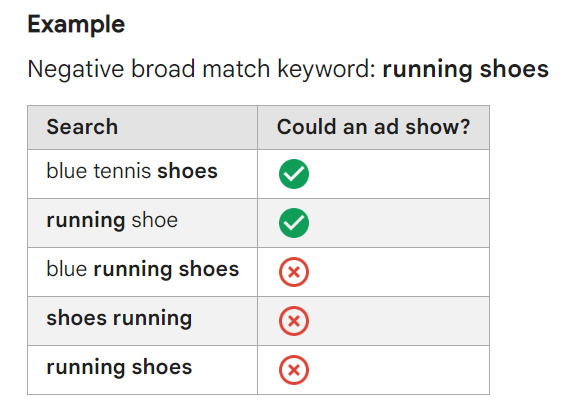
Negative broad match is useful when you want to exclude searches containing all the specified negative keyword terms, regardless of their order.
For example, adding running shoes as a negative broad match keyword blocks eligible Search and Shopping queries containing both “running” and “shoes,” even when the words appear in a different order.
However, negative broad match isn’t always the best choice. If a broad exclusion could block valuable traffic, consider negative phrase or exact match for more specific control.
Unlike positive broad match, negative broad match does not automatically expand to all related meanings, synonyms, or singular and plural forms. Review actual search terms and add separate exclusions when necessary.
However, your ad may still appear if the search query includes some of the negative keywords. For more information about how to create negative keyword lists and apply them to single or multiple campaigns, check out: Google Guidelines on negative keyword lists.
Effective negative keywords at scale
When evaluating potential negative keywords at scale, start with three performance questions:
- CTR: Does the search term have a lower click-through rate than comparable queries?
- Conversion rate: Is the query converting less frequently than other relevant search terms?
- CPA: Is its cost per conversion higher than your campaign’s acceptable acquisition cost?
These metrics can help identify searches worth investigating, but they are not automatic reasons to exclude a keyword.
Always consider search intent, business relevance, conversion value, and the amount of data available before making an exclusion.
A search term with low CTR, low conversion rate, or high CPA isn’t necessarily irrelevant.
For example, a relevant query may perform poorly because of the creative assets, product pricing, landing page, bidding strategy, or conversion tracking setup. Small sample sizes can also make performance metrics misleading.
Before excluding a search term, investigate whether it represents genuine demand for your business.
- If the query is irrelevant: Consider adding an appropriate negative keyword.
- If the query is relevant but underperforming: Review the offer, creative assets, landing page, bidding, and conversion measurement before excluding it.
- If the query has generated valuable conversions: Be especially cautious about blocking it, even if some efficiency metrics appear weak.
Where available, use Google’s negative keyword impact prediction feature to preview the estimated effect on conversions or conversion value before applying exclusions. These predictions are forecasts, not guarantees.
Review the impact of your exclusions over time, including any changes in conversion volume and conversion value. Effective negative keyword management means removing clearly unwanted search traffic without unnecessarily limiting valuable demand.
Final words
Performance Max negative keywords can be useful when your campaign receives Search or Shopping traffic that doesn’t match your business goals. We hope that you can set up negative keywords in Performance Max to reduce irrelevant clicks, optimize ad spend, and improve targeting.
Need help managing or optimizing your Google Ads campaigns? Mega Digital’s White-Glove Services offer professional advertising support across Google and other major platforms. Talk to our team about your Performance Max campaign goals and optimization needs.