


Paying for clicks without filling your appointment calendar can make Google Ads feel like a gamble. You need to reach people who fit your services while keeping acquisition costs manageable. In this article, I’ll explain everything you need to know about Google Ads for therapists, from setting a realistic budget to building campaigns and reviewing advertising policies.
Quick summary:
- Match your keywords, location targeting, and ad copy to the therapy services you offer.
- Plan your budget around local advertising costs and the number of new clients you can accommodate.
- Give visitors clear information about your services, fees, and booking process.
- Review Google’s sensitive-interest targeting and customer data policies before launching.
- Evaluate qualified inquiries and attended appointments alongside clicks and advertising costs.
Why Google Ads for Therapists?
Google Ads can help your practice reach people searching for therapy services in the areas you serve. It also gives you control over your advertising budget and a way to assess whether your campaigns generate relevant inquiries. Here are five benefits to consider.
Increase visibility in search results
When potential clients are looking for therapy services, the first place they often turn to is Google. By using Google Ads, therapists can ensure that their services appear at the top of search results, increasing their visibility to those who need their help the most. This increased visibility can lead to more clicks, more website visits, and ultimately, more clients.
Target local clients actively seeking therapy services
One of the major benefits of Google Ads is the ability to target ads based on location. This means that therapists can specifically target potential clients in their local area who are actively seeking therapy services. This level of targeting can lead to higher quality leads and a higher conversion rate, as the people seeing the ads are those most likely to require the advertised services.
Control advertising costs by setting a budget
Google Ads operates on a PPC (pay-per-click) model, meaning therapists only pay when someone clicks on their ad. This, combined with the ability to set a daily budget, gives therapists control over their advertising costs. Therapists can set a budget that suits their financial capabilities, ensuring that they do not overspend on advertising.
Potential for a strong return on investment
Google Ads can deliver a positive return when revenue from new clients exceeds advertising and service delivery costs. For example, Mental Health Ads reported that an Oregon therapy practice generated 19 inquiries at an average cost of $57.88 per inquiry in May 2026, illustrating its potential to attract prospective clients at a manageable cost.
Track the effectiveness of your ads
Google Ads provides detailed analytics that allows therapists to track the effectiveness of their ads. They can see how many people have seen their ad, how many have clicked on it, and how many have taken a desired action after clicking, such as calling the office or booking an appointment. This data can provide valuable insights that can be used to tweak and improve future ad campaigns.
How to Use Google Ads for Therapists?
Here’s a step-by-step guide on how to use Google Ads for your therapy practices to connect with those who need their services most.
Bidding on the high search intent keywords
Choosing the right keywords for your private practice and mental health services is vital for an effective campaign. When it comes to Google Ads for therapists, here are some nice and juicy keywords that will probably work well for therapy ads:
- therapist
- therapy services
- online therapist
- cbt therapist
- therapist in [location]
- therapist near me
- psychotherapist
- mental health therapy
- mental health services
- couples counseling
- counseling in [location]
- counseling near me
- online therapy
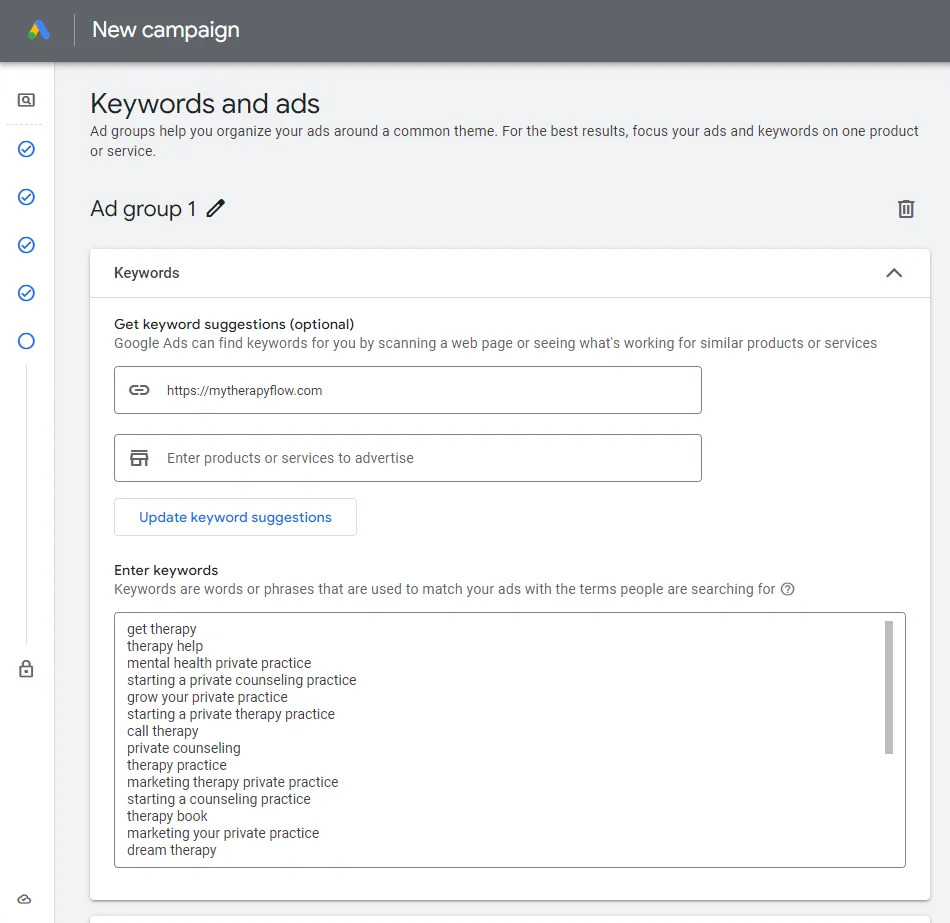
When planning a Google Ads strategy, you must consider what people are looking for when they want a therapist. Try to think about what you would “Google” if you were looking for a therapist.
A free keyword research tool that is useful for conducting keyword research, and offering insights into keyword ideas, search volumes, and cost statistics is the Google Ads Keyword Planner. This keyword research tool is integrated within Google Ads and can be accessed via the menu located at the top of the Google Ads dashboard.
Craft ads that offer hope and support
When someone searches for therapy online, they’re often in a vulnerable state. They might be feeling overwhelmed, anxious, or lost. Your Google Ads can be a beacon of hope and support during this crucial time. Here’s how to craft ads that resonate with potential clients seeking therapy:
- Headlines that resonate: Use the first 30 characters wisely to address common concerns like “Feeling Overwhelmed? Therapy Can Help” or “Anxiety Relief – Start Today”. You can also flex about your achievement to increase your credibility, like in this example.
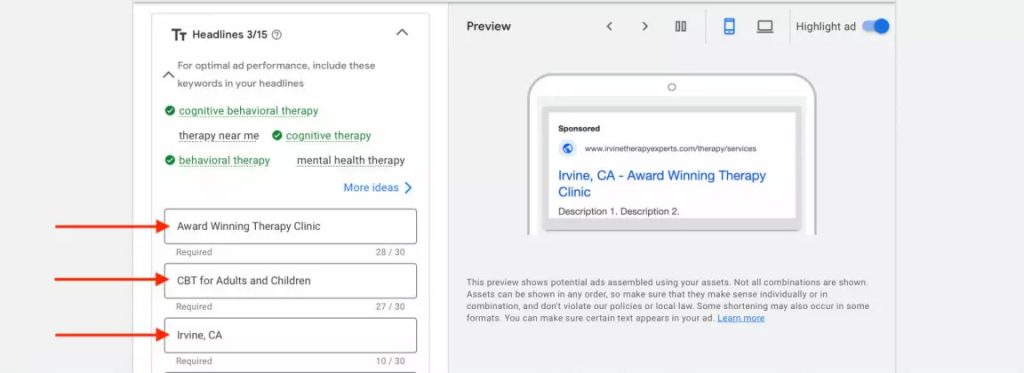
- Descriptions that offer solutions: Expand on your headlines in the description (90 characters). Mention your specialties, approach to therapy, or unique offerings (e.g., sliding scale fees).
- Warm and welcoming tone: Avoid overly clinical language. Use a compassionate and understanding tone that conveys your ability to help.
- Clear CTA: Tell potential clients what to do next! Examples include “Schedule a Free Consultation” or “Learn More About Our Services”.
Set up location targeting
To ensure your ad reaches the right people, you should target people who are normally in your location radius. This will filter out people who are outside your target location radius but are searching for your keywords. Such a setting will enhance the efficiency of your Google Ads for therapists and reduce unnecessary ad spending.
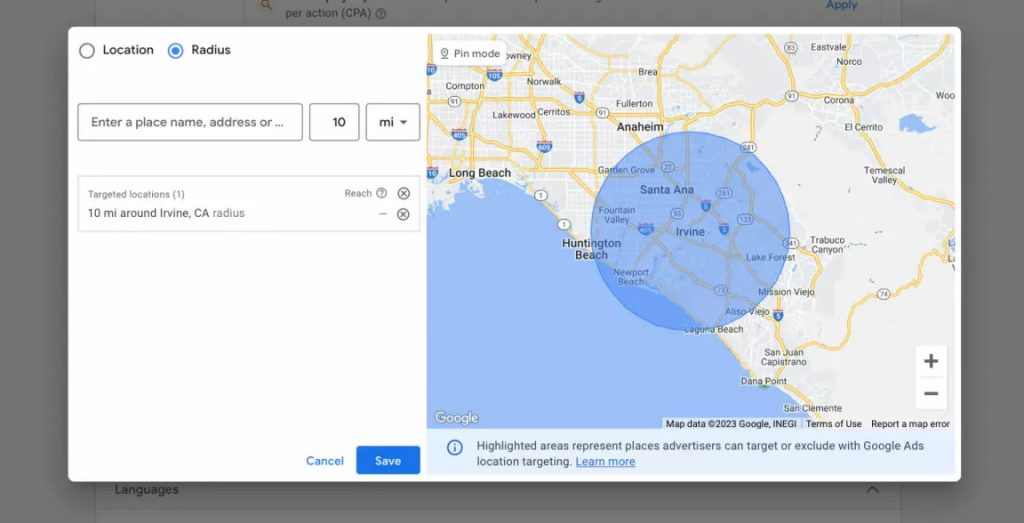
I highly recommend a radius of about 15 miles or less around where your therapy office is located. This is because most patients don’t want to drive too far to an appointment so I recommend not going higher than 15. You can adjust the size of your radius based on the size of the city your office is located in.
While location targeting is helpful, prioritize user privacy. Google Ads offers options to exclude specific demographics or interests to avoid reaching users who might not be comfortable with online advertising for therapy services.
Use ad assets
Ad assets, previously called extensions, add useful information and contact options to your ads. Not every asset will appear each time an ad is shown, so choose assets that help prospective clients evaluate your practice.
Here are three asset types to consider.
Sitelinks
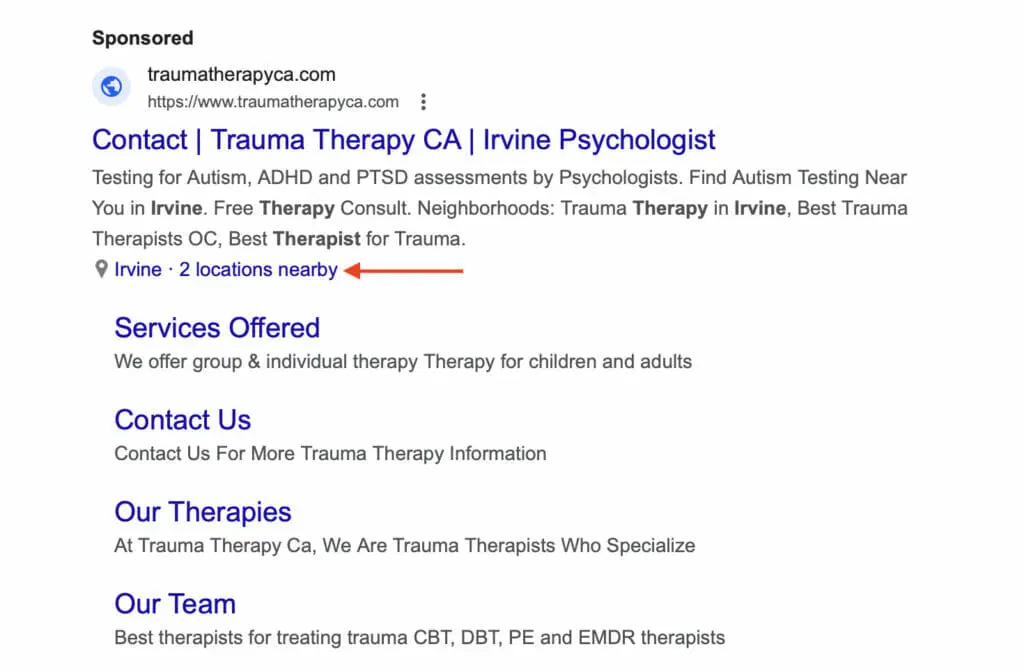
Sitelink gives users a one-click option to the potential answer of whatever the searcher is looking for. Every site link will feature a headline and a description. Suppose a user is looking for therapy services; you could display four sitelinks under your ad, each representing a different product type. Each sitelink would have the type of product in the headline and a description of the features of each product below.

Location assets
Location assets can display information about your practice’s physical location. Connect your Google Business Profile to Google Ads where applicable, and check that your address and business details are accurate. These assets are particularly relevant when promoting in-person appointments.
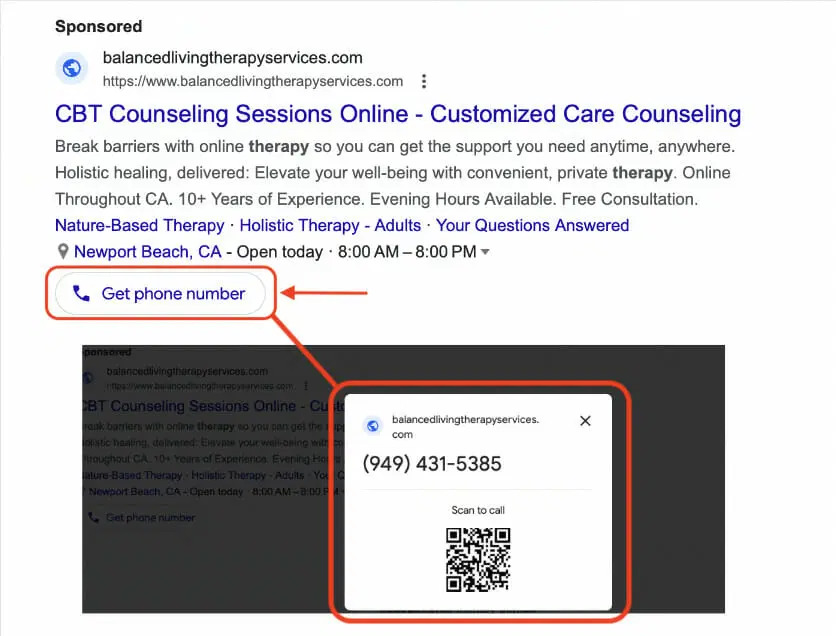
Call assets
Call assets display your phone number or a call option, helping prospective clients contact your practice. They support phone calls rather than direct messaging.
Schedule call assets for hours when someone can answer, and establish a clear process for following up on missed calls.
Consider hiring a professional
If you’re new to Google Ads or if you’re not seeing the results you want, consider hiring a professional agency, like Mega Digital. As Google’s Premier Partner agency, we’re here to help you navigate these guidelines and run effective, compliant Google Ads campaigns.
Create a landing page that supports appointment inquiries
Your landing page should match the service advertised and make the next step easy to understand. An ad for couples counseling, for example, should lead to relevant service information rather than a general homepage.
Include therapist qualifications, session formats, location, fees or insurance details where applicable, and a clear explanation of the appointment process. Use a visible CTA such as “Request an appointment” and keep the inquiry form focused on initial contact needs.
Before adding tracking to forms or booking pages, review the “Review tracking and sensitive customer data” section below.
How much should you spend on Google Ads for Therapists?
At Mega Digital, we recommend starting with a monthly budget of $600–$1,200 for a focused therapy campaign. Use this as a planning reference and adjust your advertising spend based on local keyword costs, competition, and the number of new clients your practice can accommodate.
Consider testing your budget for two to three months, using early results to refine your ads, keywords, and landing pages. Before increasing spending, assess how many inquiries become paying clients and compare acquisition costs with revenue after service delivery expenses.
Things to keep in mind when running Google Ads for therapists
Before launching your campaign, review Google’s advertising policies, how you handle sensitive data, and your process for responding to new inquiries.
Comply with Google’s personalized advertising policy
Google’s personalized advertising policy restricts audience targeting for sensitive services, including mental health counseling. Advertisers promoting these services cannot use advertiser-curated audiences such as Customer Match or your data segments.
Search keywords and location targeting can help you reach people looking for relevant services, but these settings alone do not guarantee compliance. Review your audience settings, ad copy, and landing pages, and avoid messaging that assumes knowledge of someone’s mental health condition or promises treatment outcomes.
Review tracking and sensitive customer data
Check what your inquiry forms, booking pages, and tracking tools collect and send to advertising platforms. Google explicitly states:
“Conversions related to sensitive categories can’t be used for measurement in enhanced conversions or store sales (uploads).” – Google Customer data policies
These categories include health and medical information. Review eligibility before enabling enhanced conversions or uploading client-related conversion data. Keep appointment outcomes in an appropriate internal reporting process, and do not assume that every tracking feature is suitable for your practice.
Do not ignore your ad leads
Respond to inquiries consistently and let prospective clients know when they can expect a reply. Keep appointment availability up to date and assign responsibility for following up on missed calls and form submissions. If your practice cannot respond promptly or accept new clients, reduce or pause advertising until your capacity improves.
FAQs about Google Ads for Therapists
No. Paying for Google Ads does not improve organic search rankings. Ads provide paid visibility, while SEO requires separate work on your website’s content and search performance.
Not seeing your ad does not necessarily mean it is inactive. Use Google’s Ad Preview and Diagnosis tool to check whether it appears for a specific search and location and identify possible serving issues.
Google reviews most ads within one business day, although complex reviews can take longer. Check the ad’s status if it remains under review for more than two full business days.
Check the stated policy violation, then correct the affected ad or landing page. If you believe the decision is incorrect, submit an appeal through your Google Ads account.
Wrap up
In conclusion, running a successful Google Ads campaign for therapists requires a deep understanding of your target audience, careful keyword selection, compelling ad copy and ongoing management. With these points in mind, you’ll be well on your way to attracting more clients and growing your practice.
But if you’re still not ready to go through the setup process, you can also rent a ready-to-use Google Ads agency account from Mega Digital to start advertising right away without delays or account issues!